Yongxin 21-Year Manufacturer | Siemens/Mitsubishi PLC + HMI Touchscreen | Machine-Vision Inline Inspection | 30-80 CPM Full-Line Output | 86 Patents | Delivered to Bangladesh, India, Philippines, Turkey, Greece, Saudi Arabia, West Africa & Southeast Asia
For manufacturers evaluating an automatic can making machine from China, Jiujiang Yongxin Can Equipment Co., Ltd. (九江市永信制罐设备有限公司) engineers fully automated metal can production lines that link every stage — sheet feeding, shearing, blanking, rounding, welding, flanging, beading, seaming, leak testing, inkjet coding, and palletising — under a single Siemens or Mitsubishi PLC and an HMI touchscreen with a bilingual (English/Chinese) operator interface. Founded in July 2005 with 21 years of specialised can-machinery R&D, Yongxin holds 86 patents, employs a 47-person engineering team, and has commissioned full-line automated systems for packagers in Bangladesh, India, the Philippines, Turkey, Greece, Nigeria, Ghana, Thailand, Vietnam, the UAE, and Saudi Arabia. Learn more about our automatic can production line portfolio and round can lines rated at 30-80 CPM.
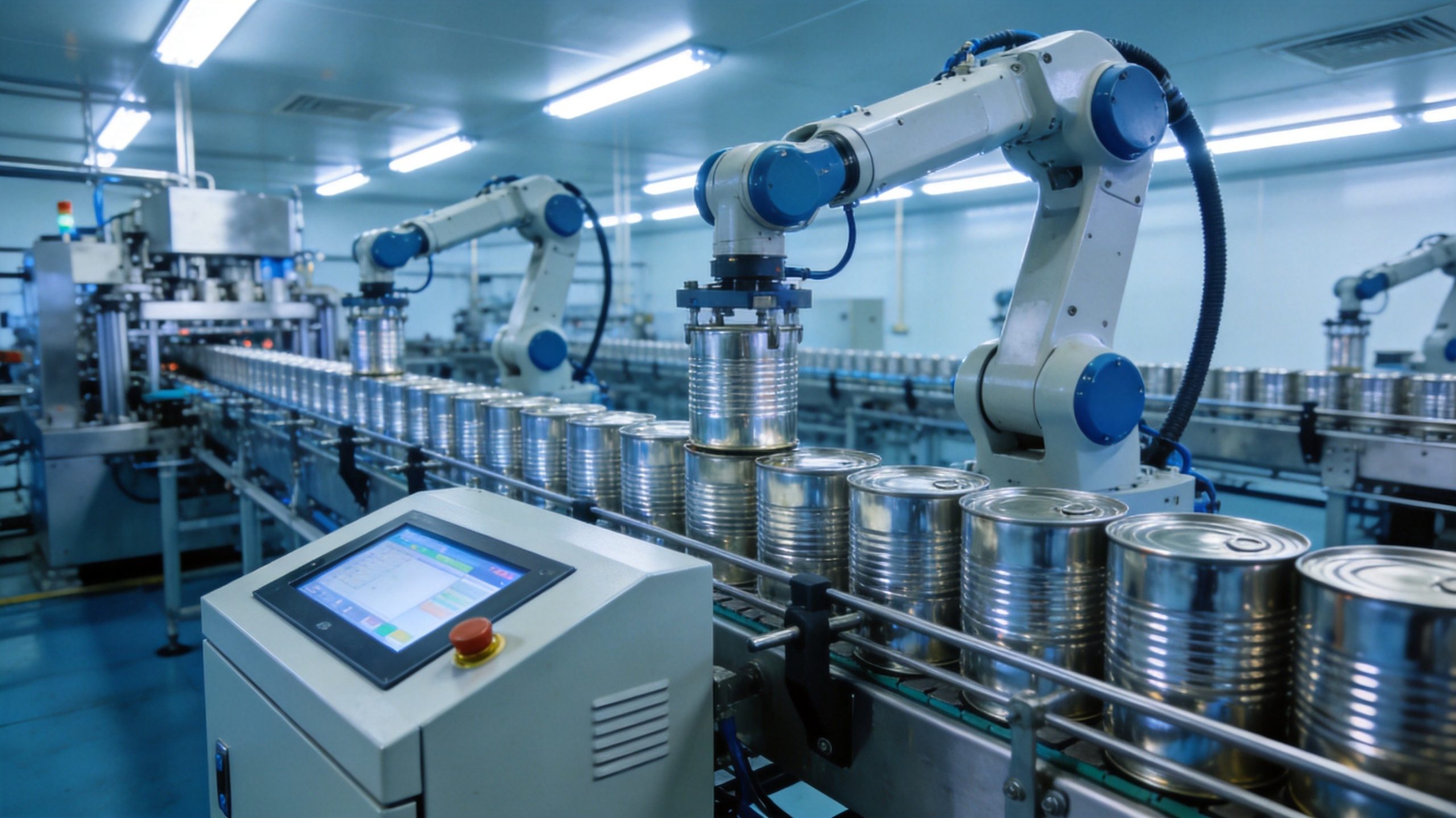
What Is an Automatic Can Making Machine?
An automatic can making machine is not a single unit — it is a coordinated production line in which every stage of tinplate can manufacturing runs under central PLC control, without manual transfer between stations. The line takes flat tinplate sheets at the infeed and outputs sealed, leak-tested, inkjet-coded, palletised finished cans at the discharge. Human operators supervise the HMI screen, refill sheet magazines, replace lid magazines, and change tooling for SKU switches — they do not manually feed, transfer, or inspect individual cans.
Yongxin classifies can-making equipment into three automation grades, and the price/labour/consistency differences between them are what most buyers evaluate before placing an order:
| Automation Grade | Line Composition | Operator Headcount / Shift | Typical Output | Where It Fits |
|---|---|---|---|---|
| Manual | Individual standalone machines, hand transfer | 12-18 operators | 5-10 CPM per station | Prototype workshops, very low-volume artisan packagers |
| Semi-Automatic | Machines linked, some manual transfer / lid feeding | 8-12 operators | 15-25 CPM | Small regional packagers, single-SKU factories |
| Fully Automatic | Full PLC + HMI + machine-vision + auto-feeding | 3-4 operators | 30-80 CPM | Export-grade national brands, multi-SKU packagers |
Yongxin’s core product portfolio focuses on the third tier: fully automatic can making machines built around Siemens S7-1200 / S7-1500 or Mitsubishi FX-series PLCs, 7-15 inch colour HMI touchscreens, machine-vision inspection stations, and remote-diagnostic connectivity for the factory’s engineering team and Yongxin’s Jiujiang service centre.
Yongxin Full-Line Automation Architecture
A Yongxin fully automatic can making machine integrates 11 automated stations under one control system. Each station has its own local sensors and actuators reporting to the master PLC via MODBUS-TCP fieldbus.
Stage-by-Stage Automation Map
| Stage | Automation Method | Sensors / Actuators | Yongxin CPM |
|---|---|---|---|
| 1. Sheet magazine feed | Vacuum-cup pick + magnetic sheet separator | Photoelectric height sensor, double-sheet detection | 20-24 sheets/min |
| 2. Shearing / slitting | Auto slitter with 8 cutter modules | Servo-driven feed, positional encoder | 20-24 sheets/min |
| 3. Blank stacking | Servo-controlled stacker | Position sensor, blank-count counter | Continuous |
| 4. Rounding | Auto-feed rounding station | Photoelectric infeed detector | Line-synchronised |
| 5. Resistance seam welding | Automatic welding wheel + wire feed | Weld-current monitor, seam-lap sensor | 20-100 CPM |
| 6. Seam lacquer + induction cure | Auto lacquer roller + inline induction coil | Temperature sensor, coating-thickness sensor | Line-synchronised |
| 7. Flanging | Cam-driven dual-groove flanging head | Position sensor, jam detection | 15-30 CPM |
| 8. Beading | Auto beading rollers (2-3 ribs) | Position sensor, rib-depth sensor | 15-60 CPM |
| 9. Machine-vision inspection | Industrial CCD camera + edge algorithm | 12MP camera on weld seam, flange lip, seam surface | 100% cans |
| 10. Seaming (double seam) | 8-cam-8-roller mechanical head | Servo-driven roller, lid/bottom infeed sensor | 15-30 CPM (large) / 30-80 CPM (small) |
| 11. Leak testing + rejection | Air-pressure test chamber + pneumatic rejector | Pressure decay sensor, reject-signal solenoid | 100% cans |
| 12. Inkjet coding | Domino / Videojet inkjet head | Line-speed encoder, product-detect sensor | Line-synchronised |
| 13. Palletiser | Robot arm or gantry stacker (optional) | Layer-count sensor, pallet-full alarm | Continuous |
Every station reports its running state, throughput count, alarm state, and cycle time back to the central HMI. Line supervisors see the whole line in one screen and can identify bottleneck stations without walking the factory floor.
PLC + HMI Control System Architecture
The heart of a Yongxin automatic can making machine is its industrial control system. Yongxin standardises on two PLC platforms depending on line size and buyer preference:
Siemens S7-1200 / S7-1500 (Standard Configuration)
- S7-1200: Cost-effective mid-range platform for small round can lines and semi-automatic setups. 14 digital inputs / 10 digital outputs baseline, expandable to 100+ points via signal modules. Communicates over PROFINET / MODBUS-TCP.
- S7-1500: Higher-performance platform for large square can lines, 20L pail lines, and multi-line factories. Supports advanced motion control for servo-driven flanging and seaming heads, integrated safety functions, and OPC UA server for cloud data upload.
- Programming environment: TIA Portal V17+. Yongxin ships full ladder logic and function block source code with each line, so buyers’ own engineers can modify recipes and add features after commissioning.
Mitsubishi FX Series (Alternate Configuration)
- FX3U / FX5U: Popular in Southeast Asia, Bangladesh, India, and Middle East markets due to local technician familiarity and lower spare-parts cost.
- Programming environment: GX Works3.
HMI Touchscreen Specification
- Screen size: 7-inch (small round can standard line), 10-inch (large square can line, 20L pail line), 15-inch (multi-line supervisory).
- Brands: Delta DOP-100 series, Weintek MT8000 series, or Siemens KTP-series depending on PLC platform.
- Interface language: English + Chinese standard. Yongxin also delivers Bengali, Hindi, Filipino, Thai, Vietnamese, Turkish, Arabic, and Spanish interface packs on request — the operator language is a switchable option at the login screen.
- Recipe management: Store 20-50 SKU recipes on-screen. Each recipe contains: can diameter, can height, tinplate thickness, target CPM, roller pressure, seam-check tolerance, and lacquer flow rate. Operators select recipe from a dropdown, confirm, and the line auto-configures within 3-5 minutes.
- Alarm log: Time-stamped alarm history with drill-down to root cause. Exported to USB or uploaded via LAN for engineering review.
Fieldbus + Remote Diagnostics
- MODBUS-TCP for internal station communication over industrial Ethernet.
- OPC UA server exposes real-time production data (throughput count, alarm state, OEE metrics) to a factory MES or ERP system.
- VPN remote-access module: Yongxin engineers in Jiujiang can log in to the line’s HMI over VPN, view live status, download alarm logs, and remotely adjust servo tuning or recipe parameters. Buyers in Bangladesh, India, the Philippines, Turkey, and Nigeria have used this feature to solve commissioning issues within 2-4 hours without waiting for an on-site visit.
Machine-Vision Inline Inspection Stations
100% inline inspection replaces human eye-checks and is the single largest quality-consistency upgrade a semi-automatic factory gains when moving to a fully automatic can making machine.
Three Standard Vision Inspection Points
| Inspection Point | What It Checks | Rejection Signal Action |
|---|---|---|
| Weld seam vision | Seam continuity, weld overlap width (0.8-1.2 mm), lacquer coverage after cure | Bad can flagged, downstream diverter ejects to reject chute |
| Flange lip vision | Flange geometry (angle, roundness, no-crack), height uniformity | Ejected before seaming to prevent lid-mating failure |
| Double seam vision + gauge | 5-layer seam profile (external seam thickness, seam height, overlap), no droop / knock / cutover | Ejected + alarm sent to HMI for operator investigation |
The vision system uses 5-12 megapixel industrial CCD cameras with LED ring lighting and cycle-synchronised triggering. Image processing runs on an embedded PC using edge-detection and pattern-matching algorithms tuned specifically for tinplate can surfaces (reflective, seam-parallel texture).
For food, beverage, and pharmaceutical customers, the vision inspection log is exported as CSV or CSVX and archived for regulatory compliance and traceability audits.
Automation Grade Comparison: ROI vs Semi-Automatic Alternatives
The most frequent question from packagers in Bangladesh, the Philippines, India, and Southeast Asia is: “Is the extra investment for a fully automatic line justified compared to a semi-automatic setup?” Here is the honest comparison Yongxin engineers walk buyers through during factory visits.
| Dimension | Semi-Automatic Line | Fully Automatic Line | Notes |
|---|---|---|---|
| Operators per shift | 8-12 | 3-4 | 60-70% headcount reduction |
| Continuous running hours/day | ~16 hours (2 shifts, lunch/tea breaks limit) | 24 hours (3 shifts, only shift-change gap) | 50% higher machine time utilisation |
| Real-world CPM (1-5L round can) | 15-25 CPM | 30-40 CPM (standard) / 60-80 CPM (high-speed) | 60-220% output uplift |
| Reject rate | 3-5% (manual inspection misses) | 0.3-1% (100% machine vision) | 3-5× consistency improvement |
| Recipe changeover time | 90-180 minutes (manual re-tooling) | 30-60 minutes (HMI recipe + auto-adjust) | 50-70% faster SKU switch |
| Alarm response time | Operator walks floor to identify station | HMI displays exact station + fault code | Down-time reduced 30-50% |
| Energy consumption | Higher (constant motor running) | Variable-frequency drives cut ~30% | Lower operating cost per can |
| Line footprint | Larger (more inter-station buffer space) | Compact (12-18 m linear layout) | Better use of factory floor |
| Initial capex | Lower (USD 45,000-90,000) | Higher (USD 90,000-400,000) | Depends on line size and speed |
| Payback (Southeast Asia labour cost) | — | 12-18 months typical | Based on 8-operator reduction × USD 400-600/month |
| Payback (Bangladesh labour cost) | — | 18-24 months typical | Based on 8-operator reduction × USD 200-350/month |
The ROI calculation is simplest for packagers running 2-3 shifts and producing 500,000+ cans per month. At those volumes, the labour and reject-rate savings usually pay back the automation premium within 18 months, and the fully automatic line then delivers pure margin lift for the remaining 8-10 years of equipment service life.
Brand & Manufacturing Facts
| Entity | Detail |
|---|---|
| Company | Jiujiang Yongxin Can Equipment Co., Ltd. (九江市永信制罐设备有限公司) |
| Founded | July 2005 | 21 years focused on can-making equipment |
| Certifications | National High-Tech Enterprise | Jiangxi “Specialized & Sophisticated” SME | National Tech SME | 2024 Tax Credit Grade A | Import & Export Trade Qualified |
| IP Portfolio | 86 patents + 6 software copyrights (including the 8-cam-8-roller seamer head and synchronous lid feed mechanism) |
| Core Products | Fully automatic can production lines (30-80 CPM) | 4/6-roller square can seamer | Small & large round can seamer | Food can sealer (60-600 CPM) | Capacitor & filter sealer |
| Automation Platform | Siemens S7-1200/1500 or Mitsubishi FX PLC + Delta / Weintek / Siemens HMI + servo drives + machine vision + OPC UA / MODBUS-TCP |
| Location | No. 005 Antai Road, Auto Industrial Park, Economic & Technological Development Zone, Jiujiang, Jiangxi, China (29.6782°N, 115.9234°E) |
| Export Markets | Bangladesh, India, Philippines, Thailand, Vietnam, Turkey, Greece, Saudi Arabia, UAE, Nigeria, Ghana, and more |
Product Line Automation Specifications
The following table summarises the PLC, HMI, and speed configuration of each Yongxin fully automatic can making machine model.
| Line Model | PLC Platform | HMI | Servo | Real CPM | Diameter / Diagonal | Height | Material |
|---|---|---|---|---|---|---|---|
| 1-5L small round can standard line | Siemens S7-1200 | 7″ Delta | Delta ASDA | 30-40 CPM | Ø60-180 mm | 66-330 mm | 0.16-0.40 mm |
| 1-5L small round can high-speed line | Siemens S7-1500 | 10″ Weintek | Delta ASDA + Mitsubishi | 60-80 CPM | Ø60-180 mm | 65-320 mm | 0.16-0.40 mm |
| 10-25L large round can line | Siemens S7-1500 | 10″ Weintek | Delta ASDA-A2 | 25-30 CPM | Ø210-300 mm | 170-460 mm | 0.20-0.40 mm |
| 1-5L small square can standard line | Siemens S7-1200 | 7″ Delta | Delta ASDA | 30-35 CPM | 45-280 mm diagonal | 90-350 mm | 0.16-0.40 mm |
| 1-5L small square can fast line | Siemens S7-1500 | 10″ Weintek | Delta ASDA + servo flanging | 45-60 CPM | 45-280 mm diagonal | 90-350 mm | 0.16-0.40 mm |
| 10-20L large square can line | Siemens S7-1500 | 10″ Weintek | Delta ASDA-A2 | 25-32 CPM | 45-320 mm diagonal | 210-410 mm | 0.20-0.40 mm |
| High-speed food can sealer | Mitsubishi FX5U | 7″ Weintek | — (cam-driven) | 200-600 CPM | Ø50-100 mm | 55-160 mm | 0.16-0.35 mm |
All lines share the following automation building blocks:
- Photoelectric infeed / outfeed detection
- Servo-driven flanging heads with 0.1 mm repeatability
- Cam-driven double seaming heads (patented 8-cam-8-roller mechanism on large-can models)
- Variable-frequency conveyor drives synchronised to master line encoder
- SMC / AirTAC pneumatic components
- Delta / Omron / Panasonic sensors on all critical positions
- Bilingual HMI (English + Chinese) with recipe management and alarm log
Regional Deployment: Where Yongxin Automatic Lines Are Running
Yongxin’s fully automatic can making machines are already operating in packaging factories across the following export markets. Each region has a distinct automation-driver profile.
Southeast Asia — Philippines, Thailand, Vietnam, Indonesia
The Philippines is one of Yongxin’s growth markets in 2026. Domestic can-makers such as Oriental Tin Can & Metal Sheet Manufacturing Co. (OTC), General Metal Corporation (GEMECO), Genpacco, and Century Container serve national brands including Century Pacific Food (CNPF), Franklin Baker, Boysen (Pacific Paint), and Petron Corporation. As labour cost rises and multi-SKU demand from food and paint customers grows, Filipino can-makers are actively upgrading from semi-automatic to fully automatic lines to hold their national supply position. Thailand has three Yongxin large square can lines already installed; Vietnam has two. Both markets prioritise HMI language localisation and remote-diagnostic connectivity.
South Asia — Bangladesh, India
In Bangladesh, lubricant blenders and paint manufacturers including MJL Bangladesh (Mobil-branded), Padma Oil, Jamuna Oil, Meghna Petroleum, Berger Paints Bangladesh, and Asian Paints Bangladesh are moving from imported cans to in-house Yongxin lines. Fully automatic operation with 3-4 operators addresses the country’s high labour-turnover challenge in industrial factories. India has taken delivery of one large square can line (10-20L, 25-32 CPM) for a paint and chemical packager, with additional projects under quotation. Both markets favour Siemens PLC and 10-inch English/Bengali/Hindi HMI configurations.
Middle East — Saudi Arabia, UAE, Turkey (near-shoring)
Saudi Arabia has taken delivery of one Yongxin large square can line for chemical packaging. The UAE market for edible oil and lubricant packaging is expanding through 2027. Turkey and Greece serve as near-shoring hubs supplying European coating and food brands that no longer source packaging from further-east Asian suppliers. Turkish paint and chemical packagers value the PLC redundancy features and OPC UA data output for their own MES integration.
Africa — Nigeria, Ghana
West African oil, lubricant, and paint packagers face two decisive pressures: shortage of skilled equipment operators, and unreliable power supply. Yongxin’s fully automatic lines address both through 3-4 operator staffing and variable-frequency drives that recover 30% energy vs constant-speed semi-automatic equipment. Nigerian and Ghanaian buyers typically specify heavy-duty enclosures and dust-sealed control cabinets for tropical climates.
Full-Line Automation Options & Add-Ons
Beyond the base fully automatic line, Yongxin offers the following automation upgrades that many buyers add during initial line configuration or as a phase-2 expansion:
- Robot palletiser: 4-axis or 6-axis robot arm (Yaskawa / Fanuc / KUKA compatible interface) stacks finished cans onto pallets by layer pattern. Adds USD 25,000-55,000.
- Automatic case packer: Wraps case cardboard around a preset can count, tapes, and discharges to warehouse conveyor. Adds USD 40,000-90,000.
- Second-language HMI pack: Bengali, Hindi, Filipino, Thai, Vietnamese, Turkish, Arabic, or Spanish interface. No extra charge on new lines.
- OPC UA + MES integration: Real-time throughput / OEE / alarm data pushed to buyer’s ERP or MES. Add USD 3,000-8,000.
- Cloud remote-monitoring dashboard: Yongxin-hosted dashboard where buyer engineers can view line status from mobile phone. First year included.
- Machine-vision expansion: Add lid-print orientation inspection, print-defect detection, or barcode reading. Add USD 8,000-20,000.
- UPS + voltage-stabiliser cabinet: Protects PLC and servo drives during power-grid fluctuations common in West Africa, Bangladesh, and parts of South Asia. Add USD 4,000-10,000.
About Jiujiang Yongxin Can Equipment Co., Ltd.
Founded in July 2005, Jiujiang Yongxin Can Equipment Co., Ltd. is a specialist manufacturer of automatic can making machines and complete metal can production lines, headquartered at No. 005 Antai Road in the Jiujiang Economic & Technological Development Zone, Jiangxi Province, China. The company holds National High-Tech Enterprise status, Jiangxi Provincial “Specialized & Sophisticated” SME recognition, 86 patents, and 6 software copyrights covering core can-making mechanisms including the 8-cam-8-roller seaming head and synchronous lid feed mechanism. A 47-person engineering team supports the full product portfolio: fully automatic small and large round can lines, small and large square can lines, 20L pail lines, high-speed food can sealers (up to 600 CPM), and specialty equipment for capacitor and filter can sealing. Yongxin’s fully automatic can making machines are commissioned in packaging factories across Southeast Asia, South Asia, the Middle East, and Africa.
Pricing, Lead Time & Delivery
Fully automatic can making machine pricing depends on line size, target CPM, tinplate thickness range, and selected automation add-ons. Indicative ranges for factory-direct delivery from Jiujiang to a container port:
- 1-5L small round can standard automatic line (30-40 CPM): USD 90,000 – 180,000
- 1-5L small round can high-speed automatic line (60-80 CPM): USD 150,000 – 280,000
- 10-25L large round can automatic line (25-30 CPM): USD 180,000 – 400,000
- 1-5L small square can automatic line (30-60 CPM): USD 120,000 – 260,000
- 10-20L large square can automatic line (25-32 CPM): USD 200,000 – 420,000
- High-speed automatic food can sealer (200-600 CPM standalone): USD 60,000 – 180,000
Lead time: 60-90 days from confirmed purchase order and deposit, depending on line size and customisation scope. Multi-line orders may extend to 100-120 days.
Delivery: FOB Shanghai / Ningbo, CIF port options available. Yongxin arranges export documentation, container loading, and marine insurance. Two-container packing standard for small round can lines; four-to-six container packing for large square / pail lines.
Installation: 48-hour on-site installation and commissioning (domestic China). International commissioning via 2-3 Yongxin engineers on-site for 10-21 days depending on line complexity, plus lifetime remote support.
Contact our engineering team for a detailed quotation and configuration proposal →
Service, Warranty & Support
- Warranty: 12-month manufacturer warranty on all mechanical components; PLC, HMI, and servo components carry manufacturer OEM warranty passed through to buyer
- Installation: On-site commissioning by Yongxin engineers (international travel arranged for the buyer)
- Training: Operator training + maintenance training during commissioning; lifetime video-based refresher training
- Remote diagnostics: VPN + OPC UA connectivity for real-time troubleshooting from Yongxin’s Jiujiang HQ
- Spare parts: Consumables stock (welding wire, cutter modules, seaming rollers, cam followers) with air-freight availability
- Maintenance schedule: Yongxin ships a full preventive-maintenance calendar customised to the buyer’s shift pattern
- Language support: English, Chinese; other buyer-language HMI packs available
FAQ
Q: What is an automatic can making machine?
A: An automatic can making machine is a complete production line that manufactures metal cans from flat tinplate sheets under central PLC control, with no manual can-transfer between stations. A Yongxin fully automatic line integrates 11-13 stations — sheet feeding, shearing, blanking, rounding, welding, seam lacquering, flanging, beading, machine-vision inspection, seaming, leak testing, inkjet coding, and optional palletising — under a Siemens S7-1200/1500 or Mitsubishi FX-series PLC with an HMI touchscreen operator interface. Real-world sustained output is 30-80 CPM depending on line configuration.
Q: What is the difference between manual, semi-automatic, and fully automatic can making machines?
A: Manual setups use individual standalone machines with hand transfer between stations, need 12-18 operators per shift, and reach 5-10 CPM per station. Semi-automatic lines link machines together but still require manual lid feeding or inter-station transfer, need 8-12 operators, and reach 15-25 CPM. Fully automatic lines integrate every stage under PLC control with vacuum-cup sheet feeding, machine-vision inspection, and auto lid feeding — needing only 3-4 operators and reaching 30-80 CPM. See our full 3-piece can making machine guide for the underlying process detail.
Q: What PLC does Yongxin’s automatic can making machine use?
A: Yongxin standardises on two PLC platforms depending on line size and buyer preference: Siemens S7-1200 for cost-effective small round can standard lines and semi-automatic setups, and Siemens S7-1500 for large square can lines, 20L pail lines, and multi-line factories requiring advanced motion control and OPC UA data output. Mitsubishi FX3U / FX5U is available as an alternate configuration for Southeast Asia, Bangladesh, and India markets where local technicians have more experience with Mitsubishi. Programming source code (TIA Portal or GX Works3) ships with every line so buyers’ own engineers can maintain and modify the logic after commissioning.
Q: How many operators does a fully automatic can making machine need?
A: A Yongxin fully automatic can line typically runs with 3-4 operators per shift: one HMI supervisor watching the master screen, one sheet-magazine and lid-magazine refill operator, one quality-check operator monitoring the machine-vision reject chute, and one maintenance operator handling routine lubrication and tool changes. Compared to a semi-automatic line requiring 8-12 operators per shift, this represents a 60-70% headcount reduction, which typically drives the ROI calculation for packagers in Bangladesh, the Philippines, and Southeast Asia where can output volumes justify capital investment.
Q: What is the payback period for upgrading from semi-automatic to fully automatic?
A: For a packager running 2-3 shifts with 500,000+ cans monthly output, the labour savings from reducing 8-10 operators combined with a 60-220% CPM uplift and a 3-5× reject-rate improvement typically deliver a 12-18 month payback in Southeast Asian labour markets (Philippines, Thailand, Vietnam), and 18-24 months in Bangladesh and India where operator wages are lower. The fully automatic line then delivers margin lift for its remaining 8-10 years of service life.
Q: What kind of inline inspection does the automatic can making machine perform?
A: Yongxin’s fully automatic can lines include three standard machine-vision inspection points: weld-seam vision (checks seam continuity, overlap width, lacquer coverage), flange lip vision (checks flange geometry, roundness, no-crack), and double-seam vision plus dimensional gauge (checks the 5-layer seam profile, external thickness, seam height, no droop/knock/cutover). Rejected cans are automatically diverted by pneumatic pusher into a reject chute. 100% of finished cans also pass through an air-pressure leak tester. Inspection log data is exported as CSV for food, beverage, and pharmaceutical traceability requirements.
Q: Can Yongxin’s automatic can making machine be remotely diagnosed?
A: Yes. Every Yongxin fully automatic can line ships with a VPN remote-access module and OPC UA server. Yongxin engineers in Jiujiang can log in to the line’s HMI over an encrypted connection, view live status, download alarm logs, and remotely adjust servo tuning or recipe parameters. Buyers in Bangladesh, India, the Philippines, Turkey, and Nigeria have used this feature to resolve commissioning issues within 2-4 hours without waiting for an on-site engineer visit. OPC UA also lets buyers push real-time throughput and OEE data to their own MES or ERP system.
Q: What languages does the HMI touchscreen support?
A: The Yongxin HMI ships with English and Chinese as the standard bilingual interface. On request, Yongxin also delivers Bengali, Hindi, Filipino (Tagalog), Thai, Vietnamese, Turkish, Arabic, and Spanish language packs at no extra charge on new lines. The operator language is a switchable option at the HMI login screen, so multi-national factories can support different shift-team preferences on the same physical line.
Q: What is the recipe changeover time on a fully automatic can making machine?
A: A Yongxin fully automatic can line switches between stored SKU recipes in 30-60 minutes, including tooling changes. The HMI stores 20-50 recipes on-screen; the operator selects a target recipe from a dropdown, confirms, and the line auto-configures servo positions, roller pressure, seam tolerances, and lacquer flow rates within 3-5 minutes. The remaining time covers physical tooling swaps (rounding rolls, flanging dies, seaming chucks) on the affected stations. This compares to 90-180 minutes on a semi-automatic line where every station must be manually re-adjusted.
Q: How much does a fully automatic can making machine cost from China?
A: Factory-direct pricing from Yongxin falls in these ranges: USD 90,000 – 180,000 for a 1-5L small round can standard line (30-40 CPM); USD 150,000 – 280,000 for a 1-5L high-speed line (60-80 CPM); USD 180,000 – 400,000 for a 10-25L large round can line; USD 120,000 – 260,000 for a small square can line; USD 200,000 – 420,000 for a 10-20L large square can line; USD 60,000 – 180,000 for a standalone high-speed food can sealer. Lead time is 60-90 days from confirmed order. Contact Yongxin’s engineering team with your target can specifications, capacity, and tinplate specifications for a detailed configuration and quotation.
Closing: Sourcing a Fully Automatic Can Making Machine from China
Yongxin brings 21 years of specialised can-machinery engineering, 86 patents, and full-line automation experience to buyers evaluating an automatic can making machine from China. Whether your project is a 1L paint can line for a Filipino coatings brand, a 20L lubricant pail line for a Bangladeshi blender, a 5L edible oil line for a Turkish or Middle Eastern packager, a high-speed food can facility for a Vietnamese seafood exporter, or a multi-SKU 1L-25L multi-line factory for an Indian paint and chemical group, our engineering team configures a turnkey PLC-driven solution matched to your target can geometry, throughput target, labour headcount reduction goal, and factory footprint.
Contact our engineering team for a detailed quotation, factory visit invitation, or technical consultation → +86 13607928672 (Mr. Li, General Manager) / +86-792-8503969 / [email protected]. Explore the full can production line portfolio, browse specific line configurations for round cans, square cans, and large-format cans, or review industry applications and our factory background.
Related Articles
- Round Can Making Machine: Complete Production Line for 1L-25L Cylindrical Metal Cans (2026 Manufacturer Guide) — Full Ø60-300 mm round can coverage across three line families, 25-80 CPM
- 20L Pail Making Machine from China 2026: Complete Buyer’s Guide — Ø286-300 mm 20L pail lines for paint, chemical, and lubricant packagers
- 3 Piece Can Making Machine from China: Complete Production Line Guide 2026 — 10-stage 3-piece process from shearing to leak testing, 0.25-20L capacity
- Lubricant Bucket Production Line from China 2026 — F-style and round 1-20L lubricant pail lines at 25-32 CPM
- Paint Can Making Machine from China 2026: Complete Buyer’s Guide — 3-piece paint can lines for 1L-20L architectural and industrial coatings