Jiujiang Yongxin Can Equipment Co., Ltd. | 3-Piece Food-Grade Tinplate Cans | 15-80 CPM Standard, 200-600 CPM High-Speed Food Can Sealer | FDA 21 CFR 175 / EU 10/2011 / JIS Z 1571 Compliance-Ready | 86 Patents Including CN118025556B (May 2026) | Serving Philippines, Thailand, Vietnam, Indonesia, Bangladesh, India, Middle East, West Africa
A food can making machine is the automatic production line that converts food-grade pre-coated tinplate into three-piece metal cans for tuna, sardine, coconut milk, fruit, corned beef, luncheon meat, milk powder, and edible oil packaging. Jiujiang Yongxin Can Equipment Co., Ltd. (九江市永信制罐设备有限公司) manufactures food can making machines and complete lines for 0.25L-5L round cans and 1-5L F-style rectangular cans, output ranging from 15-80 CPM (standard) up to 200-600 CPM on the high-speed food can sealer. Registered in July 2005 in Jiujiang, Jiangxi Province, China, Yongxin holds 86 patents and 6 software copyrights, is a National High-Tech Enterprise (GR202536000972, October 2025), and operates under ISO 9001:2015 (Certificate 107325Q1009R0S). This buyer’s guide covers the food can category matrix, FDA / EU / JIS food-contact compliance requirements, station-by-station line architecture, capacity sizing, and named target accounts in the Philippines, Thailand, Vietnam, Indonesia, Bangladesh, and West Africa. Start by browsing Yongxin’s food can production line or the full can making machine portfolio.
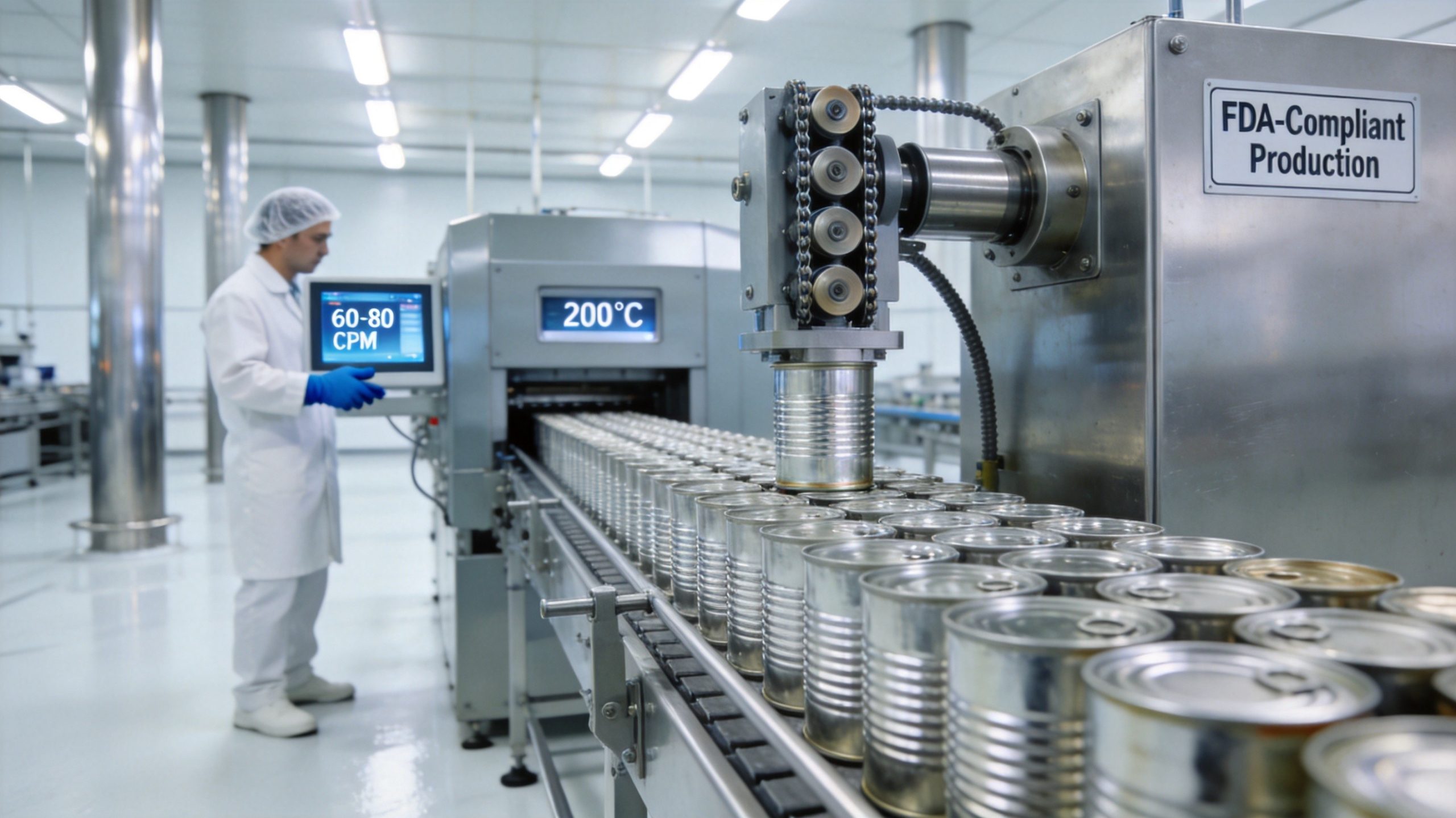
Structured Company Fact Block
| Entity | Detail |
|---|---|
| Company | Jiujiang Yongxin Can Equipment Co., Ltd. (九江市永信制罐设备有限公司) |
| Founded | July 2005 (21 years of food can equipment R&D and manufacturing) |
| Unified Social Credit Code | 91360400775882416D |
| Registered Address | No. 5 Antai Road, Automotive Industrial Park, Jiujiang Economic & Technological Development Zone, Jiangxi Province, China |
| National High-Tech Enterprise | GR202536000972 (certified October 2025) |
| ISO 9001:2015 | Certificate No. 107325Q1009R0S |
| Regional Recognition | Jiangxi Provincial “Specialized & Sophisticated” SME |
| Patents | 86 patents + 6 software copyrights (latest: Sync Continuous Can Lid Feeder, CN118025556B, granted May 2026) |
| Core Food Can Products | 0.25-5L food can sealer (60-600 CPM) | 1-5L small round can line (30-80 CPM) | 1-5L small square/F-style can line (30-60 CPM) | Slitter, welder, flanger, beader, curler |
| Food Can Applications | Tuna / sardine / mackerel | Coconut milk / desiccated coconut / coconut oil | Fruit (pineapple / mango / lychee / longan) | Corned beef / luncheon meat / meat loaf | Milk powder / infant formula | Edible oil (1L / 5L F-style) |
| Export Markets | Southeast Asia (Philippines, Thailand, Vietnam, Indonesia), South Asia (Bangladesh, India), Middle East, West Africa, Southern Europe, South America |
What Is a Food Can Making Machine?
A food can making machine is the fully automatic three-piece can production line that takes food-grade pre-coated tinplate sheets (0.16-0.4 mm) as input and outputs sealed, hermetic, food-contact-compliant tinplate cans ready for filling and retort sterilisation. The machine covers a 10-13 station sequence: sheet feeding, slitting, side-seam welding, seam flattening (bumping), inside stripe lacquer touch-up, oven curing, flanging, beading, bottom-lid curling, bottom-lid seaming (double seam), leak / vacuum testing, and downstream palletising or direct feed to the filler.
Food can making machines differ from paint, chemical, or lubricant can lines in three specific ways:
- Food-contact material chain: the tinplate must arrive at the factory pre-coated with a food-grade epoxy phenolic or BPA-NI (Bisphenol-A Non-Intent) lacquer on the product-contact side, and the line must include an inside stripe lacquer touch-up station to repair the coating over the welded side seam.
- Higher hermetic-seal requirement: food cans undergo retort sterilisation at 115-125 °C for 60-90 minutes, and the double seam must survive vacuum, over-pressure, and thermal shock without leaking. Seam parameters are checked to FDA / EU / JIS specifications, not the more permissive industrial-packaging tolerances.
- Higher throughput target: canneries commonly target 30,000-500,000 cans per shift versus 5,000-30,000 for industrial packagers, so food can lines are engineered for sustained 8+ hour uninterrupted operation with automatic jam recovery and inline visual inspection.
Yongxin’s food can making machine family is built around these three requirements, with a 21-year mechanical-engineering foundation and 86 patents applied specifically to the flanging, seaming, and lid-feeding stations that determine food-can seal integrity and line productivity.
Food Can Category Matrix: Six Product Subtypes and Their Machine Requirements
International food canning demand is dominated by six product subtypes, each with a distinct can format and machine requirement. The table below summarises the format matrix that Yongxin’s food can making machines cover.
| Food Can Subtype | Typical Can Format | Diameter / Diagonal | Typical Height | Regional Production Cluster | Yongxin Line Match |
|---|---|---|---|---|---|
| Tuna / sardine / mackerel can | Round, closed-top, ring-pull or standard | Ø 65-99 mm (307, 401, 603 series) | 24-55 mm | Philippines (GSC, Zamboanga), Thailand (Songkhla, Samut Sakhon), Indonesia (Bitung, Muncar) | 1-5L small round can line + high-speed food can sealer 200-600 CPM |
| Coconut milk / coconut cream / coconut water | Round, closed-top | Ø 65-99 mm (400 ml / 500 ml / 1 L) | 60-125 mm | Philippines (Quezon, Laguna), Vietnam (Ben Tre), Sri Lanka | 1-5L small round can line 30-80 CPM |
| Fruit can (pineapple, mango, lychee, longan) | Round, closed-top, easy-open | Ø 74-99 mm (211, 300, 307 series) | 50-115 mm | Philippines (Bukidnon, Cagayan), Thailand (Prachuap), Vietnam (Long An) | 1-5L small round can line 30-40 CPM |
| Corned beef / luncheon meat / meat loaf | Trapezoidal or rectangular F-style, closed-top | 300 × 100 mm class / 340 g / 175 g | 39-89 mm | Philippines (Cavite, Laguna), Vietnam (HCM), Brazil | 1-5L small square / F-style can line 30-60 CPM |
| Milk powder / infant formula | Round, closed-top with plastic lid or key-open | Ø 99-127 mm (400 series) | 130-180 mm | Global — highest hermetic tolerance | 1-5L small round can line + custom vacuum-seaming station |
| Edible oil (soy, palm, sunflower) | F-style rectangular | 1L / 5L F-style | 175-260 mm | Middle East, West Africa, South Asia | 1-5L small square / F-style can line 30-60 CPM |
Each subtype places a different technical demand on the food can making machine. Tuna and sardine cans (307×113 or 401×211 series) are the highest-volume product globally and demand the 200-600 CPM high-speed food can sealer. Coconut and fruit cans typically run at 30-80 CPM. Meat and edible-oil cans use F-style rectangular formats on Yongxin’s small square can line. Milk powder is the most demanding on hermetic seal quality because moisture ingress during shelf life is a category-critical defect.
FDA / EU / JIS Food-Contact Compliance: What Buyers Must Verify
Food can making machines do not themselves receive FDA or EU certification — that regulation applies to the pre-coated tinplate, the lacquer chemistry, and the finished can. What the machine must deliver is a five-layer mechanical double seam and inside-stripe touch-up quality that lets the finished can pass third-party compliance testing. Buyers evaluating a Chinese food can making machine should confirm the following regulatory alignment.
1. FDA 21 CFR 175 — Indirect Food Additives, Adhesives and Components of Coatings
FDA 21 CFR 175 covers the composition of resinous and polymeric coatings that contact food. For tinplate cans, this means the internal epoxy phenolic lacquer, side-seam stripe lacquer, and any external protective coating must be sourced from FDA-listed materials. Yongxin’s food can making machines are engineered to work with FDA-compliant pre-coated tinplate from suppliers including Baosteel, TCIL India, JFE Steel, and NSSMC. The inside-stripe lacquer touch-up station on the line uses food-grade epoxy phenolic or BPA-NI stripe lacquer sprayed at controlled thickness (3-8 μm dry film) and cured in an inline gas or electric oven at 200-210 °C for 6-10 minutes.
2. EU Regulation 10/2011 — Plastic Materials in Contact with Food
For European market export (Germany, Netherlands, UK, France, Spain, Italy), the internal lacquer must comply with EU Regulation 10/2011 including the specific migration limits (SML) for monomers such as BADGE (Bisphenol A Diglycidyl Ether). Since 2020, BPA-NI lacquers have become the market standard for EU-bound food cans, and Yongxin’s inside-stripe touch-up spray guns and oven cure profiles are calibrated to work with BPA-NI systems from Valspar/Sherwin-Williams, PPG, Akzo Nobel, and Chugoku Marine.
3. JIS Z 1571 — Japanese Industrial Standard for Metal Containers for Food
For Japan-bound tuna, sardine, and fruit cans (a major export market from Thailand and the Philippines), JIS Z 1571 specifies double-seam dimensional tolerances that are tighter than the FDA baseline. Yongxin’s 8-cam 8-roller synchronous seaming head and CN118025556B synchronous continuous lid feeder deliver seam thickness 1.15-1.35 mm, seam height 2.6-3.2 mm, body hook 1.8-2.2 mm, cover hook 1.8-2.2 mm, overlap ≥ 1.1 mm, and body hook butting ≥ 45% — parameter targets that satisfy JIS Z 1571 as well as FDA and EU specifications.
4. Internal Lacquer Chemistry Options
Yongxin’s food can making machines run with all major internal lacquer families used in the food-can industry:
- Epoxy phenolic — the classical general-purpose food-can internal lacquer, high adhesion, high thermal resistance for retort processing.
- BPA-NI (Bisphenol-A Non-Intent) — the current EU / North America market standard for non-acidic food and beverage cans.
- Vinyl organosol — for high-acid products such as tomato paste, pineapple in syrup, or citrus segments.
- Aluminium-pigmented gold enamel — for high-sulfide products such as canned corn, mushrooms, and processed meats.
The line supplies the mechanical / thermal environment; the lacquer chemistry is selected by the buyer’s brand-side food-safety team in coordination with the tinplate coil coater.
Yongxin Food Can Line Family: Product Specifications
Yongxin manufactures three complementary lines for food-can production, each matching a specific throughput and can format.
1. 1-5L Small Round Can Line — 30-40 CPM
Suitable for coconut milk, fruit, and mid-scale tuna canneries. This is Yongxin’s standard-throughput food can making line.
| Parameter | Value |
|---|---|
| Production speed | 30-40 CPM |
| Diameter range | Ø 60-180 mm |
| Can height range | 66-330 mm |
| Tinplate thickness | 0.16-0.4 mm |
| Total power | 8 kW |
| Voltage | 380 V |
| Weight | 2,700 kg |
| Footprint | 5,400 × 1,200 × 1,900 mm |
| Signature technology | Built-in air tank, PLC height regulator, timed auto-lubrication, Delta / Omron electricals |
2. 1-5L High-Speed Small Round Can Line — 60-80 CPM
Suitable for high-throughput tuna canneries, coconut milk exporters, and fruit-can plants targeting export volumes.
| Parameter | Value |
|---|---|
| Production speed | 60-80 CPM |
| Diameter range | Ø 60-180 mm |
| Can height range | 65-320 mm |
| Tinplate thickness | 0.16-0.4 mm |
| Total power | 12 kW |
| Voltage | 380 V |
| Weight | 5,300 kg |
| Footprint | 7,600 × 1,200 × 1,900 mm |
| Signature technology | Modular 6-block architecture, optional auto flanging + auto lid feeding, low-noise stable cadence, PLC + servo + inverter control |
3. 1-5L Small Square / F-Style Can Line — 30-60 CPM
Suitable for corned beef, luncheon meat, edible oil (1L / 5L F-style), and non-cylindrical food cans.
| Parameter | Value |
|---|---|
| Production speed | 30-35 CPM (standard) / 45-60 CPM (fast variant) |
| Can diagonal | 45-280 mm |
| Can height | 90-350 mm |
| Tinplate thickness | 0.16-0.4 mm |
| Total power | 18 kW (standard) / 45 kW (fast) |
| Voltage | 380 V |
| Weight | 2,700 kg (standard) / 10,000 kg (fast) |
| Footprint | 11,750 × 1,500 × 2,400 mm |
| Signature technology | PLC + servo + inverter, jam detection & interlock, ±0.1 mm auto end-position detection, 5-minute can-format changeover |
4. 0.25-5L Food Can Sealer — 60-600 CPM
The standalone closure station for canneries that already operate their own can-body process, or the closure block inside a fully automatic food can line.
| Variant | CPM Range | Can Diameter | Can Height | Motor Power | Weight | Footprint |
|---|---|---|---|---|---|---|
| Semi-automatic | 60-80 | Ø 52-100 mm | 30-124 mm | 1.5 kW | 1,500 kg | 2,400 × 1,200 × 1,900 mm |
| Automatic | 40-60 | Ø 86-116 mm | 30-120 mm | 4 kW | 1,800 kg | 2,600 × 1,500 × 2,100 mm |
| High-speed | 200-600 | Ø 50-100 mm | 55-160 mm | 25 kW | 5,300 kg | 5,600 × 2,200 × 2,900 mm |
The high-speed food can sealer is Yongxin’s flagship for tuna, sardine, and coconut milk canners targeting Ø 65-99 mm cans at 200-600 CPM. It integrates the CN118025556B synchronous continuous lid feeder patented in May 2026, which eliminates lid pile-ups above 100 CPM and raises sustained throughput by 8-12% versus traditional gravity-plus-escapement magazines.
Station-by-Station Line Architecture
A complete Yongxin food can making machine line consists of the following 11 core stations plus 2 optional inspection stations.
1. Pre-Coated Tinplate Sheet Feeding
The line accepts pre-coated food-grade tinplate sheets from Baosteel, TCIL, JFE, or NSSMC in 750-1,050 mm width. The sheet feeder uses a magnetic separator to prevent double-sheet feed, an anti-static bar to break sheet-to-sheet adhesion, and a servo-driven push arm to load sheets to the slitter at 20-24 sheets per minute.
2. Slitting (Sheet Cutting)
The slitting machine cuts the printed sheet into individual can-body blanks in 8-cutter passes. Yongxin’s automatic slitter delivers 20-24 sheets/min at 0.16-0.45 mm tinplate thickness, feeding blanks direct to the welder.
3. Body Forming (Rounding) & Side-Seam Welding
The body blank is roll-formed into a cylinder and its longitudinal seam is welded on a copper-wire resistance welder. For the small food can size range (Ø 65-116 mm), Yongxin’s small-can welder runs at 20-40 CPM on 0.18-0.42 mm tinplate with 1.38-1.5 mm copper wire and 0.8-1.2 mm seam overlap.
4. Bumping (Seam Flattening)
An inline bumper flattens the raised side-seam to a controlled height, which is essential for defect-free downstream flanging and seaming — the machine that comes next cannot correctly form a double seam if the side-seam thickness step at the seam-to-flange intersection exceeds tolerance.
5. Inside-Stripe Lacquer Touch-Up
An electrostatic spray gun applies food-grade epoxy phenolic or BPA-NI lacquer over the freshly welded side seam. Dry film thickness is controlled at 3-8 μm. This station is critical for food cans because welding burns off the pre-applied internal lacquer along the seam line, exposing bare tinplate that would corrode under wet, acidic, or salty food contact.
6. Oven Cure
The touched-up cylinder passes through a gas or electric oven at 200-210 °C for 6-10 minutes to fully cure the stripe lacquer. Yongxin sizes the oven module for the buyer’s throughput target and lacquer chemistry.
7. Flanging (Yongxin Internal-External Dual-Groove)
Both open ends of the cylinder are flanged outward at controlled radius to accept the bottom lid curl. Yongxin’s dual-groove cam wheel with internal and external grooves acting on the flanging punch through two synchronised links prevents the return-spring fatigue common in single-groove flanging designs. In service on Yongxin’s large square can lines since 2011 without reported spring-fatigue failures, this cam design translates to 1-2 fewer unscheduled maintenance interventions per year on the flanging station.
8. Beading (Rib Rolling)
For 1L+ food cans, an inline beader rolls circumferential ribs into the can wall to raise crush strength and prevent radial deformation under retort pressure. Yongxin’s automatic beader runs at 40-60 CPM on Ø 60-180 mm cans.
9. Bottom-Lid Curling
The bottom lid arrives pre-cut and coated from the buyer’s own lid press or a partner lid-line vendor. The lid curler forms the outward curl that will mate with the can-body flange in the next station.
10. Seaming (Yongxin 8-Cam 8-Roller Synchronous Head + CN118025556B Feeder)
This is the closure station covered in depth in our can seamer 5-layer mechanical seaming technology guide. For food cans the seaming station uses Yongxin’s 8-cam 8-roller synchronous head where four cams drive first-operation (curl-in) rollers and four cams drive second-operation (closure) rollers, all mechanically locked to one master shaft. Combined with the CN118025556B synchronous continuous lid feeder, the food can sealer delivers dimensionally consistent 5-layer double seams that satisfy FDA, EU, and JIS specifications.
11. Leak / Vacuum Test
Every food can passes an inline vacuum-decay or pressure-decay leak tester before palletising. Cans that fail are automatically ejected to a rework bin. This is the last defect-catch station before the can leaves the maker and enters the filler.
Optional Inspection Stations
- Machine-vision seam inspection — high-resolution cameras measure seam thickness and height on every can and reject out-of-spec units.
- Metal-detector / X-ray screening — for canneries whose customers require it before palletising (rare on the can-maker line, common on the filler line).
Capacity Sizing Guide: Matching Line Speed to Cannery Scale
Buyers evaluating a food can making machine need to size the line to actual daily / monthly output. Yongxin’s three throughput tiers cover the food-canning industry from startup to established exporter.
Tier 1 — Small-Scale 15-25 CPM (Monthly Output 1-5 Million Cans)
Suitable for start-up food canneries, regional coconut milk producers, and specialty fruit-can brands. Configuration: 1-5L small round can line at reduced-speed operation, or 1-5L small square / F-style line at 30-35 CPM operating at partial shift utilisation. Investment range USD 180,000-250,000 FOB. Typical delivery: 60-90 days.
Tier 2 — Mid-Scale 30-45 CPM (Monthly Output 5-15 Million Cans)
Suitable for mainstream food processors and mid-scale tuna canneries. Configuration: 1-5L small round can line at 30-40 CPM or 1-5L small square / F-style line at 30-35 CPM, both fully automatic. Investment range USD 250,000-320,000 FOB. Typical delivery: 90-100 days.
Tier 3 — High-Speed 50-80 CPM (Monthly Output 15+ Million Cans)
Suitable for large tuna canneries, dairy / infant-formula producers, and coconut milk exporters. Configuration: 1-5L high-speed small round can line at 60-80 CPM plus optional integration with the 200-600 CPM high-speed food can sealer for tuna and sardine format cans. Investment range USD 280,000-460,000 FOB, with high-speed food can sealer line configurations reaching USD 500,000+. Typical delivery: 100-120 days.
For canneries producing 30,000-500,000 cans per shift and running two shifts per day, Tier 2 covers most production requirements. Tier 3 becomes essential when the plant is a single-product export cannery — tuna and coconut milk are the two food-can categories where sustained 60-80 CPM operation is the industry norm.
Regional Case References: Named Target Accounts
Yongxin’s food can making machines are targeted at four food-canning production clusters. The regional breakdown below reflects verified pipeline research and named target accounts.
Philippines — Yongxin’s Priority Food-Can Market for 2026
The Philippines hosts the largest concentration of tuna, coconut, and fruit canneries in Southeast Asia, with 76 verified customer accounts identified in Yongxin’s 2026 Philippines market research (24 can-makers plus 52 downstream food packagers). Priority named accounts under active engagement:
- Century Pacific Food Inc. (CNPF) — parent of the Century Tuna brand, one of the country’s largest tuna and mackerel canneries with production facilities in Bataan and Laguna, corporate HQ in Ortigas Center. Priority target for Tier 3 high-speed food can sealer configuration.
- Alliance Select Foods International Inc. — General Santos City and Zamboanga tuna canneries, listed on the Philippine Stock Exchange, active pipeline for 200-600 CPM high-speed food can sealer.
- Century Pacific Group — Ortigas HQ — group-level packaging equipment procurement channel.
- Franklin Baker Company of the Philippines — the country’s landmark coconut processor (desiccated coconut, coconut oil, coconut water, coconut cream), operating in San Pablo City and Sta. Maria, Davao del Sur; acquired December 2025 by Metro Pacific Consumer Holdings (MPCH) under new CEO Ferdinand M. Dela Cruz. Priority target for coconut milk / coconut cream can line configuration.
- Primex Coco Products Inc. — Candelaria, Quezon coconut milk and coconut cream cannery, exporter to North America and Europe.
- Peter Paul Philippine Corporation — Candelaria, Quezon coconut products cannery producing desiccated coconut, coconut cream, and coconut oil for global export.
- Del Monte Philippines / Philpack — Ortigas HQ operating pineapple and mixed-fruit canneries in Bukidnon; Philpack subsidiary supplies the can-body process. Priority target for 30-40 CPM small round can line configuration.
- Ocean Canning Corporation — Ortigas-based canning group with tuna and sardine operations.
- PMCI (Philippine Marine Cannery Inc.) — Candelaria-based cannery specialising in tuna and marine-protein products.
The Philippines pipeline covers Manila / CALABARZON / Cebu / General Santos (GSC) / Zamboanga / Davao production regions, and is Yongxin’s highest-priority food-can market for 2026 based on total addressable line-count.
Thailand
Thailand is the world’s largest tuna can exporter, with major canneries concentrated in Samut Sakhon, Songkhla, and Prachuap Khiri Khan. Yongxin has 3 large square can lines already installed in Thailand (industrial packaging) and is expanding into the Thai food can market with the 200-600 CPM high-speed food can sealer for tuna and pineapple canneries.
Vietnam
Vietnam’s food-can industry is centred on Ho Chi Minh City, Long An, and Ben Tre (coconut). Yongxin has 2 large square can lines already installed in Vietnam. The Vietnamese food-can pipeline covers coconut milk canners in Ben Tre, corned-beef packagers in HCM, and pineapple canners in Long An.
Indonesia
Indonesia’s tuna canning cluster in Bitung (North Sulawesi) and Muncar (East Java) supplies the domestic and export markets. Coconut and fruit canning are concentrated in West Java and Bali. Yongxin’s Indonesia pipeline focuses on Ø 65-99 mm tuna and coconut can lines at 60-80 CPM.
Bangladesh
Yongxin’s engineering team completed 78-customer market research in Bangladesh (13 can-makers plus 65 downstream buyers) in mid-2026. For the food-can segment, priority target accounts include PRAN-RFL Group (juice, fruit, condensed milk canning, Narsingdi), Bengal Meat Processing Industries (beef and mutton canning, Pabna), Meghna Group of Industries (edible-oil and food-conglomerate operations, Chittagong), and BD Foods Ltd (canned vegetables and pickles). Local demand for food cans centres on 400-500 g corned-beef F-style cans and 1L edible-oil F-style cans.
South Asia — India
Yongxin has 1 large square can line already installed in India (industrial packaging) and is engaging with Indian food-can producers in Maharashtra, Tamil Nadu, and Karnataka for mango and pineapple export canneries plus condensed-milk and tomato-paste canners.
Middle East
The UAE, Saudi Arabia, and Qatar host regional food-can producers focused on edible-oil 1L / 5L F-style cans and tuna re-canning. Yongxin has 1 large square can line already installed in Saudi Arabia (industrial packaging) and is quoting food-can line configurations to Gulf edible-oil packagers.
West Africa
Nigeria and Ghana host growing food-can demand for palm-oil, tomato-paste, and sardine canneries. Yongxin is finalising heavy-duty tropical-climate enclosure specifications for the region, with named-account pipeline targeting Cote d’Ivoire, Togo, and Nigerian regional distributors.
Southern Europe
Greece and Turkey host canneries serving Aegean, Balkan, and Middle Eastern export markets — olive-oil F-style cans, tomato paste, and fruit-in-syrup canneries.
Automation, Control, and Component Selection
Every Yongxin food can making machine ships with a documented control architecture that the buyer can specify at PO time:
- PLC: Siemens S7-1200 / 1500 or Mitsubishi FX / iQ-R.
- HMI: 7-inch, 10-inch, or 12-inch Weintek or Siemens Comfort Panel with English, Chinese, Filipino, Thai, Vietnamese, Bahasa, Bengali, Hindi, Turkish, Arabic, and Spanish language packs.
- Servo drives: Delta or Yaskawa on cam-follower axes, seaming head auxiliary axes, and lid-feed servo axes.
- Pneumatics: SMC or Airtac (Yadeke).
- Sensors: Omron or Keyence photoelectric and inductive sensors for can-position detection, jam detection, and lid-feed verification.
- Remote diagnostics: OPC UA server plus VPN tunnel standard on every fully automatic line, allowing Yongxin engineers to log in from Jiujiang for parameter tuning and alarm review — used successfully during commissioning in Bangladesh, India, and the Philippines to resolve issues within 2-4 hours without an on-site engineer visit.
For food canneries planning MES / traceability integration, the OPC UA output supports lot-code, seam-parameter, and reject-count reporting to the plant SCADA / MES.
Pricing and Lead Time
Yongxin food can making machine pricing depends on line configuration, target CPM, PLC / HMI brand, and integrated inspection modules. Indicative price bands for factory-direct FOB Shanghai / Ningbo:
| Configuration | Indicative Price Band (USD, FOB) | Lead Time |
|---|---|---|
| 1-5L small round can line 30-40 CPM (Tier 2) | USD 180,000 – 260,000 | 90-100 days |
| 1-5L high-speed small round can line 60-80 CPM (Tier 3) | USD 260,000 – 360,000 | 100-120 days |
| 1-5L small square / F-style can line 30-35 CPM | USD 200,000 – 280,000 | 90-100 days |
| 1-5L small square / F-style can line 45-60 CPM | USD 280,000 – 380,000 | 100-120 days |
| 0.25-5L food can sealer semi-automatic (60-80 CPM) | USD 8,000 – 15,000 | 45-60 days |
| 0.25-5L food can sealer automatic (40-60 CPM) | USD 15,000 – 28,000 | 60-75 days |
| 0.25-5L high-speed food can sealer (200-600 CPM) | USD 90,000 – 180,000 | 90-120 days |
| Multi-line orders (2+ lines, integrated commissioning) | Volume discount 5-10% | 100-130 days |
All lines ship FOB Shanghai / Ningbo (buyer-preferred port) with CIF options quoted on request. Contact our engineering team for a project-specific quotation matched to your target food can format, throughput, and shift utilisation.
Service, Warranty, and After-Sales Support
Yongxin’s food-can customer service framework includes three service tiers:
- On-site commissioning: 2-3 Yongxin engineers dispatched to the buyer’s factory for 14-21 days depending on line complexity. Includes mechanical installation, PLC parameter tuning, servo commissioning, HMI recipe setup, seam-parameter tuning to the buyer’s tinplate specification and target food product (retort or non-retort), operator training, and maintenance training. For food-can lines, commissioning includes a signed FAT report with cross-sectional micrograph verification if the target market requires it (retort pet-food, infant formula, and EU-bound tuna are typical high-tolerance markets).
- Warranty: 12-month manufacturer warranty on all Yongxin-manufactured mechanical components (cam-follower assemblies, seaming rollers, flanging templates, chuck heads, lid feeder). PLC / HMI / servo components carry OEM warranty (Siemens, Mitsubishi, Delta, Weintek, Yaskawa) passed through to the buyer.
- Consumables air-freight: Yongxin maintains seaming roller, cam follower, chuck head, flanging punch, and lid feeder stock for immediate air-freight dispatch. Typical door-to-door delivery is 3-7 days to the Philippines, Thailand, Vietnam, Indonesia, Bangladesh, India, and West Africa.
FAQ
Q: What is a food can making machine?
A: A food can making machine is the automatic three-piece can production line that converts food-grade pre-coated tinplate into hermetic tinplate cans for tuna, sardine, coconut milk, fruit, corned beef, luncheon meat, milk powder, and edible-oil packaging. The line covers 10-13 stations from sheet feeding, slitting, welding, bumping, inside-stripe lacquer touch-up, oven cure, flanging, beading, curling, and 5-layer mechanical double seaming, through to leak testing. Yongxin’s food can making machines cover 0.25-5L round cans and 1-5L F-style rectangular cans at 30-80 CPM standard and 200-600 CPM on the high-speed food can sealer.
Q: Which food can subtypes does the Yongxin line cover?
A: Six product subtypes: (1) tuna / sardine / mackerel round cans in Ø 65-99 mm; (2) coconut milk / coconut cream / coconut water round cans in Ø 65-99 mm 400 ml-1L formats; (3) fruit cans (pineapple, mango, lychee, longan) in Ø 74-99 mm; (4) corned beef / luncheon meat F-style rectangular cans in 175 g-340 g formats; (5) milk powder / infant formula round cans in Ø 99-127 mm (highest hermetic tolerance); (6) edible oil 1L and 5L F-style rectangular cans. Each subtype is matched to the appropriate Yongxin line (small round, high-speed small round, or small square / F-style).
Q: Are Yongxin food can making machines FDA / EU / JIS compliant?
A: The FDA 21 CFR 175, EU Regulation 10/2011, and JIS Z 1571 regulations apply to the tinplate coating and finished can, not to the manufacturing equipment itself. Yongxin’s role is to deliver the mechanical seaming and inside-stripe lacquer touch-up quality that lets the finished can pass third-party compliance testing. The 8-cam 8-roller synchronous seaming head plus CN118025556B synchronous continuous lid feeder produce 5-layer double seams with seam thickness 1.15-1.35 mm, seam height 2.6-3.2 mm, body hook 1.8-2.2 mm, cover hook 1.8-2.2 mm, overlap ≥ 1.1 mm, and body hook butting ≥ 45% — parameter targets that satisfy FDA, EU, and JIS specifications. Yongxin supplies signed FAT reports with cross-sectional micrograph verification on request.
Q: What internal lacquer chemistries does the line support?
A: All major food-can lacquer families: epoxy phenolic (general-purpose retort), BPA-NI Bisphenol-A Non-Intent (EU and North American market standard), vinyl organosol (for high-acid products such as tomato and citrus), and aluminium-pigmented gold enamel (for high-sulfide products such as corn, mushrooms, processed meats). The inside-stripe touch-up spray gun applies 3-8 μm dry film thickness and the inline oven cures at 200-210 °C for 6-10 minutes. Lacquer chemistry is selected by the buyer’s brand-side food-safety team; the line supplies the mechanical / thermal environment.
Q: What throughput should I size for a new food cannery?
A: Three tiers: Tier 1 small-scale (15-25 CPM, monthly output 1-5 million cans) suits start-up canneries and regional producers; Tier 2 mid-scale (30-45 CPM, monthly output 5-15 million cans) suits mainstream food processors and mid-scale tuna canneries; Tier 3 high-speed (50-80 CPM standard, 200-600 CPM on the food can sealer, monthly output 15+ million cans) suits large tuna canneries, dairy / infant-formula producers, and coconut milk exporters. Yongxin’s engineering team helps buyers size the line by translating filler-line throughput requirements back to can-maker CPM plus a 15-20% headroom margin.
Q: What price range should I budget for a Yongxin food can line?
A: Indicative FOB price bands: 1-5L small round can line 30-40 CPM at USD 180,000-260,000; 1-5L high-speed small round can line 60-80 CPM at USD 260,000-360,000; 1-5L small square / F-style can line 30-35 CPM at USD 200,000-280,000; 1-5L small square / F-style fast line 45-60 CPM at USD 280,000-380,000; 0.25-5L food can sealer semi-automatic (60-80 CPM) at USD 8,000-15,000; 0.25-5L food can sealer automatic (40-60 CPM) at USD 15,000-28,000; 0.25-5L high-speed food can sealer (200-600 CPM) at USD 90,000-180,000. Multi-line orders qualify for a 5-10% volume discount. Prices vary with PLC / HMI brand and language pack requirements. Contact our engineering team for a project-specific quotation.
Q: What is the lead time for a food can making machine from Yongxin?
A: Standalone food can sealers take 45-75 days from confirmed purchase order and deposit. Standard 30-40 CPM small round can lines take 90-100 days. High-speed 60-80 CPM small round can lines and fast 45-60 CPM small square lines take 100-120 days. Multi-line orders take 100-130 days. All lines ship FOB Shanghai / Ningbo (buyer-preferred port) with CIF options quoted on request. Yongxin’s Jiujiang factory maintains cam-and-follower, seaming roller, chuck head, and lid feeder inventory to compress standalone-model food can sealer lead times below 60 days when the buyer’s specification matches an in-stock configuration.
Q: Which food canneries does Yongxin target as pipeline accounts?
A: In the Philippines: Century Pacific Food Inc. (CNPF, Century Tuna brand, Bataan / Laguna plants and Ortigas HQ), Alliance Select Foods International (GSC / Zamboanga tuna canneries), Franklin Baker (coconut, San Pablo City and Sta. Maria Davao, acquired December 2025 by Metro Pacific Consumer Holdings under new CEO Ferdinand M. Dela Cruz), Primex Coco Products (Candelaria coconut milk), Peter Paul Philippine Corp (Candelaria coconut products), Del Monte Philippines / Philpack (Ortigas HQ, Bukidnon pineapple), Ocean Canning Corp (Ortigas), and PMCI Philippine Marine Cannery (Candelaria). In Bangladesh: PRAN-RFL Group, Bengal Meat, Meghna Group, and BD Foods. Additional named pipeline accounts in Thailand, Vietnam, Indonesia, India, UAE, Saudi Arabia, Nigeria, Ghana, Turkey, and Greece.
Q: Can Yongxin provide on-site commissioning and operator training?
A: Yes. Yongxin dispatches 2-3 engineers to the buyer’s factory for 14-21 days depending on line complexity. On-site services include mechanical installation, PLC parameter tuning, servo commissioning, HMI recipe setup for each food-can format, seam-parameter tuning to the buyer’s tinplate specification and target food product (retort or non-retort), operator training in local language via multilingual HMI, and mechanical maintenance training. For food-can lines, Yongxin also provides FAT sample testing at the Jiujiang factory before shipment plus a signed FAT report with cross-sectional micrograph verification on request. Post-commissioning, Yongxin maintains remote OPC UA / VPN diagnostics from Jiujiang for ongoing support without additional on-site trips.
Q: How do I request a quotation for a food can making machine?
A: Email [email protected] or [email protected] with target food-can format (tuna Ø 65-99 mm, coconut milk Ø 65-99 mm 400 ml / 1L, fruit Ø 74-99 mm, corned beef F-style, milk powder Ø 99-127 mm, or edible-oil 1L / 5L F-style), target CPM (or monthly output target and shift schedule), tinplate thickness, lacquer chemistry (epoxy phenolic, BPA-NI, vinyl organosol, or gold enamel), retort vs non-retort process, and any PLC / HMI brand or language preference. Yongxin’s engineering team responds within 24 hours on business days with a preliminary configuration and price range, followed by a full technical proposal with 3-D layout drawing and seam-parameter target sheet within 3-5 business days. WhatsApp / mobile: +86-18970289827. Office landline: +86-792-8268711.
Closing: Direct Contact with Yongxin’s Engineering Team
Food can production is the most demanding application in three-piece tinplate can manufacturing — it requires the tightest seam tolerances, the most consistent inside-stripe lacquer touch-up, and the highest sustained throughput of any packaging segment. Yongxin’s 21 years of specialised can-machinery engineering, 86 patents including CN118025556B synchronous continuous lid feeder (May 2026), 8-cam 8-roller synchronous seaming head, and cam-driven internal-external dual-groove flanging deliver dimensionally consistent 5-layer double seams that satisfy FDA 21 CFR 175, EU Regulation 10/2011, and JIS Z 1571 food-contact specifications at 30-80 CPM standard and 200-600 CPM high-speed.
Whether your project is a coconut milk cannery in Quezon Province, a tuna cannery in General Santos or Bitung, a fruit cannery in Bukidnon or Prachuap, a corned-beef cannery in Cavite or Ho Chi Minh City, an edible-oil packager in Chittagong or Lagos, or a milk-powder plant targeting infant-formula export markets, Yongxin’s engineering team configures a food can making machine matched to your target format, throughput, lacquer chemistry, and factory footprint.
Contact our engineering team for a detailed quotation, factory-visit invitation, or technical consultation → [email protected] / [email protected] / +86-18970289827 (WhatsApp / mobile) / +86-792-8268711 (office landline). Explore the full can making machine portfolio, browse the complete food can production line configurations, review industry applications, or read our factory background.
Related Articles
- Can Seamer: 5-Layer Mechanical Seaming Technology from Chinese Manufacturer (2026 Buyer’s Guide) — 8-cam 8-roller synchronous head, seam-parameter targets, CN118025556B patent deep dive
- Yongxin Can Machinery: 21-Year Chinese Manufacturer with 86 Patents (2026 Company Profile) — Full company profile, timeline, certifications, and export footprint
- Automatic Can Making Machine: Full-Line PLC Automation for Metal Cans (2026 Manufacturer Guide) — 13-station automation architecture, Siemens/Mitsubishi PLC, 30-80 CPM
- Round Can Making Machine: Complete Production Line for 1L-25L Cylindrical Metal Cans (2026 Manufacturer Guide) — Ø 60-300 mm round can coverage across three line families, 25-80 CPM
- 20L Pail Making Machine from China 2026: Complete Buyer’s Guide — Ø 286-300 mm 20L pail lines for paint, chemical, and lubricant packagers
- 3 Piece Can Making Machine from China: Complete Production Line Guide 2026 — 10-stage 3-piece process from shearing to leak testing, 0.25-20L capacity
- Lubricant Bucket Production Line from China 2026 — F-style and round 1-20L lubricant pail lines at 25-32 CPM