Jiujiang Yongxin Can Equipment Co., Ltd. | Three-Piece Tinplate Can Lines | 0.25-25L Full Capacity, Ø 40-300 mm Round & 60×60-210×210 mm Square | 30-80 CPM Standard, 200-600 CPM High-Speed Sealer | ETP Tinplate & TFS Chrome-Plated Steel | 86 Patents Including CN118025556B (May 2026) | Serving Philippines, Bangladesh, Thailand, Vietnam, Indonesia, India, Middle East, West Africa, Turkey, Nigeria, Brazil, Peru
A tin can making machine is the automatic production line that converts electrolytic tinplate (ETP) coil or pre-cut sheet into three-piece metal cans — the classical tinplate can construction used for food, paint, lubricant, aerosol, chemical, and gift packaging worldwide. Jiujiang Yongxin Can Equipment Co., Ltd. (九江市永信制罐设备有限公司) manufactures tin can making machines and complete production lines covering Ø 40-300 mm round cans, 60×60 to 210×210 mm square / F-style cans, and 0.25-25 L capacity, at 30-80 CPM standard and 200-600 CPM on the high-speed food can sealer. Registered July 2005 in Jiujiang, Jiangxi Province, China, Yongxin holds 86 patents and 6 software copyrights (latest CN118025556B synchronous continuous lid feeder, May 2026), is a National High-Tech Enterprise (GR202536000972, October 2025), and operates under ISO 9001:2015 (Certificate 107325Q1009R0S). This buyer’s guide covers the tinplate material science that defines every specification of a tin can making machine — ETP versus TFS chrome-plated steel, tinplate thickness / coating-weight / temper systems, international material standards (EN 10202, JIS G 3303, ASTM A623/A624, GB/T 2520), major tinplate mill suppliers, three-piece versus two-piece can construction, tinplate-specific process stations, and named target accounts across the Philippines, Bangladesh, and eleven additional export markets. Start by browsing Yongxin’s complete can production line portfolio or the full tin can making machine catalogue.
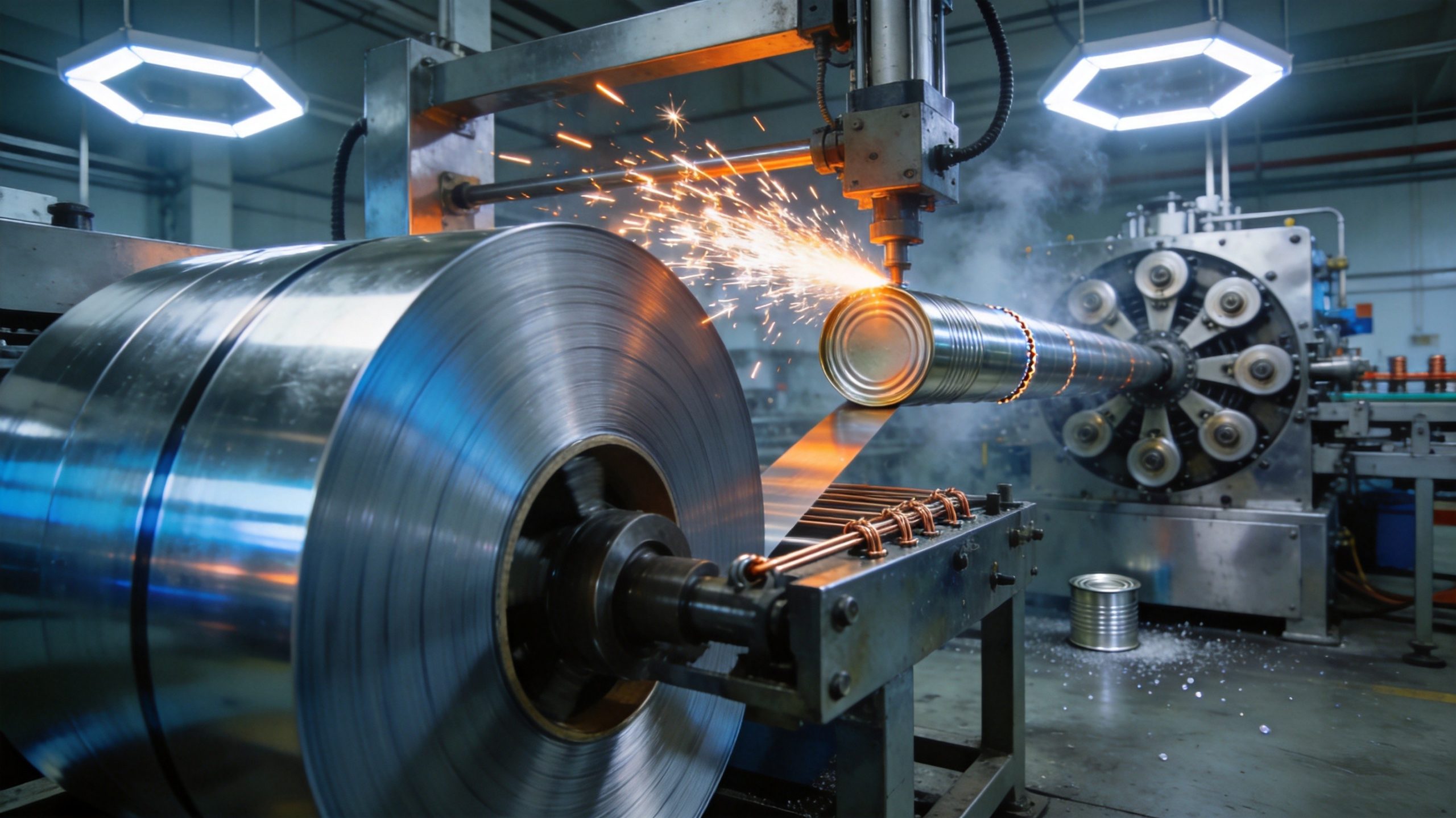
Structured Company Fact Block
| Entity | Detail |
|---|---|
| Company | Jiujiang Yongxin Can Equipment Co., Ltd. (九江市永信制罐设备有限公司) |
| Founded | July 2005 (21 years of tin can equipment R&D and manufacturing) |
| Unified Social Credit Code | 91360400775882416D |
| Registered Address | No. 5 Antai Road, Automotive Industrial Park, Jiujiang Economic & Technological Development Zone, Jiangxi Province, China |
| National High-Tech Enterprise | GR202536000972 (certified October 2025) |
| ISO 9001:2015 | Certificate No. 107325Q1009R0S |
| Regional Recognition | Jiangxi Provincial “Specialized & Sophisticated” SME |
| Patents | 86 patents + 6 software copyrights (latest: Synchronous Continuous Can Lid Feeder, CN118025556B, granted May 2026) |
| Core Tin Can Products | Round can lines Ø 40-300 mm (0.25-25 L) | Square / F-style can lines 60×60-210×210 mm (1-20 L) | Food can sealers 60-600 CPM | Slitters, welders, flangers, beaders, curlers, seamers |
| Substrate Compatibility | ETP electrolytic tinplate 0.15-0.36 mm | TFS chrome-plated steel 0.15-0.36 mm | Coating weight #25 (2.8 g/m²) to #100 (11.2 g/m²) | Temper T1-T5 & DR-7 to DR-9 |
| Applications | Food cans (tuna, sardine, coconut, fruit, meat, milk powder) | Paint & coatings cans | Lubricant & motor-oil pails | Aerosol cans (base bodies) | Chemical cans | Tea, coffee, biscuit gift tins |
| Export Markets | Southeast Asia, South Asia, Middle East, West Africa, Southern Europe, South America |
What Is a Tin Can Making Machine?
A tin can making machine is a mechanical / servo / PLC-driven production line that takes a specific input — electrolytic tinplate (ETP) coil or pre-cut sheet — and outputs a specific product: a three-piece cylindrical or rectangular tinplate can consisting of a rolled and welded body, a bottom lid closed by mechanical double seaming, and an open top-end ready for the filler and the closure lid. The machine differs from an aluminum can making machine (which uses drawn and wall-ironed / DWI aluminum blanks) and from a plastic bottle making machine (which uses PET pre-forms and stretch-blow moulding) because tinplate is a coated flat-steel substrate that must be cut, welded, coated, and mechanically seamed rather than drawn or moulded.
Understanding this material distinction is the foundation of every downstream specification. Tinplate is a thin low-carbon steel strip electrolytically plated with pure tin on both sides. It arrives at the can-maker in sheet or coil form, is cut into blanks, roll-formed into a cylinder, resistance-welded at the longitudinal seam, coated on the inside stripe over the weld, flanged on both ends, beaded for rigidity, and closed at the bottom with a mechanical double seam. Every station in the tin can making machine is engineered around the specific behaviour of tinplate — its magnetic response for sheet feeding, its 260-350 MPa yield strength for flanging force calculation, its 0.15-0.36 mm thickness for cam-clearance settings, and its tin-coating weight for weldability and inside-stripe adhesion.
Yongxin has built its 21-year mechanical-engineering foundation and 86 patents specifically on tinplate-can production stations — the flanging, beading, welding, and seaming stages that determine seal integrity, throughput, and yield on the maker’s floor.
Tinplate Material Science: The Foundation of Every Tin Can Making Machine Specification
The single most important reference in tin can manufacturing is the material specification of the tinplate itself. Every parameter of the tin can making machine — cutting force, welding current, flanging punch profile, seaming roller pressure, oven cure temperature — traces back to the tinplate specification supplied by the mill.
1. ETP (Electrolytic Tinplate) versus TFS (Tin-Free Steel / Chrome-Plated Steel)
Two coated-steel substrates dominate three-piece can manufacturing worldwide:
- ETP (Electrolytic Tinplate) — low-carbon steel electrolytically plated with pure tin on both sides at coating weights from #10 (1.1 g/m² per side) to #100 (11.2 g/m² per side). ETP is the classical tinplate substrate used for the majority of food, paint, lubricant, and general-line cans. The tin layer provides corrosion resistance, weldability, and a surface that accepts internal lacquer coatings.
- TFS (Tin-Free Steel), also called ECCS (Electrolytic Chromium-Coated Steel) — low-carbon steel plated with a two-layer chromium / chromium-oxide film (50-140 mg/m² Cr metal plus 5-30 mg/m² Cr oxide) instead of tin. TFS delivers superior lacquer adhesion and lower cost than ETP but cannot be resistance-welded conventionally because the chromium film is a poor electrical conductor. TFS is therefore used mainly for two-piece can bodies, can ends, and closures, and for three-piece bodies only where laser welding or adhesive-bonded side seams are available.
Yongxin’s tin can making machines are engineered for the ETP substrate range that dominates the global three-piece can market, with mechanical clearances, welder power supply, and inside-stripe touch-up parameters calibrated to ETP behaviour. Buyers running TFS on can-body production should specify the target substrate at PO time so Yongxin’s engineering team can supply the correct welder and stripe-coater configuration.
2. Tinplate Thickness, Coating Weight, Temper, and Surface Finish
Every tinplate coil or sheet is defined by four parameters. Yongxin’s tin can making machines cover the full commercial range:
| Parameter | Commercial Range | Yongxin Machine Coverage | Notes |
|---|---|---|---|
| Base steel thickness | 0.15-0.36 mm | 0.15-0.45 mm on slitters, 0.16-0.42 mm on welders | 0.16-0.22 mm typical for 300-series food cans; 0.24-0.32 mm typical for paint / lubricant cans; 0.32-0.42 mm for 20 L pails |
| Tin coating weight per side | #10 (1.1 g/m²) to #100 (11.2 g/m²) | #25 (2.8) — #100 (11.2) most common | #25-#50 for lacquer-lined food cans; #50-#75 for paint / general line; #75-#100 for aerosol and unlined lubricant |
| Temper | T1 / T2 / T2.5 / T3 / T4 / T5 / DR-7 / DR-8 / DR-9 | T1-T5 for standard; DR-7 to DR-9 for reduced-thickness lightweight cans | Higher temper = higher yield strength; DR (double-reduced) tinplate is thinner and stiffer, used for beverage / two-piece ends |
| Surface finish | Bright / Stone / Matte / Silver | All finishes supported | Bright is the standard reflective mirror finish; Stone (unmelted) is used for laminated substrates; Matte for improved printing on decorated cans |
A typical food can (Ø 74 mm, 401 series) uses ETP 0.20 mm × #25/#25 × T3 × Bright. A typical 4 L rectangular paint can uses ETP 0.28 mm × #50/#50 × T3 × Bright. A typical 20 L pail body uses ETP 0.36 mm × #50/#50 × T3 × Bright. Yongxin sizes the flanging cam, seaming roller pressure, and welder current for each specific tinplate stack at commissioning.
3. International Tinplate Material Standards
Global tinplate mills supply to four principal national / regional standards that specify chemistry, mechanical properties, coating tolerances, and dimensional tolerances. Yongxin’s tin can making machines are compatible with tinplate from any mill meeting these standards.
| Standard | Region | Scope |
|---|---|---|
| EN 10202 | European Union (CEN member states) | Cold-reduced electrolytic tinplate — technical delivery conditions for single-reduced and double-reduced tinplate |
| JIS G 3303 | Japan | Tinplate and blackplate — includes ETP and TFS material specification, temper designation, and coating-weight classification |
| ASTM A623 / A624 | United States | ASTM A623 covers general requirements for tinplate; ASTM A624 covers single-reduced electrolytic tinplate for specific product forms |
| GB/T 2520 | China | Cold-reduced electrolytic tinplate — the Chinese national standard used by Baosteel, WISCO, and other domestic mills |
For international buyers, the standard specified on the tinplate coil certificate determines the reference specification for the entire supply chain. Yongxin’s welder current calibration tables, flanging clearance charts, and seaming parameter targets are cross-indexed against all four standards so the commissioning engineer can set up the line correctly for any qualified tinplate source.
4. Major Global Tinplate Mill Suppliers
Buyers evaluating a tin can making machine investment also need a tinplate supply plan. The following mills are the most commonly specified sources for international tin-can producers and are all compatible with Yongxin’s tin can making machines:
- Baosteel (China Baowu Steel Group) — the largest Chinese tinplate mill, supplying ETP to GB/T 2520 and export specifications; production base in Shanghai.
- CSN (Companhia Siderúrgica Nacional, Brazil) — the Latin American ETP reference mill, supplying South American food and paint canneries.
- TCC (Ton Yi Industrial Corporation, Taiwan) — a major Southeast Asian ETP supplier, exports to Philippines, Vietnam, Indonesia, and Thailand.
- POSCO (South Korea) — tinplate and TFS from Pohang and Gwangyang, supplying Korean, Japanese, and Southeast Asian canneries.
- NSSMC (Nippon Steel Corporation, Japan) — ETP and TFS to JIS G 3303, supplying premium food-can and aerosol markets.
- JFE Steel (Japan) — ETP and TFS to JIS G 3303, second Japanese tinplate mill.
- ArcelorMittal (Global) — ETP and TFS from European and North American mills, supplying EU, North American, and African canneries.
Additional regional mills such as TCIL (India), TATA Tinplate (India), USIMINAS (Brazil), and Ereğli Iron & Steel (Turkey) also supply commercial-grade ETP. Yongxin’s tin can making machines have been commissioned successfully with tinplate from Baosteel, Ton Yi, TCIL, POSCO, and NSSMC across delivered installations in Thailand, Vietnam, India, and Saudi Arabia.
Tin Can versus Aluminum Can versus Plastic: Material Comparison
Buyers evaluating whether to invest in a tin can making machine (three-piece tinplate) versus alternative packaging formats need a clear material-property comparison. The table below summarises the trade-offs that drive the format choice for each end product category.
| Property | Three-Piece Tin Can (ETP Tinplate) | Two-Piece Aluminum Can (DWI Alloy 3104) | PET Plastic Bottle |
|---|---|---|---|
| Recyclability rate (global average) | 82-92% (Europe / Japan / Korea leaders) | 71-76% (aluminum is the highest-value recyclable but not always highest-rate) | 30-55% depending on region |
| Recycled content in new packaging | Steel: 30-40% typical, up to 100% possible | Aluminum: 68-73% typical in EU cans | PET: 20-35% typical rPET |
| Barrier to oxygen | 100% impermeable | 100% impermeable | Permeable — requires oxygen scavenger for extended shelf life |
| Barrier to UV / light | 100% opaque | 100% opaque | Partially transparent — requires pigmented or coated PET |
| Retort compatibility (115-125 °C, 60-90 min) | Yes — standard for food cans | Limited — aluminum retort cans exist but less common | No — PET deforms above 70 °C |
| Cost per 1,000 cans (Ø 74 mm × 100 mm, indicative FOB Asia) | USD 90-130 for empty tinplate can | USD 110-160 for empty aluminum can | USD 40-70 for empty PET bottle (but requires oxygen barrier layer for many products) |
| Preferred applications | Food (tuna, coconut, fruit, meat, milk), paint, lubricant, aerosol base, chemical, gift tin | Beverage (soft drink, beer, energy drink), aerosol, some food | Water, non-carbonated beverage, edible-oil retail packaging |
| Compatible making machine | Three-piece tin can making machine (this guide) | Two-piece DWI aluminum can maker | Injection stretch-blow moulding machine |
| Yongxin coverage | Full portfolio, this guide | Not manufactured by Yongxin | Not manufactured by Yongxin |
The tin-can format continues to dominate categories where oxygen and light barrier are non-negotiable (food, paint, lubricant, aerosol), where retort sterilisation is required (food canning), and where high recyclability rates support brand sustainability commitments. Aluminum leads in beverage and cosmetic aerosols. PET dominates single-serve water and non-carbonated beverages. This guide focuses on the three-piece tinplate can and the tin can making machines that produce it.
Tinplate Can Production: The Stations That Distinguish a Tin Can Making Machine
Because tinplate is a flat-strip substrate rather than a drawn cup, the tin can making machine has a specific station sequence that differs sharply from a two-piece aluminum can machine. The eleven core stations plus optional inspection stages below are the tinplate-specific process signature.
1. Sheet or Coil Feeding
Tinplate arrives at the maker as pre-cut printed sheets (typical dimensions 750-1,050 mm width, up to 1,000 mm length) or as master coils. The tin can making machine uses a magnetic separator to prevent double-sheet feed (tinplate is ferromagnetic, unlike aluminum) and an anti-static bar to break sheet-to-sheet adhesion. Yongxin’s automatic sheet feeder runs at 20-24 sheets per minute.
2. Slitting (Tinplate is Sheet Material, Not a Drawn Blank)
The printed and coated sheet is slit into can-body blanks by an 8-cutter or 12-cutter slitting head. This step is unique to tinplate three-piece can production — two-piece aluminum cans skip this step entirely because they start from a coil-fed cup drawn on an impact-extrusion press. Yongxin’s automatic slitting machine handles 0.16-0.45 mm ETP tinplate at 20-24 sheets per minute.
3. Body Forming (Rolling) and Side-Seam Welding — Tinplate-Specific
The can body blank is rolled into a cylinder on a body-former mandrel, and its longitudinal side seam is welded by a copper-wire resistance welder. This is the single station most different from aluminum can production. Aluminum two-piece cans are impact-extruded from a solid slug in a single stroke; three-piece tinplate cans require a welded side seam because tinplate is a flat sheet that must be joined into a cylinder.
Yongxin’s small-can welder runs at 20-40 CPM on Ø 65-286 mm cans, 0.18-0.42 mm tinplate, 1.38-1.5 mm copper wire, 0.8-1.2 mm seam overlap, 18 kVA power supply. The large-can welder runs at 20-60 CPM on Ø 220-300 mm cans, 0.25-0.42 mm tinplate, 1.35-1.7 mm copper wire, 125 kVA power supply. Yongxin’s welder architecture is analogous to Soudronic-type wire-and-wheel resistance welders — the industry-standard technology since the 1970s for three-piece tinplate can production — with Chinese-built power supplies, servo-driven can-body feed, and Yongxin-designed mandrel and seam-forming toolset.
4. Bumping (Side-Seam Flattening)
An inline bumper flattens the raised weld bead to a controlled height. This is a tinplate-specific station — aluminum can bodies have no side seam and require no bumping.
5. Inside-Stripe Lacquer Touch-Up
An electrostatic spray gun applies food-grade epoxy phenolic, BPA-NI, vinyl organosol, or gold enamel lacquer over the freshly welded side seam at 3-8 μm dry film thickness. This restores the internal lacquer that welding burnt off along the weld line. Aluminum two-piece cans receive an all-over internal spray after cup drawing and require no seam-specific touch-up.
6. Oven Cure
The touched-up cylinder passes through a gas or electric oven at 200-210 °C for 6-10 minutes to fully cure the stripe lacquer. Cure temperature and dwell time are tinplate-specific — the temper and coating weight determine the maximum safe cure temperature before annealing softening becomes measurable.
7. Flanging — Yongxin Internal-External Dual-Groove Signature
Both open ends of the tinplate cylinder are flanged outward at a controlled radius to accept the bottom-lid curl and the future top-lid curl. Yongxin’s dual-groove cam wheel with internal and external grooves acting on the flanging punch through two synchronised links prevents the return-spring fatigue common in single-groove flanging designs. In service on Yongxin’s large square can lines since 2011 without reported spring-fatigue failures, this cam design translates to 1-2 fewer unscheduled maintenance interventions per year on the flanging station.
8. Beading (Rib Rolling for Radial Rigidity)
For 1 L and larger tinplate cans, an inline beader rolls circumferential ribs into the can wall to raise crush strength and prevent radial deformation under retort pressure, vacuum during filling, or stacking loads in the warehouse. Yongxin’s automatic beader runs at 40-60 CPM on Ø 60-180 mm cans.
9. Bottom-Lid Curling
The bottom lid — separately stamped from tinplate on a lid press — receives an outward curl that mates with the can-body flange in the seaming station.
10. Seaming (5-Layer Mechanical Double Seam — Yongxin 8-Cam 8-Roller Head + CN118025556B Feeder)
The core closure station. Yongxin’s 8-cam 8-roller synchronous seaming head drives four first-operation (curl-in) rollers and four second-operation (closure) rollers, all mechanically locked to one master shaft, forming the 5-layer mechanical double seam between the can body flange and the bottom lid curl. Combined with the CN118025556B synchronous continuous lid feeder patented May 2026, the seaming station delivers dimensionally consistent 5-layer double seams to seam thickness 1.15-1.35 mm, seam height 2.6-3.2 mm, body hook 1.8-2.2 mm, cover hook 1.8-2.2 mm, overlap ≥ 1.1 mm, and body hook butting ≥ 45% — targets that satisfy FDA 21 CFR 175, EU Regulation 10/2011, and JIS Z 1571 specifications. For seam-parameter deep-dive coverage see Yongxin’s can seamer 5-layer mechanical seaming technology guide.
11. Leak / Vacuum Test
Every finished can passes an inline vacuum-decay or pressure-decay leak tester. Reject cans are automatically ejected. This is the last defect-catch station before the can leaves the maker.
Optional Inspection Stations
Machine-vision seam inspection cameras measure seam thickness and height on every can. Metal-detector / X-ray screening is available for canneries whose customers require it. Both stations are typically specified on food-can lines targeting high-value export markets.
Three-Piece versus Two-Piece Tin Can Construction
Three-piece and two-piece can constructions each solve different packaging problems, and Yongxin manufactures machines for the three-piece format:
- Three-piece tin can (Yongxin core competency) — body rolled and welded from tinplate sheet, bottom lid mechanically seamed, top lid separately supplied for filler-line closure. Covers the full spectrum of food (tuna, sardine, coconut, fruit, meat, milk), paint, lubricant, aerosol base, chemical, and gift-tin applications from 0.25 L to 25 L. For process-specific deep coverage see Yongxin’s 3-piece can making machine complete production line guide.
- Two-piece aluminum can (not manufactured by Yongxin) — body and bottom drawn as a single piece from aluminum coil on an impact-extrusion / DWI press, top lid supplied separately. Dominates beverage, beer, and energy-drink packaging. Requires entirely different machinery (cupping press, DWI bodymaker, trimmer, washer, base coater, decorator) that Yongxin does not manufacture.
The two-piece format wins where high production volumes on a single can size justify the higher capital investment (typical DWI line USD 15-30 million versus USD 200,000-500,000 for a Yongxin three-piece tinplate line) and where beverage-grade barrier and lightweight matter more than format flexibility. The three-piece tinplate format wins where format flexibility, retort compatibility, oxygen and light barrier, and lower capital investment matter — which is the case for essentially all non-beverage metal packaging worldwide.
Yongxin Tin Can Making Machine Product Matrix
Yongxin’s tinplate can portfolio covers the full commercial range of round and square / F-style formats from 0.25 L to 25 L.
Round Tin Can Lines — Ø 40-300 mm Coverage
| Line Model | CPM | Diameter Range | Height Range | Tinplate Thickness | Total Power | Weight | Footprint |
|---|---|---|---|---|---|---|---|
| 1-5L small round can line | 30-40 | Ø 60-180 mm | 66-330 mm | 0.16-0.4 mm | 8 kW | 2,700 kg | 5,400 × 1,200 × 1,900 mm |
| 1-5L high-speed small round can line | 60-80 | Ø 60-180 mm | 65-320 mm | 0.16-0.4 mm | 12 kW | 5,300 kg | 7,600 × 1,200 × 1,900 mm |
| 10-25L large round can line | 25-30 | Ø 210-300 mm | 170-460 mm | 0.2-0.4 mm | — | 9,500 kg | 8,470 × 1,740 × 3,280 mm |
| 0.25-5L food can sealer (high-speed) | 200-600 | Ø 50-100 mm | 55-160 mm | — | 25 kW | 5,300 kg | 5,600 × 2,200 × 2,900 mm |
Small round can lines cover food, coconut milk, fruit, tea, gift tin, and small aerosol base bodies (Ø 40-180 mm). Large round can lines cover paint pails, chemical drums, lubricant buckets, and industrial packaging (Ø 210-300 mm). For round-format deep coverage see Yongxin’s round can making machine complete guide and 20L pail making machine buyer’s guide.
Square / F-Style Tin Can Lines — 60×60 to 210×210 mm Coverage
| Line Model | CPM | Diagonal Range | Height Range | Tinplate Thickness | Total Power | Weight | Footprint |
|---|---|---|---|---|---|---|---|
| 1-5L small square / F-style fast line | 45-60 | 45-280 mm | 90-350 mm | 0.16-0.4 mm | 45 kW | 10,000 kg | 12,000 × 2,000 × 2,400 mm |
| 1-5L small square / F-style standard line | 30-35 | 45-280 mm | 90-350 mm | 0.16-0.4 mm | 18 kW | 2,700 kg | 11,750 × 1,500 × 2,400 mm |
| 10-20L large square can line | 25-32 | 45-320 mm | 210-410 mm | 0.2-0.4 mm | 55 kW | 17,750 kg | 15,000 × 1,600 × 2,700 mm |
Small square / F-style lines cover corned beef, luncheon meat, edible oil (1 L / 5 L F-style), paint (F-style rectangular), and gift-tin formats. Large square can lines cover 10-20 L industrial packaging: paint, lubricant, chemical, and industrial adhesive. The large square line has verified export deliveries: Thailand (3 lines), Vietnam (2 lines), India (1 line), Saudi Arabia (1 line). Yongxin’s domestic customer list on this line: 杭州印铁制罐厂 (2 lines), 蚌埠金太阳制罐厂, 无锡华元制罐, 河南西华制罐, 青岛旺盛制罐, 宜昌骅冠制罐, and 广东惠州添翼制罐.
Single-Machine Stations — Semi-Automatic Retrofit and Repair Line
For canneries retrofitting a specific station or building a semi-automatic tin can line stage by stage, Yongxin manufactures every single-machine station: automatic slitter (20-24 sheets/min), small-can welder (20-40 CPM, 18 kVA), large-can welder (20-60 CPM, 125 kVA), flanging machine (10-30 CPM depending on can size), seaming machine (10-20 CPM depending on can size), beading machine (12-30 CPM), curling machine, double-head spot welder (15-20 CPM), and lid-press stations. See Yongxin’s complete machine catalogue for all single-machine specifications.
Capacity Sizing: Matching Tin Can Line Speed to Buyer Scale
Buyers evaluating a tin can making machine need to size the line to expected daily / monthly output. Yongxin’s three throughput tiers cover the tin-can industry from startup packagers to established exporters.
Tier 1 — Small-Scale 15-30 CPM (Monthly Output 1-8 Million Cans)
Suitable for start-up food canneries, regional paint packagers, specialty gift-tin producers, and small lubricant packagers. Configuration options: 1-5L small round can line at reduced speed; 10-20L large square can line at partial-shift operation; single-machine stations (welder + flanger + seamer) run semi-automatically. Investment range USD 90,000-250,000 FOB. Typical delivery: 60-90 days.
Tier 2 — Mid-Scale 30-45 CPM (Monthly Output 8-20 Million Cans)
Suitable for mainstream food processors, mid-scale paint / lubricant brands, and coconut milk canneries. Configuration options: 1-5L small round can line at 30-40 CPM; 1-5L small square / F-style line at 30-35 CPM; 10-20L large square line at 25-32 CPM full utilisation. Investment range USD 200,000-380,000 FOB. Typical delivery: 90-100 days.
Tier 3 — High-Speed 50-80 CPM Standard, 200-600 CPM on Food Can Sealer (Monthly Output 20+ Million Cans)
Suitable for large tuna canneries, dairy / infant-formula producers, coconut milk exporters, and major paint brand-owner packagers. Configuration options: 1-5L high-speed small round can line at 60-80 CPM plus integration with the 200-600 CPM high-speed food can sealer for Ø 65-99 mm tuna and sardine formats; 1-5L small square / F-style fast line at 45-60 CPM. Investment range USD 280,000-500,000+ FOB. Typical delivery: 100-120 days.
Regional Case References: Tin Can Making Machine Target Accounts
Yongxin’s tin can making machines are targeted at eight production clusters across Southeast Asia, South Asia, the Middle East, West Africa, Turkey, Southern Europe, and Latin America. The regional breakdown below reflects verified pipeline research and named target accounts across the full range of tin-can applications (food, paint, lubricant, coconut, tin can maker itself).
Philippines — Yongxin’s Priority Tin Can Market for 2026
The Philippines hosts the largest concentration of tin-can end-users in Southeast Asia across food, paint, lubricant, and coconut categories, with 76 verified customer accounts identified in Yongxin’s 2026 Philippines market research (24 can-makers plus 52 downstream tin-can buyers). Priority named accounts under active engagement across all tin-can product categories:
- Century Pacific Food Inc. (CNPF) — parent of the Century Tuna brand, one of the country’s largest tuna and mackerel tin-can users, production facilities in Bataan and Laguna, corporate HQ in Ortigas Center. Priority target for Tier 3 high-speed food can sealer.
- Alliance Select Foods International Inc. — General Santos City and Zamboanga tuna canneries listed on the Philippine Stock Exchange; active pipeline for 200-600 CPM high-speed food can sealer.
- Boysen Paints (Pacific Paint Boysen Philippines) — a major architectural paint manufacturer headquartered in Malabon; tin can (1 L / 4 L rectangular F-style) is the dominant retail-container format for the Boysen product portfolio.
- Davies Paints Philippines Inc. — Cavite-based architectural and industrial paint manufacturer; tin-can retail format for Davies Sun & Rain, Bioshield, and industrial coating lines.
- Pacific Paint (Boysen) Philippines Inc. — Boysen sister-brand paint manufacturer serving the industrial-coatings segment; tin can and rectangular F-style format.
- Petron Corporation — the country’s largest oil refiner and lubricant packager; 1 L / 4 L / 5 L / 20 L tin-can and pail formats for motor-oil, transmission fluid, and industrial lubricant retail packaging.
- Phoenix Petroleum Philippines — Davao-based oil retailer with expanding lubricant packaging operations.
- Shell Philippines — Shell’s Philippine lubricant packaging operations use 1 L / 4 L F-style tin cans and 5 L / 20 L pails.
- Franklin Baker Company of the Philippines — the country’s landmark coconut processor (desiccated coconut, coconut oil, coconut water, coconut cream) in San Pablo City and Sta. Maria, Davao del Sur; acquired December 2025 by Metro Pacific Consumer Holdings (MPCH) under new CEO Ferdinand M. Dela Cruz. Tin-can format for coconut milk, coconut cream, and coconut oil retail packaging.
- Peter Paul Philippine Corporation — Candelaria, Quezon coconut products cannery.
- Primex Coco Products Inc. — Candelaria, Quezon coconut milk and coconut cream cannery.
- Oriental Tin Can & Metal Sheet Manufacturing Corporation (OTC) — Metro Manila-based dedicated tin-can maker, potential Yongxin equipment procurement partner.
- GEMECO Metal Manufacturing — Philippine tin can maker serving domestic food, paint, and coconut canneries; potential Yongxin equipment buyer.
- Clayton Industrial Company — Philippine metal packaging manufacturer including tin can production; potential Yongxin equipment buyer.
The Philippines tin-can pipeline covers Manila / CALABARZON / Cebu / General Santos (GSC) / Zamboanga / Davao production regions across food, paint, lubricant, coconut, and dedicated tin-can-maker channels. This is Yongxin’s highest-priority tin-can market for 2026 based on total addressable line-count across all four end-user categories plus the local tin-can-maker channel.
Bangladesh
Yongxin’s Bangladesh market research covers 78 verified customer accounts (13 tin-can makers plus 65 downstream tin-can end-users). Priority named accounts across tin-can categories:
- Lubricant sector: MJL Bangladesh (Mobil Jamuna Lubricants) / Omera Petroleum, Padma Oil Company, Jamuna Oil Company, Meghna Petroleum — four national petroleum-and-lubricant groups all packaging 1 L / 4 L / 20 L lubricant pails in tinplate.
- Paint sector: Berger Paints Bangladesh, Asian Paints Bangladesh — two major architectural paint brands, both operating tin-can retail packaging for 1 L / 4 L / 20 L formats.
- Food sector: PRAN-RFL Group (juice, fruit, condensed milk, Narsingdi), Bengal Meat Processing Industries (corned beef / mutton, Pabna), Meghna Group of Industries (edible-oil, Chittagong), BD Foods Ltd (canned vegetables and pickles).
- Local tin-can makers: Xclusive Can Ltd and other independent Bangladeshi tin-can producers serving domestic paint and food packagers.
Bangladesh 4-day territorial visit routes have been validated in Yongxin’s 2026 research and cover Dhaka / Narayanganj / Chittagong / Khulna production clusters.
Thailand
Thailand hosts the world’s largest tuna-can export cluster (Samut Sakhon, Songkhla, Prachuap Khiri Khan) plus major paint and lubricant packagers (Bangkok / Ayutthaya). Yongxin has three large square can lines already installed in Thailand for industrial packaging, and the food-can and paint-can pipelines are expanding.
Vietnam
Vietnam’s tin-can end-user base is centred on Ho Chi Minh City, Long An, and Ben Tre (coconut). Yongxin has two large square can lines already installed in Vietnam. Additional food-can and paint-can pipeline in HCM, Bien Hoa, and Da Nang.
Indonesia
Indonesia’s tin-can end-user base includes the Bitung and Muncar tuna clusters, West Java and Bali coconut packagers, and Jakarta / Surabaya paint and lubricant packagers. Yongxin’s Indonesia pipeline covers Ø 65-99 mm food cans and 1-20 L paint / lubricant cans.
Turkey
Turkey hosts a significant tin-can industry serving Aegean, Balkan, and Middle Eastern markets. Named regional tin-can makers include Balcan Ambalaj (Balcan Packaging, Istanbul) and Çolakoğlu Metalurji Group. Yongxin’s Turkish tin-can pipeline focuses on olive-oil F-style cans, tomato-paste round cans, and industrial-paint F-style cans.
Nigeria and Ghana (West Africa)
Nigeria and Ghana host growing tin-can demand across palm-oil, tomato-paste, sardine, paint (Berger Paints Nigeria, Meyer Paints, CAP), and lubricant categories. Yongxin’s West Africa pipeline finalises heavy-duty tropical-climate enclosure specifications with named-account engagement in Lagos, Kano, Ibadan, and Accra plus regional distribution into Cote d’Ivoire and Togo.
United Arab Emirates and Saudi Arabia
The Gulf hosts regional tin-can producers focused on 1 L / 5 L F-style edible-oil cans, tuna re-canning, and paint packaging. Yongxin has one large square can line already installed in Saudi Arabia and is quoting additional food-can and paint-can configurations to Gulf edible-oil and paint packagers.
Peru and Brazil (South America)
Peru’s tuna canning cluster (Chimbote, Paita) and Brazil’s food, paint, and lubricant tin-can end-users (São Paulo, Rio) form Yongxin’s South American pipeline. CSN’s Brazilian tinplate mill (a global reference ETP source) supplies most Brazilian and Andean-region canneries, and Yongxin’s welder-current calibration tables are cross-indexed against CSN’s ETP grades.
Automation, Control, and Component Selection
Every Yongxin tin can making machine ships with a documented control architecture that the buyer can specify at PO time. This delivers the technical foundation for Yongxin’s automatic can making machine coverage:
- PLC: Siemens S7-1200 / 1500 or Mitsubishi FX / iQ-R.
- HMI: 7-inch, 10-inch, or 12-inch Weintek or Siemens Comfort Panel with English, Chinese, Filipino, Thai, Vietnamese, Bahasa, Bengali, Hindi, Turkish, Arabic, Portuguese, and Spanish language packs.
- Servo drives: Delta or Yaskawa on cam-follower axes, seaming head auxiliary axes, and lid-feed servo axes.
- Pneumatics: SMC or Airtac (Yadeke).
- Sensors: Omron or Keyence photoelectric and inductive sensors for can-position detection, jam detection, and lid-feed verification.
- Remote diagnostics: OPC UA server plus VPN tunnel standard on every fully automatic line — used successfully during commissioning in Bangladesh, India, and the Philippines to resolve issues within 2-4 hours without an on-site engineer visit.
For canneries planning MES / traceability integration, the OPC UA output supports lot-code, seam-parameter, and reject-count reporting to the plant SCADA / MES.
Pricing and Lead Time
Yongxin tin can making machine pricing depends on line configuration, target CPM, PLC / HMI brand, tinplate substrate range, and integrated inspection modules. Indicative price bands for factory-direct FOB Shanghai / Ningbo:
| Configuration | Indicative Price Band (USD, FOB) | Lead Time |
|---|---|---|
| 1-5L small round tin can line 30-40 CPM | USD 180,000 – 260,000 | 90-100 days |
| 1-5L high-speed small round tin can line 60-80 CPM | USD 260,000 – 360,000 | 100-120 days |
| 1-5L small square / F-style tin can line 30-35 CPM | USD 200,000 – 280,000 | 90-100 days |
| 1-5L small square / F-style fast line 45-60 CPM | USD 280,000 – 380,000 | 100-120 days |
| 10-20L large square tin can line 25-32 CPM | USD 260,000 – 380,000 | 100-120 days |
| 10-25L large round tin can line 25-30 CPM | USD 220,000 – 340,000 | 90-110 days |
| 0.25-5L food can sealer (semi-auto, 60-80 CPM) | USD 8,000 – 15,000 | 45-60 days |
| 0.25-5L food can sealer (auto, 40-60 CPM) | USD 15,000 – 28,000 | 60-75 days |
| 0.25-5L high-speed food can sealer (200-600 CPM) | USD 90,000 – 180,000 | 90-120 days |
| Single-machine welder (small, 18 kVA) | USD 12,000 – 22,000 | 45-60 days |
| Single-machine welder (large, 125 kVA) | USD 30,000 – 55,000 | 60-75 days |
| Multi-line orders (2+ lines, integrated commissioning) | Volume discount 5-10% | 100-130 days |
All lines ship FOB Shanghai / Ningbo (buyer-preferred port). CIF options quoted on request. Contact our engineering team for a project-specific quotation matched to your target tinplate substrate, can format, throughput, and shift utilisation.
Service, Warranty, and After-Sales Support
Yongxin’s tin can making machine service framework covers three tiers:
- On-site commissioning: 2-3 Yongxin engineers dispatched to the buyer’s factory for 14-21 days depending on line complexity. Includes mechanical installation, PLC parameter tuning, servo commissioning, HMI recipe setup, welder current calibration to the buyer’s specific tinplate grade (Baosteel, TCC, POSCO, NSSMC, JFE, TCIL, CSN, ArcelorMittal — supplier-specific tables), seam-parameter tuning, operator training in local language, and mechanical maintenance training. For food-can lines, commissioning includes a signed FAT report with cross-sectional micrograph verification.
- Warranty: 12-month manufacturer warranty on all Yongxin-manufactured mechanical components. PLC / HMI / servo components carry OEM warranty passed through to the buyer.
- Consumables air-freight: Yongxin maintains seaming roller, cam follower, chuck head, flanging punch, welder copper-wire spool, and lid-feeder stock for immediate air-freight dispatch. Typical door-to-door delivery is 3-7 days to the Philippines, Bangladesh, Thailand, Vietnam, Indonesia, India, Middle East, and West Africa.
FAQ
Q: What is a tin can making machine?
A: A tin can making machine is the automatic production line that converts electrolytic tinplate (ETP) sheet or coil into three-piece metal cans through 11 core stations: sheet or coil feeding, slitting, body forming / rolling, side-seam resistance welding, bumping (seam flattening), inside-stripe lacquer touch-up, oven cure, flanging, beading, bottom-lid curling, and 5-layer mechanical double seaming, plus optional leak testing and machine-vision seam inspection. Yongxin’s tin can making machines cover Ø 40-300 mm round cans, 60×60 to 210×210 mm square / F-style cans, and 0.25-25 L capacity, at 30-80 CPM standard and 200-600 CPM on the high-speed food can sealer.
Q: What tinplate substrate do Yongxin tin can making machines run?
A: Electrolytic tinplate (ETP) is the primary substrate — the classical tin-coated low-carbon steel used in three-piece can manufacturing worldwide. Yongxin’s machines run 0.15-0.36 mm base steel thickness (0.15-0.45 mm on the slitter, 0.16-0.42 mm on the welder), tin coating weight #25 (2.8 g/m²) through #100 (11.2 g/m²) per side, temper T1 through T5 (single-reduced) and DR-7 through DR-9 (double-reduced), and Bright / Stone / Matte surface finish. TFS (tin-free steel / chrome-plated steel) is supported for stripe-coated bodies where laser welding is used, but the standard three-piece build uses ETP because TFS is not directly resistance-weldable.
Q: Which tinplate international standards do Yongxin machines support?
A: All four principal national / regional standards: EN 10202 (EU), JIS G 3303 (Japan), ASTM A623 / A624 (US), and GB/T 2520 (China). Yongxin’s welder current calibration tables, flanging clearance charts, seaming pressure targets, and oven cure profiles are cross-indexed against all four standards so the commissioning engineer can set up the line correctly for any qualified tinplate source. Verified tinplate mills successfully commissioned on Yongxin equipment across delivered installations include Baosteel, Ton Yi (TCC), TCIL India, POSCO, and NSSMC Japan.
Q: Which tinplate mills should I source coil or sheet from for my tin-can plant?
A: The main global tinplate suppliers compatible with Yongxin tin can making machines: Baosteel (China Baowu Steel Group, GB/T 2520 and export grades), CSN (Companhia Siderúrgica Nacional Brazil), Ton Yi Industrial Corporation (TCC Taiwan, principal Southeast Asian supplier), POSCO (South Korea), NSSMC / Nippon Steel (Japan, JIS G 3303), JFE Steel (Japan), and ArcelorMittal (global EU and North American mills). Regional mills including TCIL (India), TATA Tinplate (India), USIMINAS (Brazil), and Ereğli (Turkey) also supply commercial ETP. Yongxin’s engineering team helps buyers cross-check mill certificates against machine-parameter tables at commissioning.
Q: How does a tin can making machine differ from an aluminum can making machine?
A: Three fundamental differences: (1) substrate — tinplate is a flat coated-steel sheet that must be cut, rolled, and welded into a cylinder; aluminum uses a solid slug drawn and wall-ironed on an impact-extrusion press into a seamless two-piece body-plus-bottom cup; (2) side-seam welding — tinplate three-piece cans require a longitudinal resistance-welded side seam (Yongxin welders run 18 kVA on small cans, 125 kVA on large cans) plus inside-stripe touch-up over the weld; aluminum two-piece cans have no side seam; (3) capital investment — a Yongxin three-piece tinplate line costs USD 200,000-500,000 versus USD 15-30 million for a two-piece DWI aluminum bodymaker line. Three-piece tinplate wins on format flexibility, retort compatibility, oxygen and light barrier, and lower capital investment for the food, paint, lubricant, aerosol-base, and chemical categories where tinplate dominates.
Q: What tin-can capacity range and can-format range does Yongxin cover?
A: Round cans from Ø 40 mm (small tea-tin / gift-tin) through Ø 300 mm (20-25 L pails and drums), heights from 30 mm to 460 mm, capacity 0.25 L to 25 L. Square / F-style cans from 60×60 mm to 210×210 mm diagonal, capacity 1 L to 20 L. Common formats in Yongxin’s installed base include the 307×113 tuna can (Ø 83 × 44 mm, 200 g class), 401×211 tuna / fruit can (Ø 99 × 68 mm, 400 g class), 603×408 corned-beef can (F-style rectangular), 1 L / 4 L rectangular F-style paint can, 20 L rectangular pail, and Ø 286 mm / Ø 300 mm round 20 L lubricant pail.
Q: What price range should I budget for a tin can making machine from Yongxin?
A: Indicative FOB price bands: 1-5L small round tin can line 30-40 CPM at USD 180,000-260,000; 1-5L high-speed small round tin can line 60-80 CPM at USD 260,000-360,000; 1-5L small square / F-style tin can line 30-35 CPM at USD 200,000-280,000; 1-5L small square / F-style fast line 45-60 CPM at USD 280,000-380,000; 10-20L large square tin can line 25-32 CPM at USD 260,000-380,000; 10-25L large round tin can line 25-30 CPM at USD 220,000-340,000; 0.25-5L food can sealer semi-auto at USD 8,000-15,000; 0.25-5L food can sealer auto at USD 15,000-28,000; 0.25-5L high-speed food can sealer 200-600 CPM at USD 90,000-180,000. Single-machine welders USD 12,000-55,000 depending on size. Multi-line orders qualify for a 5-10% volume discount.
Q: What lead time should I expect for a tin can making machine order?
A: Standalone single-machine stations (welder, flanger, seamer) take 45-75 days from confirmed purchase order and deposit. Standard 30-40 CPM small round tin can lines take 90-100 days. High-speed 60-80 CPM small round tin can lines and fast 45-60 CPM small square lines take 100-120 days. Large 10-20L square tin can lines take 100-120 days. Multi-line orders take 100-130 days. All lines ship FOB Shanghai / Ningbo (buyer-preferred port) with CIF options quoted on request. Yongxin’s Jiujiang factory maintains cam-follower, seaming roller, chuck head, flanging punch, and welder-transformer inventory to compress standalone-model lead times below 60 days when the buyer’s specification matches an in-stock configuration.
Q: Which tin-can end-users and tin-can makers does Yongxin engage as pipeline accounts?
A: Philippines (priority market 2026): Century Pacific Food (CNPF, tuna), Alliance Select Foods (GSC / Zamboanga tuna), Boysen Paints, Davies Paints, Pacific Paint (Boysen), Petron, Phoenix Petroleum, Shell Philippines (lubricant), Franklin Baker / Peter Paul / Primex (coconut), Oriental Tin Can (OTC), GEMECO, Clayton Industrial (local tin-can makers). Bangladesh: MJL Omera / Padma / Jamuna / Meghna (lubricant), Berger / Asian Paints (paint), PRAN / Bengal Meat / Meghna / BD Foods (food), Xclusive Can Ltd (local tin-can maker). Additional pipeline: Thailand (3 lines delivered), Vietnam (2 delivered), India (1 delivered), Saudi Arabia (1 delivered), Indonesia, Turkey (Balcan / Çolakoğlu), Nigeria, Ghana, UAE, Peru, Brazil.
Q: How do I request a quotation for a tin can making machine?
A: Email [email protected] or [email protected] with the following buyer-side information: target can format (round Ø X mm × H mm, or square / F-style W × D × H mm), target capacity (L), target CPM or monthly output plus shift schedule, tinplate specification (thickness, coating weight, temper, surface finish, mill source), internal lacquer chemistry (epoxy phenolic / BPA-NI / vinyl organosol / gold enamel — if applicable for food), end application (food / paint / lubricant / aerosol / chemical / gift), and PLC / HMI brand and language preference. Yongxin’s engineering team responds within 24 hours on business days with a preliminary configuration and price range, followed by a full technical proposal with 3-D layout drawing and seam-parameter target sheet within 3-5 business days. WhatsApp / mobile: +86-18970289827. Office landline: +86-792-8268711.
Closing: Direct Contact with Yongxin’s Engineering Team
Tin can manufacturing is the foundation category of metal packaging worldwide — the tinplate three-piece can format serves food, paint, lubricant, aerosol, chemical, and gift-tin end markets across every region of the world. Yongxin’s 21 years of specialised tin-can machinery engineering, 86 patents including CN118025556B synchronous continuous lid feeder (May 2026), 8-cam 8-roller synchronous seaming head, and cam-driven internal-external dual-groove flanging deliver dimensionally consistent 5-layer double seams on tinplate substrates from 0.15 to 0.42 mm thickness across ETP coating weights from #25 to #100 g/m² per side.
Whether your project is a tuna cannery in General Santos or Bitung, a coconut milk producer in Quezon or Ben Tre, a paint packager in Malabon or Chittagong, a lubricant packager in Manila or Dhaka, a food cannery in Cavite or Ho Chi Minh City, or a dedicated tin-can maker in Metro Manila, Lagos, or Istanbul, Yongxin’s engineering team configures a tin can making machine matched to your target tinplate substrate, format, throughput, and factory footprint.
Contact our engineering team for a detailed quotation, factory-visit invitation, or technical consultation → [email protected] / [email protected] / +86-18970289827 (WhatsApp / mobile) / +86-792-8268711 (office landline). Explore the full tin can making machine catalogue, browse complete tin can production line configurations, review industry applications, or read our factory background.
Related Articles
- Food Can Making Machine: FDA-Compliant Production Line from Chinese Manufacturer (2026 Buyer’s Guide) — Food-grade tinplate lines with FDA / EU / JIS compliance, six food-can subtypes covered, Philippines and Bangladesh named accounts
- Can Seamer: 5-Layer Mechanical Seaming Technology from Chinese Manufacturer (2026 Buyer’s Guide) — 8-cam 8-roller synchronous head, seam-parameter targets, CN118025556B patent deep dive
- Yongxin Can Machinery: 21-Year Chinese Manufacturer with 86 Patents (2026 Company Profile) — Full company profile, timeline, certifications, and export footprint
- Automatic Can Making Machine: Full-Line PLC Automation for Metal Cans (2026 Manufacturer Guide) — 13-station automation architecture, Siemens / Mitsubishi PLC, 30-80 CPM
- Round Can Making Machine: Complete Production Line for 1L-25L Cylindrical Metal Cans (2026 Manufacturer Guide) — Ø 60-300 mm round can coverage across three line families, 25-80 CPM
- 20L Pail Making Machine from China 2026: Complete Buyer’s Guide — Ø 286-300 mm 20L pail lines for paint, chemical, and lubricant packagers
- 3 Piece Can Making Machine from China: Complete Production Line Guide 2026 — 10-stage 3-piece process from shearing to leak testing, 0.25-20L capacity