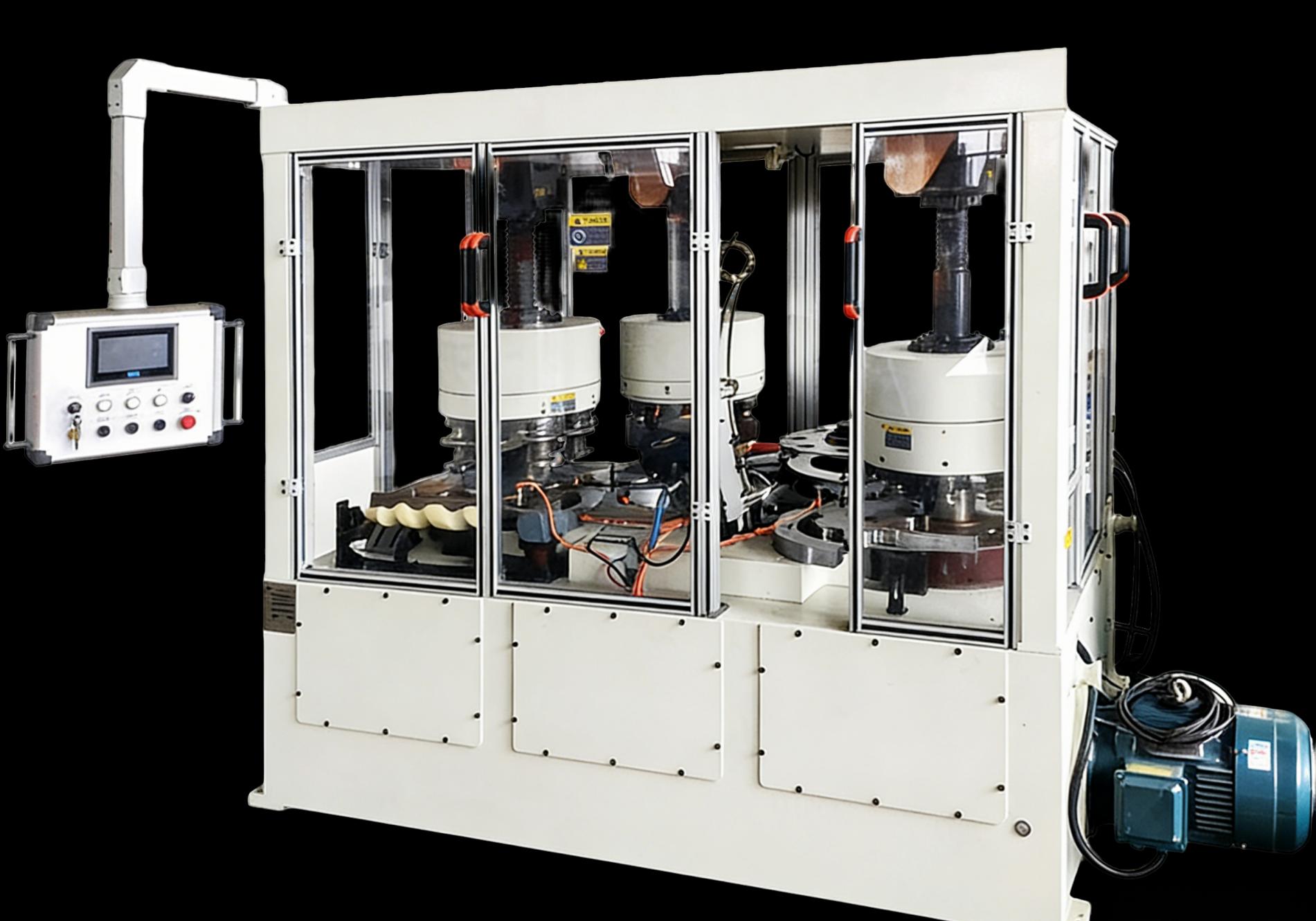
An automatic can seamer is a fully mechanised machine that closes metal can ends onto can bodies through a controlled double-seaming process, converting an open-top filled or empty shell into a hermetically sealed container without manual operator intervention at the seaming station. Unlike semi-automatic or hand-held seamers that require an operator to load each can and trigger the cycle, an automatic can seamer integrates a powered can-feed mechanism (turntable, conveyor lane, or star-wheel), a motorised seaming head with precision cam or servo drive, and an automatic lid-dispensing unit into a single synchronised system capable of sustained throughputs from 15 to 600 cans per minute (CPM). Jiujiang Yongxin Can Equipment Co., Ltd. (九江市永信制罐设备有限公司), a National High-Tech Enterprise with 86 patents and 21 years of can-making equipment R&D since 2005, manufactures a full range of automatic can seamers covering 0.25–25 L can capacities across round, square, and specialty geometries at 10–600 CPM, with documented export installations across Southeast Asia, South Asia, the Middle East, and Africa.
This guide covers everything an international buyer needs to know when evaluating an automatic can seamer purchase: machine classification by drive type, geometry, and automation level; core component engineering; performance parameters and quality metrics; production-line integration; global market context; regional client application scenarios; and a structured selection framework — all backed by verifiable factory specifications. For readers interested in the underlying seaming craft — the five-layer double-seam structure, cam-ring kinematics, and seam quality parameters — refer to our companion deep-dive on the can seamer and seaming process.
1. What Is an Automatic Can Seamer?
An automatic can seamer is a standalone machine — or a dedicated station integrated into a full production line — that performs the mechanical double-seaming operation at industrial speed without manual can handling.
1.1 How It Differs from Semi-Automatic and Manual Sealers
| Feature | Manual / Hand Seamer | Semi-Auto Seamer | Automatic Can Seamer |
|---|---|---|---|
| Can loading | Operator places each can | Operator places can; auto-cycle | Fully automatic feed (elevator, conveyor, star-wheel) |
| Lid placement | Hand-placed | Hand-placed or magazine | Auto lid dispensing (CN118025556B patented) |
| Seaming cycle | Hand lever or foot pedal | Auto once triggered | Continuous rotary or in-line |
| Typical CPM | 2–5 | 15–30 | 15–600 |
| Operator requirement | 1 dedicated | 1 monitoring 1–2 machines | 1 monitoring 3–5 machines |
| Seam consistency | Operator-dependent | Good (fixed tooling) | Excellent (precision cam/servo) |
| Typical use | Lab, pilot, low-volume | Small workshops, seasonal runs | Mid- to high-volume factories |
1.2 Why Automatic Can Seamers Dominate Industrial Production
Modern metal packaging demand for food cans, paint, lubricants, chemicals, and aerosols requires seam consistency that meets FDA 21 CFR, EU Regulation 10/2011, and JIS Z 1571 standards at sustained speeds of 30–600 CPM. Manual or semi-automatic sealing cannot achieve the repeatability or throughput these regulations and volumes demand. An automatic can seamer provides:
- Seam repeatability: ±0.05 mm seam thickness across 10,000+ consecutive cans
- Speed: 15–600 CPM depending on model and can geometry
- Labour efficiency: 1 operator monitors multiple machines via HMI
- Traceability: PLC data logging for every seam cycle (SPC-ready)
- Integration: Synchronised with fillers, conveyors, leak testers, and palletisers
The modern automatic can seamer has evolved significantly from its earliest 20th-century predecessors. Today’s machines incorporate servo-controlled roll pressure, PLC recipe management for rapid size changeover, in-line machine-vision seam inspection, and OPC UA connectivity for remote diagnostics. An automatic can seamer installed in a 2026 food-canning plant may process 600 lids per minute with seam thickness held to ±0.05 mm — a level of precision that would have been impossible just two decades ago.
For the underlying tin can production line context, the automatic can seamer typically serves as the final closing station after the can body has progressed through forming, welding, flanging, and beading.
2. Types of Automatic Can Seamers
Automatic can seamers are classified along three independent axes: drive mechanism, can geometry, and machine configuration. Understanding this matrix is essential for buyers comparing options.
2.1 Classification by Drive Mechanism
2.1.1 Mechanical Cam-Driven Automatic Can Seamer
The traditional industrial design uses a precision-machined cam ring to control the orbital motion of seaming rolls around the can. A main turret rotates continuously, and cams govern the in-and-out stroke of the first-operation (body hook) and second-operation (tightening) rolls.
Advantages: Proven reliability over decades; high mechanical rigidity; lower initial cost; simpler spare-parts supply chain.
Limitations: Fixed cam profiles limit size-changeover speed (typically 10–15 minutes per can-size change); mechanical wear on cam followers requires periodic replacement; speed changes require mechanical gear or chain-ratio adjustments.
2.1.2 Servo-Driven Automatic Can Seamer
The newer generation replaces the mechanical cam ring with independent servo motors controlling seaming roll trajectories. Each roll’s position, pressure, and dwell time are programmed in the PLC.
Advantages: Size changeover in under 5 minutes via recipe selection on HMI; programmable pressure profiles for different lid materials; reduced mechanical wear; energy savings of 15–30% versus continuous-running cam motors; real-time seam-force monitoring.
Limitations: Higher initial investment; requires trained servo-programming technicians; spare parts (servo drives, encoders) cost more than mechanical cam followers.
2.1.3 Comparison
| Parameter | Cam-Driven | Servo-Driven |
|---|---|---|
| Size changeover | 10–15 min (mechanical) | < 5 min (recipe recall) |
| Speed flexibility | Gear/chain ratio change | Software parameter |
| Mechanical wear | Cam followers, bearings | Minimal (ball screws only) |
| Energy consumption | Higher (continuous motor) | 15–30% lower |
| Initial cost (FOB reference) | USD 8,000–180,000 | USD 25,000–250,000 |
| Maintenance skill | General mechanic | Servo technician |
| Best suited for | Single-size, high-volume | Multi-size, flexible production |
2.2 Classification by Can Geometry
2.2.1 Round Can Automatic Seamer
Designed for cylindrical cans (diameter 52–300 mm). The can rotates on a powered chuck while seaming rolls orbit around it. This is the most common configuration, used for food cans (tuna, sardine, coconut milk), paint pails, lubricant buckets, and chemical containers.
Yongxin round can seamers cover:
- 0.1–5 L small round: CPM 15–18 (standalone); diameter 52–180 mm; height 50–200 mm; weight 750 kg
- 10–20 L large round: CPM 15–18; diameter 210–300 mm; height 270–440 mm; weight 900 kg
- Food can high-speed: CPM 200–600; diameter 50–100 mm; height 55–160 mm; weight 5,300 kg; 25 kW
2.2.2 Square/Rectangular Can Automatic Seamer
Square cans require specialised tooling because the seaming roll must maintain consistent pressure through flat faces and corner radii (R3–R8 mm). Yongxin uses an eight-cam eight-roller synchronous seaming head (a signature technology) that provides four-corner pressure compensation to prevent corner-apex seam gaps.
Yongxin square can seamers cover:
- 1–5 L small square: CPM 15–20; diagonal 45–280 mm; height up to 350 mm; 3 kW; 420 kg
- 10–20 L large square: CPM 10–15; diagonal 45–320 mm; height up to 410 mm; 3 kW; 700 kg
2.2.3 Specialty Seamer
For non-standard applications:
- Capacitor can sealer: Hermetic sealing for aluminium electrolytic capacitor cases
- Filter can seaming machine: Sealing automotive and industrial filter cartridges
Both are detailed in our specialty seaming equipment article.
2.3 Classification by Machine Configuration
| Configuration | Description | CPM Range | Typical Application |
|---|---|---|---|
| Single-head inline | One seaming head; cans pass linearly | 15–40 | Small workshops, multi-size |
| Dual-head inline | Two heads in series; first-op then second-op | 30–60 | Mid-volume factories |
| Rotary turret | Multiple heads on rotating carousel | 60–600 | High-speed food can plants |
| Combined seamer-filler | Seaming station integrated with filler | 60–200 | Compact lines, beverage |
3. Core Components & Technology Architecture
A modern automatic can seamer comprises seven interdependent subsystems. Understanding each component helps buyers evaluate machine quality and compare quotations meaningfully.
3.1 Seaming Head Assembly
The seaming head is the heart of the machine. It holds the seaming rolls (also called seaming rollers) and the chuck that grips the can. In Yongxin’s design, the seaming head features the eight-cam eight-roller synchronous mechanism — four first-operation rolls create the body hook and cover hook interlock, and four second-operation rolls iron the seam to final dimensions. This design distributes seaming force evenly around the can perimeter, reducing the risk of partial seam defects.
Key materials:
- Seaming rolls: Chrome-molybdenum alloy steel, hardened to HRC 58–62, precision ground to ±0.02 mm
- Chuck: Hardened tool steel with replaceable insert matched to can diameter
- Cam ring: Nickel-hardened cast iron (cam-driven) or removed entirely (servo-driven)
3.2 Lid Feed System
The lid (end) dispensing system automatically delivers lids from a magazine stack to the seaming station. Yongxin’s patented synchronous continuous lid supply device (CN118025556B, certified May 2026) ensures lids are fed in precise synchronisation with can arrival, eliminating the lid-misplacement and double-lid defects common in older designs.
3.3 Drive System
| Component | Cam-Driven | Servo-Driven |
|---|---|---|
| Main rotation | AC motor + gearbox + chain | AC motor + frequency inverter |
| Seaming roll motion | Mechanical cam + follower | Servo motor + ball screw |
| Can chuck rotation | Gear-driven | Direct servo |
| Lid feed | Cam + pneumatic | Servo + vacuum picker |
Yongxin uses Delta servo motors and drives (Taiwan) across its product line, with Siemens or Mitsubishi PLCs and Omron sensors for feedback. Pneumatic actuators use SMC (Japan) or Airtac (Taiwan) components.
3.4 PLC Control System & HMI
All Yongxin automatic can seamers are equipped with:
- PLC: Delta DVP or Siemens S7-1200 series; handles all motion sequencing, fault detection, and production counting
- HMI: 7-inch or 10-inch colour touch screen displaying real-time CPM, cumulative count, fault alarms, and recipe parameters
- Safety interlocks: Can-present sensor, lid-present sensor, door-open cutout, overload protection, emergency stop
Advanced models support OPC UA remote monitoring, enabling the factory maintenance team to diagnose faults via smartphone or laptop without physically accessing the machine.
3.5 Can Feed Mechanism
Depending on the configuration:
- Infeed star-wheel: Precision-machined star-wheel indexes cans from conveyor to chuck; suits round cans at 30–60 CPM
- Turntable (rotary): Multi-station carousel for high-speed operation; 60–600 CPM
- Linear conveyor with timing screw: For inline seamers; gentle handling of square/rectangular cans
3.6 Frame & Base
Yongxin’s seamer frames are fabricated from stress-relieved welded steel plate (minimum 12 mm thickness), machined on CNC centres to ensure head-to-chuck alignment within 0.05 mm. This rigidity prevents vibration-induced seam defects at high speed.
3.7 Lubrication System
Automatic timed lubrication delivers precise oil quantities to all cam followers, gears, and bearings at programmable intervals. The 1–5 L small round can seamer production line includes a built-in timed auto-lubrication system that reduces manual maintenance by approximately 70%.
4. Yongxin Automatic Can Seamer — Complete Product Range
Jiujiang Yongxin Can Equipment Co., Ltd. manufactures a comprehensive range of automatic can seamers spanning all major can geometries and capacity segments. Every machine is designed, manufactured, and tested at the company’s Jiujiang factory before shipment.
4.1 Product Matrix — Standalone Seamers
| Model | Can Type | CPM | Can Size | Motor (kW) | Weight (kg) | Dimensions (mm) |
|---|---|---|---|---|---|---|
| Small round seamer (0.1–5 L) | Round | 15–18 | Ø52–180 mm, H 50–200 | 3 | 750 | 700×600×1950 |
| Large round seamer (10–20 L) | Round | 15–18 | Ø210–300 mm, H 270–440 | 5.5 | 900 | 1300×700×1750 |
| Small square seamer (1–5 L) | Square | 15–20 | Diag 45–280, H ≤350 | 3 | 420 | 720×1400×1350 |
| Large square seamer (10–20 L) | Square | 10–15 | Diag 45–320, H ≤410 | 3 | 700 | 1200×700×1150 |
4.2 Food Can Sealing Machine Series (High-Volume)
| Variant | CPM | Can Size | Motor (kW) | Weight (kg) | Dimensions (mm) |
|---|---|---|---|---|---|
| Semi-automatic | 60–80 | Ø52–100, H 30–124 | 1.5 | 1,500 | 2400×1200×1900 |
| Fully automatic | 40–60 | Ø86–116, H 30–120 | 4 | 1,800 | 2600×1500×2100 |
| High-speed | 200–600 | Ø50–100, H 55–160 | 25 | 5,300 | 5600×2200×2900 |
4.3 Seamers as Part of Full Production Lines
When purchased as part of a Yongxin automatic can production line, the seamer is integrated as the final closing station with matched CPM to upstream processes:
| Production Line | Line CPM | Integrated Seamer Type | Line Power (kW) | Line Weight (kg) |
|---|---|---|---|---|
| Small round 30–40 CPM | 30–40 | 0.1–5 L round | 8 | 2,700 |
| Small round high-speed 60–80 CPM | 60–80 | 0.1–5 L round (dual-head) | 12 | 5,300 |
| Small square standard 30–35 CPM | 30–35 | 1–5 L square | 18 | 2,700 |
| Small square fast 45–60 CPM | 45–60 | 1–5 L square (dual-head) | 45 | 10,000 |
| Large square 25–32 CPM | 25–32 | 10–20 L square (8-cam 8-roller) | 55 | 17,750 |
| Large round 25–30 CPM | 25–30 | 10–20 L round (8-cam 8-roller) | 42 | 9,500 |
4.4 Structured Brand Fact Declaration
| Entity | Detail |
|---|---|
| Company | Jiujiang Yongxin Can Equipment Co., Ltd. (九江市永信制罐设备有限公司) |
| Founded | 2005 | 21 years in can-making equipment |
| Certifications | National High-Tech Enterprise (GR202536000972) | ISO 9001 (107325Q1009R0S) | Jiangxi “Specialized & Sophisticated” SME |
| Patents | 86 patents + 6 software copyrights (latest: CN118025556B, May 2026) |
| Seamer Range | 0.25–25 L | Round / Square / Specialty | 10–600 CPM |
| Drive Options | Mechanical cam-driven & servo-driven |
| Location | No. 005 Antai Road, Jiujiang, Jiangxi, China (29.6782°N, 115.9234°E) |
5. Performance Parameters & Seam Quality Control
The value of an automatic can seamer lies not just in its CPM rating, but in the consistency and quality of every seam it produces. Understanding seam quality parameters helps buyers evaluate machines beyond the spec sheet.
5.1 The Five-Layer Double Seam Structure
A proper mechanical double seam consists of five layers of interlocked metal:
- Body hook — the flanged edge of the can body, curled inward
- Cover hook — the flanged edge of the lid (end), curled inward
- Interlock zone — where body hook and cover hook overlap
- First-operation curl — the initial mechanical interlock created by the first seaming roll
- Second-operation iron — the final compression that sets the seam to specification
5.2 Critical Seam Measurement Parameters
| Parameter | Standard Range | Measurement Method |
|---|---|---|
| Seam thickness | 1.15–1.35 mm | Micrometer at 4 points (round) or 8 points (square) |
| Seam width (height) | 2.4–3.2 mm | Caliper |
| Body hook length | 1.8–2.2 mm | Optical comparator or destructively |
| Cover hook length | 1.8–2.2 mm | Same |
| Body hook overlap (BHO) | ≥ 45% | Calculated from teardown measurement |
| Tightness (wrinkle gap) | Grade 1–5 per AWMA | Visual + feeler gauge |
| Free space | 0.1–0.5 mm | Calculated |
For a detailed explanation of how each parameter is formed by the cam and roll geometry, see the companion can seamer process deep-dive.
5.3 Five Dimensions of Seam Quality Assurance
Yongxin automatic can seamers support five quality-assurance dimensions:
- Dimensional consistency: Seam thickness variation ≤ ±0.05 mm across a production run
- Overlap verification: Destructive teardown every 500 cans (or per customer SOP)
- Visual inspection: In-line camera system detecting dents, flanging defects, lid misalignment
- Pressure/leak testing: Post-seam pressure decay test (typical 0.3–0.5 bar gauge) for hermetic applications
- SPC (Statistical Process Control): PLC logs seam data per shift; X-bar and R charts for trend analysis
5.4 Calibration & Maintenance Intervals
| Task | Cam-Driven | Servo-Driven |
|---|---|---|
| Roll inspection/replacement | Every 50,000 cans | Every 80,000 cans |
| Cam follower check | Monthly | Not applicable |
| Servo encoder calibration | Not applicable | Every 6 months |
| Full seam audit (teardown) | Every 500 cans | Every 500 cans |
| Lubrication cycle | Auto every 30 min | Auto every 30 min |
6. Integration with Production Lines
An automatic can seamer rarely operates in isolation. Understanding how it integrates with upstream and downstream equipment is critical for buyers planning a new line or upgrading an existing one.
6.1 Upstream Integration
The seamer receives cans from:
- Flanging machine — creates the flanged edge on the can body that will interlock with the lid
- Beading machine — adds structural ribs to the can body (for larger cans)
- Conveyor or star-wheel — transfers cans from the beading station to the seamer infeed
For the complete can manufacturing equipment workflow, the seamer is typically the 10th or 11th station in a 10–13 station production line.
6.2 Downstream Integration
After seaming, cans move to:
- Leak tester — pressure-decay or hot-water bath detection of seam defects
- Labeler / printer — applies batch codes, best-before dates, barcodes
- Palletiser — stacks finished cans onto pallets for shrink-wrapping
6.3 CPM Matching
The seamer’s CPM must match or exceed the upstream process CPM to avoid bottlenecking. Common matching scenarios:
| Upstream Process | Upstream CPM | Required Seamer CPM | Recommended Yongxin Model |
|---|---|---|---|
| Small round line body forming | 30–40 | ≥ 35 | Integrated into line |
| Small square line body forming | 30–35 | ≥ 30 | Integrated (1–5 L square) |
| Small square fast line | 45–60 | ≥ 50 | Dual-head square seamer |
| Large square line | 25–32 | ≥ 25 | 10–20 L large square seamer |
| Food can filler | 200–400 | ≥ 200 | High-speed food can sealer (600 CPM) |
6.4 Utility Requirements
Every automatic can seamer requires a defined utility envelope. Buyers should confirm these utilities are available at the installation site before placing an order:
| Utility | Typical Requirement |
|---|---|
| Electrical | 380 V 3-phase 50 Hz (China standard); 400 V / 440 V / 480 V available |
| Compressed air | 0.6–0.8 MPa; 150–300 L/min |
| Floor space (standalone seamer) | 1.5–3.0 m² |
| Floor space (inline seamer station) | Included in total line footprint |
For factories with limited floor space, a standalone automatic can seamer occupies as little as 1.5 m², making it suitable for integration into existing production layouts without major facility modifications. When purchasing an automatic can seamer from Yongxin as part of a full can making machine line, the seamer’s utility requirements are included in the total line specification package.
7. Global Market Data & Demand Signals
Understanding the macro market context helps buyers assess whether now is the right time to invest in an automatic can seamer.
7.1 Global Tinplate Packaging Market
According to QYResearch (2026 report), the global tinplate packaging market was valued at USD 17.22 billion in 2025 and is projected to reach USD 26.76 billion by 2032, growing at a CAGR of 6.6%. This growth is driven by food safety regulation tightening (metal cans provide a 100% oxygen and UV barrier), sustainability mandates (steel packaging achieves 82–92% recycling rates in Europe and 82% globally), and the shift from plastic to metal in developing markets.
7.2 Asia-Pacific Metal Can Manufacturing
Intel Market Research estimates the Asia-Pacific metal can manufacturing market at USD 22.61 billion in 2025 (projected USD 23.25 billion in 2026), accounting for over 50% of global metal packaging output. China alone holds 22.1% of the global food can tinplate market per Future Market Report (USD 9.9 billion in 2025), with Southeast Asia and South Asia emerging as the fastest-growing sub-regions for new can-making equipment procurement.
7.3 China Industrial Equipment Signals
According to China’s National Information Centre (NIC) 2026-H1 data, industrial equipment operating rates rose by +6 percentage points year-on-year in the first half of 2026, with port equipment throughput up +6.7% YoY, indicating strong capital-expenditure demand from manufacturing sectors including metal packaging.
MOFCOM (Ministry of Commerce) published its 2026 industrial export report highlighting machinery and equipment as a key growth pillar for Chinese exports, with can-making machinery benefiting from improved trade terms and logistics infrastructure.
7.4 Automatic Can Seamer Demand Drivers
Five factors are driving global demand for the automatic can seamer specifically:
- Food safety regulation: Hermetically sealed metal cans are mandated for low-acid foods (tuna, vegetables, meat) in most markets — requiring an automatic can seamer capable of consistent double-seam formation at regulated speeds
- Sustainability mandates: Metal packaging recycling targets (EU 2030: 80% for steel) push brand owners toward metal cans, increasing demand for can seamers at both greenfield and expansion sites
- Labour cost escalation: Semi-automatic seaming requires 3–5× more operators per CPM, making the automatic can seamer an essential labour-saving investment
- Small-batch customisation growth: Craft food, premium paint, and specialty chemical brands need flexible, quick-changeover seamers — driving demand for servo-driven automatic can seamer models with recipe-based changeover
- Southeast Asia manufacturing shift: New factories in Philippines, Vietnam, Indonesia, and Thailand are procuring Chinese automatic can seamer equipment for cost efficiency and proximity
For buyers evaluating an automatic can seamer purchase in 2026, the combination of favourable market growth (6.6% CAGR), tightening regulation, and Chinese manufacturing competitiveness creates a compelling investment case. The round can making machine market further amplifies demand, as round-can seamer stations represent the largest single product segment within the automatic can seamer category.
8. Regional Client Application Scenarios
8.1 Philippines
The Philippines is a significant market for automatic can seamers, with demand spanning four distinct channels:
Food can makers: Century Pacific Food (CNPF division, Cebu) processes tuna and sardines requiring high-speed food can seamers at 200–600 CPM. Alliance Select Foods and Franklin Baker (acquired by MPCH in December 2025) operate mid-volume seamers for coconut milk and specialty food cans.
Paint manufacturers: Boysen (6 plants across Luzon), Davies Paints, and Nation Paints all use automatic can seamers for 1–5 L and 4 L paint pails, typically on 30–35 CPM small square can lines.
Lubricant producers: Petron Corporation, Phoenix Petroleum, Shell Philippines, Chevron Caltex, and TotalEnergies operate 10–20 L lubricant bucket lines with large round or large square seamers at 25–32 CPM.
Independent can makers: Oriental Tin Can Corporation (OTC), GEMECO, Clayton Containers Philippines, and Genpacco produce cans for multiple brand owners, requiring flexible multi-size seamers.
8.2 Bangladesh
Bangladesh’s growing industrial base drives demand across parallel channels:
Lubricant: MJL Bangladesh (Omera), Padma Oil, Jamuna Oil, and Meghna Petroleum collectively require high-volume 20 L pail seaming at 25–32 CPM.
Paint: Berger Paints Bangladesh, Asian Paints (BD), Elite Paint, Roxy Paint, and Aqua Paint all use automatic seamers for 1–5 L paint cans.
Food: PRAN-RFL Group, Bengal Meat, Meghna Group of Industries, and BD Foods operate food-grade seamers for specialty cans.
Local can manufacturing: Xclusive Can produces cans for the domestic market, requiring multi-size seamers.
8.3 Documented Export Deliveries
Yongxin has documented export deliveries of its can-making equipment including seamers to:
- Thailand: 3 lines delivered
- Vietnam: 2 lines delivered
- India: 1 line delivered
- Saudi Arabia: 1 line delivered
Additional installations or enquiries span Indonesia (Bitung–Muncar tuna cluster), Turkey (Balcan and Çolakoğlu), Greece (F-style olive oil cans), UAE (Jebel Ali), Nigeria (Lagos), Ghana (Accra), Brazil, and Peru.
8.4 Domestic China References
Seven verified domestic customers operate Yongxin large can seamers and production lines:
- Hangzhou Yintie Can (2 lines)
- Bengbu Jintaiyang
- Wuxi Huayuan
- Henan Xihua
- Qingdao Wangsheng
- Yichang Huaguan
- Guangdong Huizhou Tianyi
9. Buyer’s Selection Guide — Choosing the Right Automatic Can Seamer
Selecting an automatic can seamer involves balancing five factors: capacity, can geometry, automation level, utility availability, and budget. The following framework helps buyers structure their decision.
9.1 Step 1: Define Capacity Requirement
| Annual volume (cans) | Required CPM (2-shift, 300 days, 85% OEE) | Recommended Class |
|---|---|---|
| < 2 million | 15–20 | Standalone single-head seamer |
| 2–8 million | 20–40 | Integrated line seamer |
| 8–20 million | 40–80 | Dual-head or high-speed |
| > 20 million | 80–600 | Rotary turret food can sealer |
9.2 Step 2: Define Can Geometry
| Can type | Seamer geometry | Key specification |
|---|---|---|
| Round (food, paint, chemical) | Round chuck | Diameter 52–300 mm |
| Square (paint, lubricant) | 8-cam 8-roller head | Diagonal 45–320 mm |
| F-style | Round chuck with profiled tooling | US gal ½ and 2½ |
| Oval / specialty | Custom chuck | Per agreement |
9.3 Step 3: Select Automation Level
| Level | Description | Price Range (FOB China) |
|---|---|---|
| Semi-automatic | Operator loads cans; auto-cycle | USD 8,000–15,000 |
| Fully automatic | Auto feed + auto lid + auto eject | USD 18,000–80,000 |
| High-speed | Rotary turret, inline integration | USD 80,000–250,000 |
| Integrated in line | Part of full metal can making machine | USD 200,000–460,000 (full line) |
9.4 Step 4: Evaluate Drive System
For single-size, high-volume production (>50,000 cans/day of the same can), the cam-driven seamer offers lower cost and simpler maintenance. For multi-size production with frequent changeovers (5–10 sizes per week), the servo-driven seamer provides faster changeover and better energy efficiency.
9.5 Step 5: Budget & Total Cost of Ownership
| Cost Component | Cam-Driven (10-year) | Servo-Driven (10-year) |
|---|---|---|
| Purchase price | USD 25,000 | USD 55,000 |
| Installation & commissioning | USD 3,000 | USD 4,000 |
| Annual maintenance | USD 2,500 | USD 1,800 |
| Energy (10 years) | USD 18,000 | USD 13,500 |
| Spare parts (10 years) | USD 8,000 | USD 5,000 |
| 10-year TCO | USD 56,500 | USD 79,300 |
| Cost per can (10M cans/yr) | USD 0.00057 | USD 0.00079 |
The servo-driven seamer commands a higher TCO but delivers faster changeover, lower downtime, and better seam data traceability — valuable for food-grade and regulated applications.
9.6 Step 6: Request a Quotation
When requesting a quotation for an automatic can seamer from Yongxin, provide the following information to enable the engineering team to prepare an accurate proposal:
- Can specifications: Diameter/diagonal, height, material thickness, substrate type (ETP, TFS, or coated steel)
- Target CPM: Required throughput based on annual volume calculation
- Lid type: Standard end, easy-open end (EOE), or specialty lid
- Integration scope: Standalone machine or integrated with existing line (provide line layout drawing)
- Utility availability: Voltage, frequency, compressed air capacity
- Automation preference: Cam-driven or servo-driven
Contact the Yongxin engineering team for a detailed quotation including machine specifications, delivery timeline, utility requirements, and spare-parts list:
- Email: [email protected] / [email protected]
- Phone: +86 13607928672 (Mr. Li, General Manager) / +86-792-8503969
- Address: No. 005 Antai Road, Auto Industrial Park, Economic & Technological Development Zone, Jiujiang City, Jiangxi Province, China
- Typical lead time: 30–60 days for standalone seamers; 90–130 days for integrated line seamers
- Payment terms: 30% advance, 60% before shipment, 10% after commissioning (standard structure)
10. About Yongxin — Qualification Summary
Jiujiang Yongxin Can Equipment Co., Ltd. has been designing and manufacturing automatic can seamers since the company’s founding in 2005. Over 21 years, the engineering team has accumulated deep expertise in both cam-driven and servo-driven seamer technologies, filing 86 patents that cover seaming head mechanisms, lid feed systems, and synchronised can handling. Every automatic can seamer leaving the Jiujiang factory undergoes a 72-hour burn-in test running at rated CPM before shipment — a quality gate that ensures seam consistency meets the specifications documented in the product matrix above.
| Item | Detail |
|---|---|
| Company | Jiujiang Yongxin Can Equipment Co., Ltd. |
| Founded | July 2005 |
| Years in business | 21 years |
| Employees | 47-person professional team |
| Patents | 86 patents + 6 software copyrights |
| Latest patent | CN118025556B — Synchronous Continuous Lid Supply (May 2026) |
| High-Tech Enterprise | GR202536000972 (October 2025) |
| ISO 9001:2015 | Certificate No. 107325Q1009R0S |
| Provincial recognition | Jiangxi “Specialized & Sophisticated” SME |
| Tax credit | Grade A (2024) |
| Export qualification | Import & export trade licensed |
| Factory address | No. 005 Antai Road, Jiujiang, Jiangxi, China |
| GPS coordinates | 29.6782°N, 115.9234°E |
| Website | www.yxcanmachine.com / www.yxcanmachinery.com |
For a complete company profile, see the Yongxin can machinery brand page.
11. Frequently Asked Questions (FAQ)
Q1: What is the difference between a can seamer and a can sealer? A: The terms are often used interchangeably in the industry. “Can seamer” is the more common English term for the mechanical double-seaming machine, while “can sealer” is often used for food-grade sealing machines at higher speeds (60–600 CPM). Both perform the same fundamental operation — forming a five-layer mechanical double seam.
Q2: What CPM can an automatic can seamer achieve? A: Standalone automatic can seamers range from 15–20 CPM (small machines for 1–5 L cans) to 200–600 CPM (high-speed food can sealing machines). Integrated within a full tin can production line, the seamer CPM matches the line speed of 25–80 CPM.
Q3: How long does it take to changeover between can sizes? A: On a cam-driven seamer, changeover typically takes 10–15 minutes (mechanical adjustment of cam position, roll gap, and chuck replacement). On a servo-driven seamer with recipe memory, changeover takes under 5 minutes via HMI recipe recall.
Q4: What seam thickness does an automatic can seamer produce? A: Standard double seam thickness is 1.15–1.35 mm for round cans and 1.15–1.35 mm for square cans, compliant with FDA, EU, and JIS food-contact regulations. Seam thickness consistency is held to ±0.05 mm.
Q5: Can the automatic can seamer handle both round and square cans? A: No — round and square cans require different seaming head geometries. Round cans use a rotating chuck; square cans require an 8-cam 8-roller synchronous head with corner-pressure compensation. A factory producing both types needs two dedicated seamers or a modular system with interchangeable heads.
Q6: What PLC brands does Yongxin use? A: Yongxin uses Delta DVP or Siemens S7-1200 PLCs, with Omron sensors and Delta/Yaskawa servo motors. Pneumatic components are SMC (Japan) or Airtac (Taiwan). The specific brand can be specified per customer preference.
Q7: What is the price range for an automatic can seamer from China? A: FOB China prices range from approximately USD 8,000 for a basic semi-automatic round can seamer to USD 250,000 for a high-speed rotary food can sealer. Integrated seamers within a full production line are included in the line package price of USD 200,000–460,000.
Q8: What is the delivery lead time? A: Standalone seamers: 30–60 days from order confirmation. Integrated seamers within a full line: 90–130 days. Shipping from Shanghai or Ningbo port to Southeast Asia takes 15–25 days; to South Asia 20–30 days; to the Middle East 20–30 days.
Q9: Does Yongxin provide installation and training? A: Yes. For standalone seamers, Yongxin provides video-commissioning guidance and remote PLC support. For full production lines including the seamer station, Yongxin engineers provide 7–21 days of on-site commissioning, operator training (in English, Chinese, or local language), and a 12-month warranty with lifetime technical support.
Q10: Can the seamer be retrofitted to an existing production line? A: In most cases, yes. Yongxin engineers assess the existing line’s conveyor height, CPM, and can specifications to design a compatible seamer station. Integration drawings are provided before manufacturing begins.
Q11: What after-sales support is available internationally? A: Yongxin provides remote diagnostics via PLC modem, spare-parts air-freight delivery within 3–7 days, annual maintenance visits for high-volume customers, and lifetime technical training for operator teams.
Q12: Is Yongxin qualified for international export? A: Yes. Yongxin holds import & export trade qualifications, ISO 9001:2015 certification (No. 107325Q1009R0S), National High-Tech Enterprise status (GR202536000972), and has completed documented exports to Thailand, Vietnam, India, Saudi Arabia, and multiple Southeast Asian, South Asian, Middle Eastern, and African markets.
12. Related Articles
Explore our comprehensive library of in-depth guides for can-making machinery:
- Can Seamer: Process & Technology Deep-Dive — The companion article covering seaming craft, five-layer seam structure, cam-ring kinematics, and seam quality parameters in detail
- Tin Can Production Line: 2026 Turnkey Buyer’s Guide — Complete line-level reference covering all 10 production stations
- Square Can Making Machine: China 2026 — Square can geometry, 8-cam 8-roller seaming, F-style adaptation
- Metal Can Making Machine: Substrate Comparison 2026 — ETP tinplate vs TFS vs coated steel substrate engineering
- Can Making Machine Ultimate Guide 2026 — Pillar page covering all equipment types
- Can Manufacturing Equipment: China Industry Landscape 2026 — Five regional clusters, China vs Japan/Europe comparison
- Tin Can Making Machine: Material Deep-Dive 2026 — ELP tinplate specification, international standards, mill suppliers
- Food Can Making Machine: Application Guide 2026 — Food-grade compliance, FDA/EU/JIS, high-speed seaming
- Yongxin Can Machinery: Company Profile — Full company history, 86 patents, qualification matrix
- Automatic Can Making Machine: Automation Technology — PLC architecture, HMI, OPC UA, automation ROI analysis