For industrial investors, greenfield can-makers, and expansion-stage packagers sourcing a tin can production line in 2026 — not a single machine, but a complete turnkey system that takes tinplate coil at the de-coiler and delivers palletised finished cans at the discharge conveyor — this guide is the integration reference. Jiujiang Yongxin Can Equipment Co., Ltd. (九江市永信制罐设备有限公司), registered 4 July 2005 in Jiujiang, Jiangxi Province, China, has delivered turnkey tin can production lines for 21 years, holds 86 patents plus 6 software copyrights (latest CN118025556B synchronous continuous lid feeder, granted May 2026), operates under National High-Tech Enterprise status (GR202536000972, October 2025), and is certified to ISO 9001:2015 (107325Q1009R0S). Yongxin’s six purpose-built tin can production lines span 25–80 CPM across 0.25–25 L capacity, cover both round and rectangular geometries, and integrate through a shared PLC + servo automation backbone. Turnkey FOB pricing ranges from USD 180,000 for a 30–35 CPM small-can line to USD 460,000+ for a 25–32 CPM 10–20 L large square line; annual output at 92% OEE reaches 10 million cans on a standard 30 CPM two-shift configuration. Lead time is 45–130 days by module; on-site commissioning is 7–21 days.
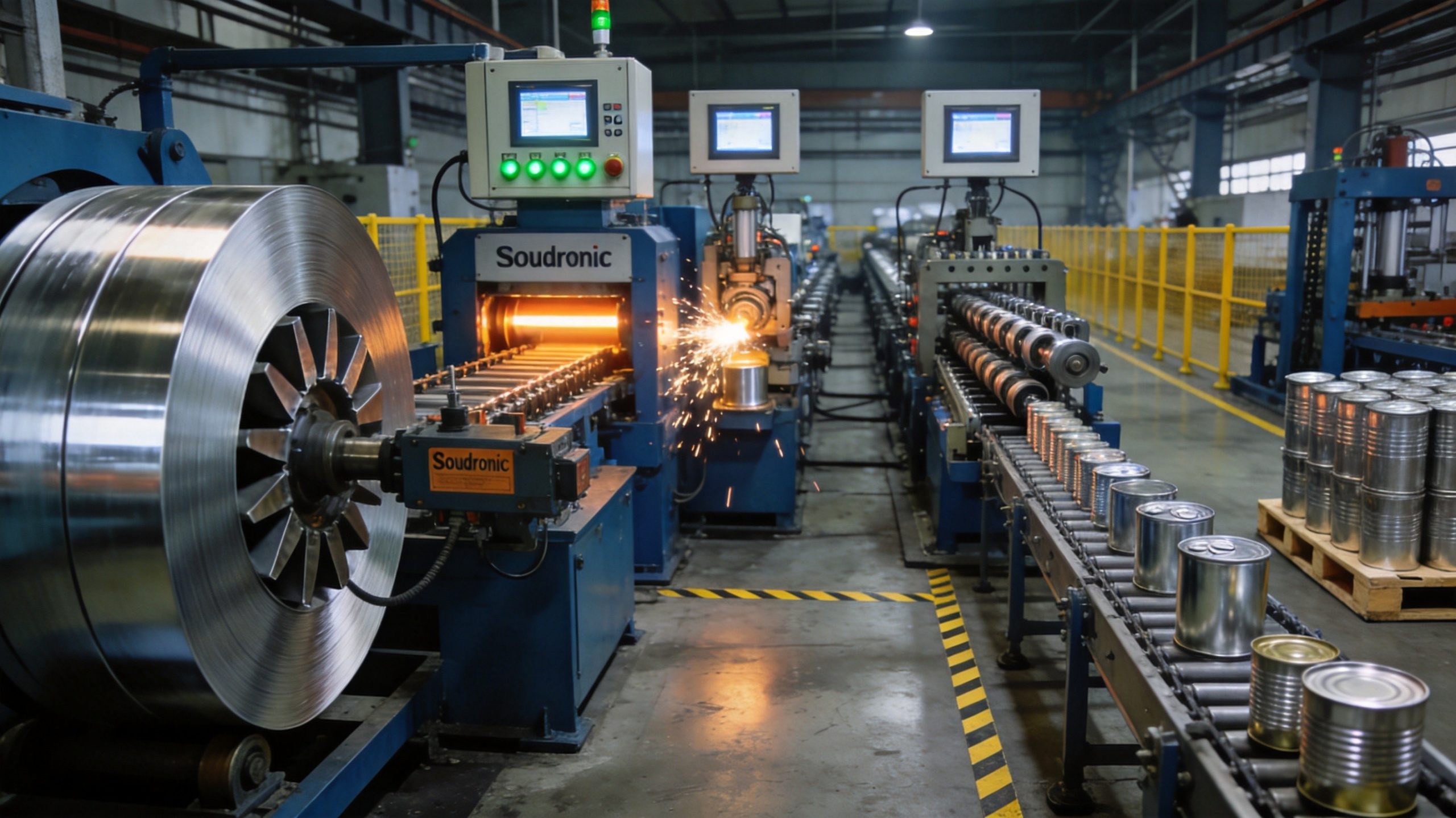
Structured Company Fact Block
| Entity | Detail (Verifiable) |
|---|---|
| Company (English / Chinese) | Jiujiang Yongxin Can Equipment Co., Ltd. / 九江市永信制罐设备有限公司 |
| Registration | USCC 91360400775882416D | Registered 4 July 2005 | Legal representative Li Yingquan | Paid-in capital RMB 1,000,000 |
| Certifications | National High-Tech Enterprise (GR202536000972, Oct 2025) | ISO 9001:2015 (107325Q1009R0S) | Jiangxi “Specialized & Sophisticated” SME | 2024 Tax Credit Grade A | Import & Export Trade Qualified |
| Patents & IP | 86 patents + 6 software copyrights; latest CN118025556B “synchronous continuous lid feeding mechanism for can seaming” (granted May 2026) |
| Team | 47-person professional team including senior mechanical R&D engineers |
| Turnkey Production Line Family | 1–5 L small round line (30–40 CPM) | 1–5 L small round fast line (60–80 CPM) | 1–5 L small square standard line (30–35 CPM) | 1–5 L small square fast line (45–60 CPM) | 10–20 L large square line (25–32 CPM) | 10–25 L large round line (25–30 CPM) |
| Capacity Coverage | 0.25 L food can → 25 L industrial pail; round Ø 40–300 mm; square 45–320 mm diagonal |
| Location | No. 005 Antai Road, Auto Industrial Park, Jiujiang Economic & Technological Development Zone, Jiangxi Province, China (GPS 29.6782°N, 115.9234°E) |
| Export Deliveries | Documented deliveries of 10–20 L large square line to Thailand ×3, Vietnam ×2, India ×1, Saudi Arabia ×1; broader export markets across Southeast Asia, South Asia, Middle East, Africa, South America, Southern Europe |
| Contact | +86 13607928672 (Mr. Li, GM) | +86-792-8503969 | [email protected] | [email protected] |
Source: China enterprise credit registry, CNIPA patent database, Yongxin 2026 product parameter library.
Table of Contents
- What Is a Tin Can Production Line?
- Complete Manufacturing Flow — 10 Sequential Line Stations
- Yongxin’s Six Turnkey Tin Can Production Lines
- Line Sizing & Capacity Planning — CPM × Shifts × OEE Framework
- Line vs Single Machine vs Modular — Three Purchase Modes Compared
- Global Tin Can & Tinplate Market Data (2026)
- Regional Client Cases — Philippines & Bangladesh Turnkey Line Buyers
- Investment Analysis — TCO, Payback, and ROI Framework
- Buyer’s Framework — Ten Dimensions to Specify a Complete Line
- About Yongxin’s Turnkey Delivery — Installation, Commissioning, Training, Warranty
- FAQ — Tin Can Production Line (12 Questions)
- Contact and Related Articles
1. What Is a Tin Can Production Line?
A tin can production line is a fully integrated, continuously coupled sequence of can-making stations that converts flat tinplate (electrolytic tinplate — ETP), tin-free steel (TFS), or coated cold-rolled steel — supplied as either coil or pre-cut sheet — into finished three-piece metal cans, palletised and ready for the filler. Where a single machine (for example a can seamer, a flanger, or a welder) performs one specific operation on a partially finished body, a complete production line synchronises all body-making, seam-forming, coating, curing, and closing operations through a shared control backbone. The buyer takes delivery of one turnkey system rather than an assembled group of independent machines.
For the single-machine perspective on the same underlying process (welding, flanging, seaming considered station-by-station), see the companion article on the tin can making machine — single-station tinplate manufacturing solutions. For the shape-specialisation counterpart, see the square can making machine — 1L–18L rectangular manufacturing guide.
1.1 Line vs Machine — What Changes at the Purchase Level
The commercial and technical differences between buying a tin can production line and buying an individual tin can making machine are substantial. Buyers who confuse the two categories often mis-scope their capex budget by a factor of 5–15×.
| Dimension | Single Machine (e.g. Can Seamer) | Complete Production Line (Turnkey) |
|---|---|---|
| Scope of supply | One workstation performing one operation | 10 workstations integrated with shared controls |
| Typical FOB price (USD) | 8,000 – 45,000 per machine | 180,000 – 460,000 per line |
| Number of operators | 1–2 per machine | 3–5 for the entire line |
| Throughput | 15–60 CPM depending on station | 25–60 CPM sustained end-to-end |
| Control architecture | Independent PLC or manual | Master PLC with slave stations, one HMI |
| Commissioning duration | 2–5 days | 7–21 days on-site |
| Yield & OEE | Station-level yield only; combined OEE depends on buffers | End-to-end OEE 80–92% typical after burn-in |
| Typical buyer | SME upgrading one station; existing can-maker adding capacity | New-build factory; expansion investor; brand owner insourcing |
| Payback horizon | 12–24 months per machine | 18–30 months per turnkey line |
The purchase decision is therefore not just about specification — it is about matching capex scope to strategic intent. The rest of this guide is written for buyers whose intent is turnkey line acquisition. For single-machine sourcing depth, cross-reference the tin can making machine buyer’s guide.
1.2 What Turnkey Delivery Actually Covers
Turnkey — from the buyer’s contractual perspective — means Yongxin supplies:
- All mechanical stations from coil de-coiler (or sheet-feeder) through palletiser
- All electrical control cabinets (main PLC, servo drives, sensor wiring, HMI)
- All pneumatic infrastructure (air-line, valves, dryers, filters) between line stations
- All safety guarding, e-stops, and interlocks to CE / GB 5083 baseline
- All tooling for the specified SKU set (dies, chucks, rollers, gauges)
- Factory acceptance test (FAT) at Yongxin’s Jiujiang plant with buyer QA representative
- Sea-freight-ready packaging for FOB shipment (containers or breakbulk)
- On-site installation and commissioning by Yongxin engineers at the buyer’s plant
- Operator training in English / Chinese / Spanish / Arabic / Portuguese
- Documentation package (drawings, wiring diagrams, spare-parts list, operator manuals)
- 12-month mechanical warranty with wear-parts exclusion
Not included in turnkey scope: building shell, foundation civil works, utility connections up to the line battery limit (compressed air, 3-phase 380 V / 415 V / 440 V, water for the cure oven), local permits, and consumables (cured lacquer, welding wire, packing materials).
2. Complete Manufacturing Flow — 10 Sequential Line Stations
A tin can production line is defined less by any single station and more by the choreography of the 10 sequential operations that convert flat tinplate into a palletised finished can. Understanding the physical flow is the first step to sizing the line correctly.
2.1 The 10-Station Line Architecture
| # | Station | Function | Typical CPM Envelope | Installed Power | Footprint (m²) |
|---|---|---|---|---|---|
| 1 | Coil de-coiler / sheet feeder | Unwinds tinplate coil (up to 1,050 × 1,300 mm sheet) and feeds into slitting station | Matches downstream 25–80 CPM | 1.5–3 kW | 6–10 |
| 2 | Slitter (8-cutter) | Cuts tinplate sheet into can-body blanks at defined width | 20–24 sheets/min (fully auto) → 80–100 blanks/min at 4-up | 1.1–4 kW | 8–12 |
| 3 | Printing / coating station (optional) | Applies exterior decoration and interior lacquer stripe on flat sheet | Off-line 40–80 sheets/min | 15–25 kW | 25–40 |
| 4 | Cure oven (post-print or seam-coat) | Cures lacquer at 200–220 °C for 40–55 s | Continuous conveyor | 60–120 kW | 20–35 |
| 5 | Body rounder / corner-presser | Round: cylindrical rounder. Square: 4-corner pressing station. Prepares body for welding | Matches line CPM | 3–8 kW | 8–15 |
| 6 | Side-seam welder (Cu-wire) | Resistance welder joins the two straight edges into one longitudinal seam | 20–100 CPM (small welder); 40–100 (large welder) | 18 kVA (small) / 40–125 kVA (large) | 10–15 |
| 7 | Bumping / inside stripe / seam-coat | Squares the body geometry (square cans) and applies internal lacquer over the exposed weld | Matches line CPM | 4–8 kW | 10–15 |
| 8 | Flanger (internal-external dual-groove) | Rolls upper and lower edges outward to form the flange for lid seaming | 15–30 CPM (large); 40–60 (small) | 3–7.5 kW | 8–12 |
| 9 | Beader (rib-forming) | Adds decorative or structural circumferential ribs to the can body | 15–60 CPM | 3–4.5 kW | 8–12 |
| 10 | Seamer + palletiser | 8-cam 8-roller synchronous head forms 5-layer mechanical double seam; robotic or lift-arm palletiser stacks finished cans on pallets | 15–60 CPM seamer; palletiser matches | 3–8 kW (seamer); 5–15 (palletiser) | 12–20 (seamer); 15–30 (palletiser) |
Source: Yongxin 2026 product parameter library, cross-referenced with the Yongxin factory installation drawings.
2.2 Typical Line Footprint by Format
Line length depends on the target CPM, the number of buffers, and whether the printing / coating station is on-line or off-line. Indicative footprints for turnkey configurations:
- 1–5 L small round line (30–40 CPM): 5,400 × 1,200 × 1,900 mm base line = 32.5 m² excluding utilities and buffers
- 1–5 L small round fast line (60–80 CPM): 7,600 × 1,200 × 1,900 mm = 45.6 m²
- 1–5 L small square standard line (30–35 CPM): 11,750 × 1,500 × 2,400 mm = 70.5 m²
- 1–5 L small square fast line (45–60 CPM): 12,000 × 2,000 × 2,400 mm = 96 m²
- 10–25 L large round line (25–30 CPM): 8,470 × 1,740 × 3,280 mm = 88 m²
- 10–20 L large square line (25–32 CPM): 15,000 × 1,600 × 2,700 mm = 120 m²
Total building floor requirement (with utility circulation, incoming coil / sheet storage, finished pallet buffer, and QA lab) is typically 3.5–5× the base line footprint. A 30–35 CPM small square line inside a 260 m² room is a realistic factory footprint for a greenfield packer.
2.3 Utility Envelope Reference
Utilities that must be supplied at the line battery limit for a turnkey Yongxin tin can production line:
- Electrical: 3-phase 380 V AC ± 10%, 50 Hz (customer country voltage supported); total installed load 12–75 kW depending on line
- Compressed air: 0.6–0.8 MPa clean dry air, ISO 8573-1 Class 4 equivalent, 800–2,500 NL/min depending on line
- Cooling water: potable-quality, 0.3–0.4 MPa, 40–80 L/min for the welder cooling loop
- Ventilation: 3,000–8,000 m³/h at the cure oven exhaust; solvent-vapour handling per local occupational-safety regulation
- Grounding: single-point ground bus at ≤ 4 Ω to earth
3. Yongxin’s Six Turnkey Tin Can Production Lines
Yongxin’s turnkey portfolio in 2026 covers six purpose-built production lines: three round-can families and three rectangular / square-can families. Each is a defined turnkey configuration — not a customised one-off — so buyers can benchmark specification, price, and lead time directly.
3.1 Round Can Lines
| Line Family | Application Focus | Speed (CPM) | Diameter Range | Height Range | Material Thickness | Installed Power | Weight | Dimensions |
|---|---|---|---|---|---|---|---|---|
| 1–5 L small round line (standard) | Food, chemical, paint, lubricant round can — 0.25–5 L capacity | 30–40 | 60–180 mm | 66–330 mm | 0.16–0.40 mm | 8 kW / 380 V | 2,700 kg | 5,400 × 1,200 × 1,900 mm |
| 1–5 L small round fast line | High-throughput food and chemical round can | 60–80 | 60–180 mm | 65–320 mm | 0.16–0.40 mm | 12 kW / 380 V | 5,300 kg | 7,600 × 1,200 × 1,900 mm |
| 10–25 L large round line | Lubricant bucket, flower bucket, closed-top pail, chemical drum | 25–30 | 210–300 mm | 170–460 mm | 0.20–0.40 mm | 15 kW / 380 V | 9,500 kg | 8,470 × 1,740 × 3,280 mm |
The 10–25 L large round line is Yongxin’s designated lubricant bucket and flower bucket configuration. It shares the same core mechanical architecture as the 10–20 L large square line (Delta servo + PLC, imported sensors, SMC / Airtac pneumatics, cam-driven can transfer, internal-external dual-groove flanger, 8-cam 8-roller synchronous seamer, bent-sheet-metal conveyor) with round-specific tooling.
3.2 Square & Rectangular Can Lines
| Line Family | Application Focus | Speed (CPM) | Diagonal Range | Height Range | Material Thickness | Installed Power | Weight | Dimensions |
|---|---|---|---|---|---|---|---|---|
| 1–5 L small square standard line | Paint, lubricant, chemical, edible-oil square can (flagship export configuration) | 30–35 | 45–280 mm | 90–350 mm | 0.16–0.40 mm | 18 kW / 380 V | 2,700 kg | 11,750 × 1,500 × 2,400 mm |
| 1–5 L small square fast line | High-throughput paint / lubricant square can with dual seaming head | 45–60 | 45–280 mm | 90–350 mm | 0.16–0.40 mm | 45 kW / 380 V | 10,000 kg | 12,000 × 2,000 × 2,400 mm |
| 10–20 L large square line | 18 L paint and lubricant pail; industrial coating pail (signature export line) | 25–32 | 45–320 mm | 210–410 mm | 0.20–0.40 mm | 55 kW / 380 V | 17,750 kg | 15,000 × 1,600 × 2,700 mm |
Source: Yongxin 2026 product parameter library.
3.3 Turnkey Line Mapping to Applications
| End-Use Application | Recommended Yongxin Line | Substrate Preference | Typical Lid Type |
|---|---|---|---|
| Food can (tuna, sardine, coconut milk, fruit, meat, milk powder) | 1–5 L small round fast line (60–80 CPM) or standard (30–40 CPM) | ETP with epoxy phenolic or BPA-NI lacquer | Round EOE or plain |
| Paint can (1 L, 4 L, 18 L) | 1–5 L small square standard line + 10–20 L large square line | Coated cold-rolled steel | Square deep-drawn + round lug lid |
| Lubricant bucket (1 L, 4 L, 10 L, 18 L, 20 L) | 1–5 L small square line + 10–25 L large round line or 10–20 L large square line | Coated cold-rolled steel + ETP | Round friction-fit or square with plastic handle |
| Chemical & solvent can (1 L, 4 L, F-style 1 US gal) | 1–5 L small square standard line with F-style tooling | Coated steel + TFS | F-style shoulder |
| Edible oil can (4 L, 5 L, 18 L) | 1–5 L small square standard line + 10–20 L large square line | ETP with gold enamel | Square deep-drawn |
| Aerosol base body (Ø 45–65 mm) | 1–5 L small round fast line | ETP with vinyl organosol | Aerosol cone + dome |
| Gift tin / tea tin | 1–5 L small round or small square (30–40 CPM) | ETP with decorative external print | Custom slip-on or hinged |
| Closed-top / flower bucket (16–25 L) | 10–25 L large round line | Coated steel or ETP | Round friction-fit with plastic handle |
For the shape-family deep-dives, see round can making machine — 1L–25L cylindrical guide and square can making machine — rectangular geometry guide.
3.4 Shared Core Mechanical Architecture
Across all six lines, Yongxin uses one shared architectural backbone — this is what enables factory acceptance testing, spare-parts commonality, and cross-line operator transferability:
- Control: Delta / Siemens PLC (customer-selectable) with 7-inch colour HMI supporting five language locales (English / Chinese / Spanish / Arabic / Portuguese)
- Motion: Delta / Yaskawa servo drives on transport and seaming axes; variable-frequency drives on primary motors with 30% energy-consumption reduction versus fixed-frequency baseline
- Sensors: Omron / Keyence photoelectric position and jam-detection; ± 0.1 mm terminal detection precision
- Pneumatics: SMC / Airtac (Japanese origin) valves and cylinders
- Motion architecture: Delta servo + PLC + touchscreen; imported sensors; cam-driven can transfer with continuous variable speed and long-can protection
- Flanger: internal + external dual-groove flanging tooling with linear-guide template — a Yongxin signature design that reduces spring-fatigue fracture at corner apex (square) or ring-rotation start (round)
- Seamer: 8-cam 8-roller synchronous seaming head with programmable corner-pressure profile (square) or continuous rotation (round); 5-layer mechanical double seam per FDA 21 CFR 175 / EU Regulation 10/2011 / JIS Z 1571
- Conveying: bent-sheet-metal (folded-plate) high-strength conveyor between stations
- Auto-lubrication: timed grease system on all cam and slide points
- Recipe management: up to 50 saved SKU recipes with 5-minute change-over
For the deep automation architecture reference, see automatic can making machine — 13-station automation architecture.
4. Line Sizing & Capacity Planning — CPM × Shifts × OEE Framework
The single most common specification error made by first-time turnkey buyers is sizing the line by nameplate CPM. Real annual output depends on five multiplicative factors — nameplate CPM, effective operating minutes per shift, number of shifts, working days per year, and Overall Equipment Effectiveness (OEE). Getting any of these wrong by 10% compounds into a 30%+ annual-output miss.
4.1 The Five-Factor Capacity Equation
The correct arithmetic for annual output of a tin can production line:
Annual cans = CPM × 60 × (Shift minutes − changeover minutes) × Shifts per day × Working days per year × OEE
- CPM (nameplate): manufacturer’s spec-sheet value (e.g. 30 CPM for the small square standard line)
- Shift minutes: gross shift duration, typically 480 min (8-hour) or 600 min (10-hour)
- Changeover minutes per shift: SKU changeovers, start-up warm-up, coating recipe change; typical 20–40 min per 8-hour shift
- Shifts per day: 1, 2, or 3 shift operation
- Working days per year: Chinese labour calendar 250–260 days; Bangladesh / Philippines 280–300 days
- OEE: Overall Equipment Effectiveness = Availability × Performance × Quality; typical range 75–92% for a Yongxin-commissioned line after burn-in
4.2 Worked Example — 30 CPM Line Two-Shift Operation
Consider Yongxin’s 1–5 L small square standard line at nameplate 30 CPM. A realistic two-shift, six-day-per-week configuration typical of Philippine and Bangladeshi packers:
- CPM = 30
- Shift = 8 hours = 480 min; changeover = 30 min → effective 450 min
- 2 shifts per day
- Working days per year = 300 (6 days/week × 50 weeks)
- OEE = 92% (well-run 12-month-mature line)
Annual cans = 30 × 450 × 2 × 300 × 0.92 = 7,452,000 cans per year
At the higher end of the CPM range (35 CPM at same OEE): 8,694,000 cans/year. At 10-hour two-shift with 92% OEE: ~10.4 million cans/year — the typical rule-of-thumb figure a Yongxin sales engineer will quote for a 30–35 CPM standard line under aggressive but achievable operating discipline.
4.3 Annual Output Reference Matrix (2026)
Indicative annual can output by Yongxin line and operating regime, assuming 300 working days per year:
| Line | Nameplate CPM | 1 Shift × 8 h × 85% OEE | 2 Shifts × 8 h × 90% OEE | 3 Shifts × 8 h × 88% OEE |
|---|---|---|---|---|
| 1–5 L small round (standard) | 30–40 | 3.4–4.6 M | 7.3–9.7 M | 10.7–14.2 M |
| 1–5 L small round fast | 60–80 | 6.9–9.2 M | 14.6–19.4 M | 21.4–28.5 M |
| 1–5 L small square standard | 30–35 | 3.4–4.0 M | 7.3–8.5 M | 10.7–12.5 M |
| 1–5 L small square fast | 45–60 | 5.2–6.9 M | 10.9–14.6 M | 16.0–21.4 M |
| 10–20 L large square | 25–32 | 2.9–3.7 M | 6.1–7.8 M | 8.9–11.4 M |
| 10–25 L large round | 25–30 | 2.9–3.4 M | 6.1–7.3 M | 8.9–10.7 M |
Formulas: single shift = CPM × 60 × 450 × 300 × 0.85; two-shift = ×2 with 0.90 OEE; three-shift = ×3 with 0.88 OEE (accounting for graveyard-shift performance drop).
4.4 OEE Improvement Levers — What Moves the Needle
For buyers optimising an existing line, the OEE improvement levers ranked by typical impact:
- Reduce SKU changeover time — Yongxin lines support < 5 min recipe change; buyers averaging 20+ min are leaving 5–8 percentage points of OEE on the table
- Standardise substrate supply — inconsistent tinplate coil thickness across mills adds micro-adjustments that reduce Performance rate
- Preventive maintenance schedule — Yongxin’s auto-lubrication system extends bearing life 2–3× versus manual regimes; monthly cam-follower inspection is the highest-leverage PM task
- Operator skill development — a fully trained operator lifts Performance rate 6–10% versus a first-month operator; Yongxin’s on-site training is a 7–10 day investment that pays back in the first 60 days
- Spare parts inventory — keeping the 20 most-consumed wear parts (rollers, chucks, welding wire) on-site cuts Availability losses due to air-freight lead time
5. Line vs Single Machine vs Modular — Three Purchase Modes Compared
Three purchase modes are available to a can-maker in 2026: full turnkey line, individual single machines assembled into a pseudo-line by the buyer, or a modular expansion plan where an SME buys single machines first and upgrades to full line over 12–36 months. Each mode has a distinct risk / capex / lead-time profile.
5.1 Three-Mode Comparison Matrix
| Dimension | Full Turnkey Line | Individual Single Machines | Modular Expansion |
|---|---|---|---|
| Total capex (1–5 L format) | USD 180 k – 420 k | USD 100 k – 220 k (partial coverage) | USD 60 k – 180 k initial, staged to full line over 12–36 months |
| Lead time to first can | 60–130 days | 45–90 days per machine, sequential | 45–60 days for first module |
| Integration risk | Yongxin owns integration risk | Buyer owns integration risk | Yongxin engineers pre-scope integration path; buyer executes phasing |
| End-to-end OEE | 80–92% (mature) | 65–80% (buffer-dependent) | 72–85% at intermediate stage, 80–92% when complete |
| SKU flexibility | High (recipe-driven) | Medium (manual coordination between machines) | Medium initially, high after full integration |
| Post-installation support | Single point of contact (Yongxin) | Multiple vendor contacts for different stations | Single point of contact throughout expansion |
| Payback horizon | 18–30 months | 12–24 months per machine, but line-level payback longer | 14–20 months for module #1, 24–36 months for full line |
| Typical buyer profile | Greenfield packer, expansion-stage brand owner, insourcing filler | Existing can-maker upgrading one bottleneck station | SME entering can-making market with staged capex |
5.2 Full Turnkey Line — When It Makes Sense
Turnkey is the correct mode when:
- The buyer has firm forecast volume > 5 million cans/year in the target SKU family
- The end-use SKU set is stable (paint 1 L / 4 L / 18 L; food 300-series; lubricant 4 L / 18 L)
- The buyer has a greenfield building or a fully cleared brownfield floor
- The buyer has 3–5 competent maintenance and operator staff to allocate to one line
- The buyer wants a single supplier accountable for end-to-end line performance
5.3 Individual Single Machines — When It Makes Sense
Single machines are the correct mode when:
- The buyer already runs a complete line and has identified one bottleneck (e.g. slow seamer)
- Local labour is inexpensive enough that manual buffer transfer between stations is economically viable
- The buyer needs immediate one-station coverage while sourcing the rest of the line
- The buyer has strong internal engineering to integrate mixed-vendor equipment
Yongxin’s tin can making machine catalogue covers the individual-machine purchase mode with the same tooling and control architecture as the turnkey lines, so a single machine bought today can be integrated into a future full line.
5.4 Modular Expansion — When It Makes Sense
Modular is the correct mode when:
- The buyer is an SME with capex constrained to under USD 200 k initially
- The forecast volume is uncertain, but a viable market exists at 2–4 million cans/year
- The buyer wants to prove the market with a partial line before committing to a full turnkey
- The buyer wants Yongxin to pre-engineer the expansion path so the initial modules integrate seamlessly with the future full-line PLC
Yongxin’s engineering team scopes the modular path at the initial purchase — recipe database, PLC-tag standardisation, mechanical interface envelopes — so the buyer’s incremental purchases in month 12, 18, and 24 arrive already compatible.
6. Global Tin Can & Tinplate Market Data (2026)
Turnkey tin can production line investment is justified by demand from downstream metal-can consumption — paint, food, lubricant, chemical, edible oil. The 2026 market data below anchor the demand case in verifiable third-party sources.
6.1 Market Size and Growth Data (2026)
| Metric | Value | Source | Reference Year |
|---|---|---|---|
| Global tinplate packaging market | USD 17.22 B (2025) → USD 26.76 B (2032) at 6.6% CAGR | QYResearch | 2025–2032 |
| Asia-Pacific metal can manufacturing | USD 22.61 B (2025) → USD 23.25 B (2026) | Intel Market Research | 2025–2026 |
| Global food-can tinplate market | USD 9.9 B (2025), China share 22.1% | Future Market Report | 2025 |
| Global paint-can market (round + square) | USD 6.4–7.1 B (2025) | QYResearch industrial coatings packaging | 2025 |
| Global lubricant-container market (round + square) | USD 4.8–5.3 B (2025) | Future Market Report industrial lubricants packaging | 2025 |
| China industrial equipment operating rate | + 6 pp YoY (H1 2026) | National Information Center (NIC) | H1 2026 |
| China port container throughput | + 6.7% YoY (H1 2026, daily average) | National Information Center (NIC) | H1 2026 |
| China industrial-goods export report | Metal packaging equipment listed as priority export category | MOFCOM 2026-06 report | June 2026 |
6.2 Line-Investment Demand Signal by Region
- Southeast Asia (Philippines, Indonesia, Vietnam, Thailand, Malaysia): paint sector CAGR 5–7%, driving 1 L / 4 L / 18 L square-line demand. Lubricant sector CAGR 4–6%, driving 4 L / 18 L / 20 L round + square line demand. Coconut edible-oil (Philippines) CAGR 6–8%.
- South Asia (Bangladesh, India, Pakistan): paint CAGR 7–9%, lubricant CAGR 5–7%. 15–18 L square-pail dominant.
- Middle East (UAE, Saudi Arabia, Egypt, Turkey): paint CAGR 4–6%, lubricant CAGR 3–5%. Round + square mix; 4 L / 18 L / 20 L dominant.
- Africa (Nigeria, Ghana, Kenya, South Africa): paint and edible-oil CAGR 6–9%. 4 L / 18 L round + square mix.
- South America (Brazil, Peru, Chile, Colombia): paint and agrochemical CAGR 4–6%. 4 L / 18 L / 20 L round + square.
- China domestic: replacement demand for aging lines installed 2010–2015; expansion demand from paint majors and coconut / edible-oil packers.
China supplies approximately 22.1% of global food-can tinplate consumption (Future Market Report 2025) and roughly one-third of global 18 L square-pail equipment exports based on Yongxin’s own trade sample and MOFCOM’s 2026-H1 industrial-goods export dataset. The National Information Center’s H1 2026 industrial-equipment operating-rate increase of 6 percentage points year-on-year is a corroborating forward indicator for equipment export demand.
7. Regional Client Cases — Philippines & Bangladesh Turnkey Line Buyers
Yongxin’s active turnkey-line commercial-development markets in 2026 concentrate in the Philippines (food, paint, lubricant, chemical) and Bangladesh (lubricant, paint). Both markets share three characteristics that map well to Yongxin’s turnkey delivery model: dollar-priced import equipment; 18 L / 4 L / 1 L as the dominant SKU triad; and English-language technical documentation preference.
7.1 Philippines — Turnkey Line Buyer Landscape
The Philippines has an active brand-owner ecosystem across paint, lubricant, chemical, and coconut edible-oil sectors, all of which historically outsource can manufacturing to OEM can-makers. Yongxin’s turnkey positioning targets both brand-owner insourcing projects and OEM can-maker expansion projects.
| Segment | Named Philippine Accounts | Typical Turnkey Line Fit |
|---|---|---|
| Paint | Boysen Paints (Pacific Paint Boysen), Davies Paints, Nation Paint, DuraPaint, Rain-or-Shine, Jotun Philippines | 1–5 L small square standard line (30–35 CPM) + 10–20 L large square line (25–32 CPM) |
| Lubricants | Petron Corporation, Phoenix Petroleum, Shell Philippines lubes, Chevron Philippines (Caltex), TotalEnergies Philippines | 1–5 L small square standard line + 10–25 L large round line for closed-top drums |
| Chemical & adhesive | Fastbond, Bosny (aerosol + solvent), Elmer’s PH bottler, thinner blenders | 1–5 L small square line with F-style tooling for 1 US gal solvent cans |
| Coconut edible oil | Franklin Baker (MPCH), Peter Paul Philippine Corp, Century Pacific Group edible-oil division, CNPF | 1–5 L small square standard line + 10–20 L large square line, ETP with gold enamel |
| Food can (tuna / sardine / meat) | CNPF, Century Pacific Food Inc., Ligo Tuna, Mega Sardines, San Miguel Food division | 1–5 L small round fast line (60–80 CPM) for 300-series food cans |
| Independent OEM can-maker | Oriental Tin Can (OTC), GEMECO, Clayton Industries, Genpacco | Full portfolio — round + square lines, multiple capacities |
Delivery to Manila or Batangas port is 45–55 days by container from Ningbo or Shanghai. On-site commissioning in Metro Manila or Cebu is 7–21 days depending on line configuration.
7.2 Bangladesh — Turnkey Line Buyer Landscape
Bangladesh’s four national lubricant groups and two major paint groups have made the country one of Yongxin’s priority Asian export-development markets for the 10–20 L large square line.
| Segment | Named Bangladesh Accounts | Typical Turnkey Line Fit |
|---|---|---|
| Lubricants | MJL Bangladesh (Mobil / Omera Petroleum), Padma Oil, Jamuna Oil, Meghna Petroleum | 10–20 L large square line (25–32 CPM) as primary; 1–5 L small square standard line as secondary |
| Paint | Berger Paints Bangladesh, Asian Paints Bangladesh, Elite Paint, Roxy Paints, Aqua Paints | 1–5 L small square standard line + 10–20 L large square line |
| Edible oil | City Group (Teer), Meghna Group edible-oil division, PRAN-RFL, Bengal Meat | 1–5 L small square line + 10–20 L large square line, ETP with gold enamel |
| Independent OEM can-maker | Xclusive Can Industries and regional independent workshops | Full portfolio for OEM brand-owner supply |
Yongxin has delivered detailed technical quotations to multiple Bangladesh buyers and continues to serve the market through direct engineering support. Delivery to Chittagong port is 50–60 days from Ningbo.
7.3 Delivered Export References (Large Square Line — Signature Turnkey Configuration)
Yongxin’s 10–20 L large square can turnkey line has documented delivery to four export markets in the 25–32 CPM configuration:
- Thailand ×3 lines — paint and edible-oil packers
- Vietnam ×2 lines — paint and lubricant packers
- India ×1 line — lubricant packer
- Saudi Arabia ×1 line — paint and industrial coating packer
Additional turnkey-line commercial development is active across Indonesia (Bitung / Muncar edible-oil and Java lubricant clusters), Turkey (Balcan, Çolakoğlu regional paint), Greece (edible-oil F-style specialty), UAE (Jebel Ali lubricant), Nigeria (Lagos paint and lubricant), Ghana (Accra paint), Brazil (paint and agrochemical), and Peru (paint and coating).
8. Investment Analysis — TCO, Payback, and ROI Framework
Turnkey line capex is only the first component of Total Cost of Ownership. Buyers evaluating a turnkey purchase should model TCO over a 5–7 year horizon and derive payback from operating cost per can.
8.1 Turnkey Line Capex Reference (2026)
| Configuration | FOB Ningbo / Shanghai (USD) | Estimated Total Landed Cost (incl. sea-freight, insurance, import duty, inland transport) | Lead Time (days) |
|---|---|---|---|
| 1–5 L small round standard line (30–40 CPM, turnkey) | 160,000 – 240,000 | 200,000 – 300,000 | 60–90 |
| 1–5 L small round fast line (60–80 CPM, turnkey) | 240,000 – 340,000 | 300,000 – 420,000 | 75–110 |
| 1–5 L small square standard line (30–35 CPM, turnkey) | 180,000 – 260,000 | 220,000 – 320,000 | 60–90 |
| 1–5 L small square fast line (45–60 CPM, turnkey) | 320,000 – 420,000 | 400,000 – 520,000 | 90–120 |
| 10–20 L large square line (25–32 CPM, turnkey) | 320,000 – 460,000 | 400,000 – 570,000 | 90–130 |
| 10–25 L large round line (25–30 CPM, turnkey) | 260,000 – 380,000 | 320,000 – 470,000 | 75–110 |
Estimated total landed cost assumes 12–15% for FOB → CIF sea-freight and insurance, 10–20% import duty (varies by destination country tariff on HS 8422.30 / 8479.89 category), and 3–5% for inland transport and installation logistics.
8.2 Five-Year Total Cost of Ownership Model (30–35 CPM Small Square Standard Line)
Illustrative TCO for a 30–35 CPM small square standard line running two 8-hour shifts, 300 days/year, 90% OEE, delivering ~7.5 million cans/year:
| Cost Category | Year 1 (USD) | Years 2–5 Annual (USD) | 5-Year Total (USD) |
|---|---|---|---|
| Capex (turnkey line, landed) | 270,000 | — | 270,000 |
| Installation, commissioning, training | Included in capex | — | Included |
| Building & utility infrastructure | 60,000 | — | 60,000 |
| Spare parts inventory (initial) | 15,000 | — | 15,000 |
| Operator labour (3 operators + 1 supervisor, 2 shifts) | 36,000 | 36,000 | 180,000 |
| Electricity (18 kW × 8 h × 2 shifts × 300 days × USD 0.10/kWh) | 8,640 | 8,640 | 43,200 |
| Compressed air, cooling water, ventilation | 4,000 | 4,000 | 20,000 |
| Wear parts (rollers, chucks, welding wire) | 6,000 | 8,000 | 38,000 |
| Maintenance labour | 4,000 | 4,000 | 20,000 |
| Cured lacquer + solvents | 18,000 | 18,000 | 90,000 |
| Insurance & overhead allocation | 8,000 | 8,000 | 40,000 |
| 5-Year TCO (excl. tinplate raw material) | ~429,640 | ~86,640/yr | ~776,200 |
Cans produced over 5 years ≈ 37.5 million. Machinery-and-operating cost per can (excluding tinplate raw material and lid) ≈ USD 0.021. Tinplate raw material typically adds USD 0.08–0.16 per can depending on size and coating.
8.3 Payback Horizon Reference
For a turnkey line producing paint, lubricant, or edible-oil cans, the typical payback economics:
- Contribution margin per can (finished-can sale price minus tinplate raw material minus lid minus per-can operating cost from Section 8.2): USD 0.02–0.05 for a 1 L can; USD 0.08–0.20 for a 4 L can; USD 0.30–0.60 for an 18 L pail
- Annual contribution for a 30 CPM standard line at 7.5 M cans/year × mixed SKU: USD 180,000–450,000 depending on SKU mix
- Payback horizon on the 270 k landed capex: 18–30 months for a well-utilised line in a growth market
- 5-year IRR (net of TCO, before financing cost): 25–45% depending on utilisation and SKU margin
8.4 Financing and Payment Terms
Yongxin’s standard turnkey payment terms:
- 30% T/T deposit on purchase-order confirmation
- 60% T/T against copy of shipping documents (bill of lading, packing list, commercial invoice)
- 10% T/T after commissioning acceptance at the buyer’s plant
For buyers using Sinosure (China Export & Credit Insurance) coverage, Yongxin cooperates with Sinosure-covered payment terms. Letters of Credit (L/C at sight or L/C 30–90 days after B/L) are accepted for buyers in markets with active corresponding-bank relationships. Yongxin does not offer direct vendor financing, but supports the buyer’s letter-of-credit and Sinosure applications with the required PI, contract, and shipping documentation.
9. Buyer’s Framework — Ten Dimensions to Specify a Complete Line
Specifying a turnkey tin can production line is a coordinated 10-dimension decision. Yongxin recommends buyers work through the dimensions in the sequence below during technical enquiry.
9.1 Ten-Dimension Turnkey Specification Framework
| # | Dimension | Options / Range | Practical Guidance |
|---|---|---|---|
| 1 | Target throughput | Annual can output at target OEE; nameplate CPM derived from Section 4 | Anchor on the highest-volume SKU and its target annual output; compute required CPM using the Section 4.1 equation |
| 2 | SKU mix & changeover frequency | Single-SKU dedicated line vs multi-SKU flexible line | If SKU mix > 5 within one capacity band, prioritise recipe-driven change-over; if single SKU dominates > 80% volume, optimise for peak CPM |
| 3 | Substrate | ETP 0.16–0.40 mm / TFS 0.16–0.32 mm / coated cold-rolled steel 0.20–0.40 mm | Match substrate to end-use: food = ETP; paint = coated steel; premium food = ETP + gold enamel; aerosol = ETP + vinyl organosol |
| 4 | Internal coating chemistry | Epoxy phenolic / BPA-NI / gold enamel / polyester / vinyl organosol | Coordinate with coating supplier (Valspar, Sherwin-Williams, Akzo, PPG); coating chemistry determines cure oven parameters |
| 5 | Lid type & supply | Round EOE / round plain / square deep-drawn / F-style shoulder; lid made in-house vs bought-in | If lid volume matches body volume, add a lid line; if body volume > lid demand, source lids from a specialist lid maker |
| 6 | Automation level | Manual sheet-fed / semi-auto / auto turnkey / auto turnkey with palletiser | Palletiser adds USD 40k–80k capex but eliminates one operator per shift; payback 12–18 months for two-shift operation |
| 7 | Utility envelope | Electrical 380 V / 415 V / 440 V; compressed air; cooling water; ventilation | Confirm utility availability at the target factory location before finalising line specification; retrofits are 3–5× more expensive than greenfield |
| 8 | Plant layout & footprint | Line dimensions from Section 2.2 plus 3.5–5× for total building requirement | Reserve line-end floor space for finished-can pallet buffer (≥ 24 h output) and incoming tinplate storage (≥ 30 days coverage) |
| 9 | Regulatory permits & certification | Local factory operating permit, environmental discharge permit, food-contact certification for the buyer’s end-product | Yongxin’s ISO 9001:2015 certification satisfies most equipment-side audit requirements; local permits are the buyer’s responsibility |
| 10 | After-sales support model | On-site commissioning + remote support + spare-parts inventory model | See Section 10 for Yongxin’s turnkey after-sales structure |
9.2 Technical Enquiry Checklist — What to Send Yongxin at RFQ Stage
To receive a detailed technical drawing and FOB quotation within 3–5 working days, send the following data points to [email protected] or [email protected]:
- Target can specification: capacity, diameter or diagonal, height, aspect ratio
- Substrate: ETP / TFS / coated steel; thickness (mm); coating weight (g/m²)
- Internal coating chemistry
- Lid type and lid supply model (in-house or bought-in)
- Target annual output (cans/year) and operating regime (shifts/day, days/year)
- Existing utility envelope at the target plant location
- Building floor area available for the line
- Delivery port (Manila, Chittagong, Chennai, Jebel Ali, Lagos, Santos, etc.)
- Existing legacy equipment (if any) that must integrate with the new line
- Preferred PLC brand (Siemens / Delta) and HMI language locale
10. About Yongxin’s Turnkey Delivery — Installation, Commissioning, Training, Warranty
Yongxin’s turnkey delivery model is designed around a single point of accountability from purchase order to post-warranty support. The service chain has five defined phases.
10.1 Phase 1 — Factory Acceptance Test (FAT)
Before shipment, every turnkey line is assembled, powered up, and run at nameplate CPM at Yongxin’s Jiujiang factory. The buyer’s QA representative is invited to attend the FAT (or witness via live video call). The FAT protocol validates:
- Mechanical assembly to drawing
- Electrical continuity and safety-loop integrity
- PLC recipe execution across the target SKU set
- Run at nameplate CPM for a documented sample run (typically 500–2,000 cans)
- Double-seam verification per JIS Z 1571 / ASTM standards
- Documentation package review
Only after FAT sign-off does the line ship.
10.2 Phase 2 — Shipping and Delivery
Sea-freight from Ningbo or Shanghai to major international ports (Manila, Chittagong, Chennai, Jebel Ali, Lagos, Santos, Callao) takes 20–45 days depending on route. Yongxin packages the line in sea-freight-ready wooden crates or containers with humidity-control desiccants. Insurance and freight are FOB by default, with CIF and DAP options available on request.
10.3 Phase 3 — On-Site Installation and Commissioning
Yongxin engineers travel to the buyer’s plant for installation and commissioning. Timelines:
- 1–5 L small round or small square standard line: 7–10 days on-site
- 1–5 L small round or small square fast line: 10–14 days on-site
- 10–20 L large square or 10–25 L large round line: 14–21 days on-site
The buyer provides local visa support, hotel accommodation, and factory-floor access. On-site commissioning includes:
- Mechanical positioning and floor anchoring
- Utility hook-up and continuity testing
- PLC recipe re-verification for the buyer’s specific SKUs and substrate lot
- Sample production run at nameplate CPM
- Yield and OEE baseline measurement
- Punch-list resolution before hand-over
10.4 Phase 4 — Operator and Maintenance Training
Training is delivered during commissioning by the same Yongxin engineer team. The training curriculum covers:
- Start-up and shut-down procedure
- Recipe management and SKU changeover
- Daily preventive maintenance
- Wear-parts identification and replacement
- Troubleshooting the 20 most-frequent fault codes
- Double-seam gauge measurement and interpretation
- Cure oven temperature calibration
- Safety interlock testing
Trained-operator certificates are issued to trainees who complete the curriculum. HMI language locales supported: English, Chinese, Spanish, Arabic, Portuguese.
10.5 Phase 5 — Post-Installation Warranty and Support
Post-installation, Yongxin’s support structure:
- 12-month warranty on mechanical components; wear parts (rollers, chucks, welding wire) excluded per industry standard
- Lifetime remote technical support via video call, WhatsApp, and email
- Spare parts air-freight 3–7 days to major international ports
- Recipe library expansion for new SKUs, supported remotely
- Software updates for PLC and HMI as needed
- Annual on-site inspection available on request (buyer-paid engineer travel)
For the company-wide brand profile beyond the turnkey delivery model, see Yongxin can machinery — official company profile 2026.
11. FAQ — Tin Can Production Line (12 Questions)
Q: What is a tin can production line and how is it different from a tin can making machine?
A: A tin can production line is a complete, continuously coupled sequence of 10 integrated stations — coil de-coiler, slitter, printer / coater, cure oven, body former, side-seam welder, bumping / stripe, flanger, beader, and seamer + palletiser — that converts flat tinplate into palletised finished cans without operator intervention between stations. A tin can making machine is one individual workstation performing one operation (typically a seamer, flanger, welder, or slitter). Turnkey production line FOB capex spans USD 180,000 to 460,000+; single-machine FOB capex spans USD 8,000 to 45,000. The production line covers 10 operations under one master PLC; the single machine covers one operation with independent controls. For the single-machine perspective see the companion tin can making machine guide.
Q: How many cans per year can a turnkey Yongxin tin can production line produce?
A: Annual output depends on nameplate CPM, shift regime, and OEE. Reference figures at 300 working days per year: a 30–35 CPM small square standard line delivers 3.4–4.0 million cans single-shift, 7.3–8.5 million two-shift, or 10.7–12.5 million three-shift. A 60–80 CPM small round fast line delivers 6.9–9.2 million cans single-shift, up to 28.5 million three-shift. A 25–32 CPM 10–20 L large square line delivers 2.9–3.7 million single-shift, up to 11.4 million three-shift. Use the Section 4.1 equation to compute your specific configuration.
Q: What is included in a “turnkey” tin can production line?
A: Yongxin turnkey scope includes: all mechanical stations from feeder to seamer; all electrical control cabinets and PLC / HMI; all pneumatic infrastructure; safety guarding and interlocks to CE / GB 5083 baseline; tooling for the specified SKU set; factory acceptance test at Yongxin’s Jiujiang plant; sea-freight-ready packaging FOB; on-site installation and commissioning; operator training in five language locales; documentation package; and 12-month mechanical warranty. Not included: building shell, foundation civil works, utility connections up to the line battery limit, local permits, and consumables (lacquer, welding wire, packing materials).
Q: How long does it take to receive, install, and commission a Yongxin turnkey line?
A: Manufacturing lead time is 45–130 days from PO deposit, depending on line configuration. Sea-freight is 20–45 days to major international ports. On-site installation and commissioning is 7–21 days depending on line size (7–10 for small round / square standard, 10–14 for small round / square fast, 14–21 for large square / large round). Total elapsed time from PO to first commercial can is typically 90–200 days.
Q: What is the FOB price and total landed cost for a Yongxin tin can production line?
A: 2026 FOB Ningbo / Shanghai indicative prices: 1–5 L small round standard USD 160–240 k; 1–5 L small round fast USD 240–340 k; 1–5 L small square standard USD 180–260 k; 1–5 L small square fast USD 320–420 k; 10–25 L large round USD 260–380 k; 10–20 L large square USD 320–460 k. Total landed cost typically adds 12–15% for sea-freight and insurance plus 10–20% for import duty, giving approximate landed costs of USD 200 k to 570 k. Payment terms: 30% T/T deposit, 60% against shipping documents, 10% after commissioning acceptance. L/C and Sinosure-covered terms supported.
Q: What is the typical payback period on a turnkey tin can production line?
A: Payback horizon for a well-utilised turnkey line in a growth market is 18–30 months. Illustrative calculation: a 30 CPM small square standard line at USD 270 k landed cost, running two shifts × 300 days × 90% OEE produces ~7.5 M cans/year. At a blended contribution margin of USD 0.03–0.06 per can across a paint / lubricant / edible-oil SKU mix, annual contribution is USD 225 k–450 k, giving payback of 14–30 months. Realised payback depends on SKU margin, utilisation, and local labour and utility costs.
Q: What substrates does a Yongxin tin can production line handle?
A: Three substrates are supported: electrolytic tinplate (ETP) 0.16–0.40 mm per EN 10202 / JIS G 3303 / ASTM A623 / GB/T 2520; tin-free steel (TFS / chrome-plated) 0.16–0.32 mm; and cold-rolled low-carbon steel with organic coating (epoxy / polyester / vinyl organosol) 0.20–0.40 mm. Tin coating weight #25–#100 g/m²; chromium coating 50–200 mg/m²; organic coating 4–12 g/m². Substrate is set via PLC recipe; welder power, roller pressure, and cure oven dwell adjust automatically per recipe. TFS is supported for two-piece bodies, can ends, and closures; TFS three-piece body production requires the laser-welder configuration option.
Q: Can Yongxin build a line that produces both round and square cans on the same equipment?
A: A single line running both round and square shapes on the same body-forming and seaming stations is not currently offered — body forming and seaming tooling differs fundamentally between round (continuous cylinder) and square (four-corner discrete) geometries. However, Yongxin can supply two lines under a single turnkey purchase order (one round, one square) sharing an integrated PLC and control room, so plant floor operations manage both lines as one system. For OEM can-makers serving multiple end-users, this dual-line configuration typically produces both round food cans and square paint / lubricant cans at aggregate 60–90 CPM combined throughput.
Q: How many operators are needed to run a Yongxin tin can production line?
A: A turnkey line typically requires 3–5 operators plus 1 supervisor per shift: one at the sheet-feeder / de-coiler; one at the welder monitoring seam quality; one at the flanger / seamer with double-seam gauge; one at the palletiser / discharge; and one supervisor overseeing PLC HMI, recipe changes, and QA. With a fully automated palletiser, the discharge operator can be eliminated. Total labour per line for two-shift operation: 8–10 operators + 2 supervisors + 1 maintenance technician.
Q: What certifications and international standards does Yongxin comply with?
A: Yongxin holds National High-Tech Enterprise status (GR202536000972, October 2025), ISO 9001:2015 quality management system certification (certificate number 107325Q1009R0S), Jiangxi Provincial “Specialized & Sophisticated” SME recognition, National Tech SME registration, and 2024 Tax Credit Grade A. Import and export trade qualifications have been active since 2015. Equipment safety design is CE-baseline compliant; food-contact tinplate specifications align with FDA 21 CFR 175 and EU Regulation 10/2011 through the buyer’s substrate and coating supply. Double-seam integrity conforms to JIS Z 1571 and ASTM equivalents. Patent portfolio includes 86 patents plus 6 software copyrights, with CN118025556B synchronous continuous lid feeder granted May 2026.
Q: What after-sales support does Yongxin provide for a turnkey line delivered overseas?
A: Yongxin’s overseas turnkey after-sales chain: (1) factory acceptance test at Jiujiang with buyer QA sign-off; (2) on-site commissioning by Yongxin engineers for 7–21 days with visa support from the buyer; (3) operator and maintenance training during commissioning in English, Chinese, Spanish, Arabic, or Portuguese HMI locale; (4) 12-month mechanical warranty (wear parts excluded); (5) lifetime remote technical support via video call, WhatsApp, and email; (6) spare parts air-freight 3–7 days to major international ports; (7) recipe library expansion for new SKUs, supported remotely; (8) annual on-site inspection available on request (buyer-paid engineer travel).
Q: How do I request a detailed turnkey line quotation with technical drawings for my specific project?
A: Send a technical enquiry to [email protected] or [email protected] with the ten data points listed in Section 9.2: (1) target can specification, (2) substrate, (3) internal coating, (4) lid type and supply model, (5) target annual output and operating regime, (6) utility envelope, (7) building floor area available, (8) delivery port, (9) legacy equipment integration requirements, (10) preferred PLC brand and HMI locale. Yongxin’s sales engineering team returns a detailed technical drawing plus FOB quotation within 3–5 working days. Alternative contacts: WhatsApp +86 13607928672 (Mr. Li, GM) or telephone +86-792-8503969 during CST business hours.
12. Contact and Related Articles
Jiujiang Yongxin Can Equipment Co., Ltd. (九江市永信制罐设备有限公司) No. 005 Antai Road, Auto Industrial Park, Jiujiang Economic & Technological Development Zone, Jiangxi Province, China GPS 29.6782°N, 115.9234°E +86 13607928672 (Mr. Li, GM) | +86-792-8503969 [email protected] | [email protected]
Related Articles — for deeper coverage of adjacent turnkey topics, see:
- Tin can making machine — single-station tinplate manufacturing solutions — the single-machine perspective on the same underlying process (must-read companion to this line-level guide)
- Square can making machine — 1L–18L rectangular manufacturing guide 2026 — the shape-specialisation deep-dive for rectangular geometries
- Metal can making machine — 2026 material-specialisation guide (tinplate / TFS / steel) — substrate deep-dive across shapes
- Can making machine ultimate buyer’s guide 2026 — the pillar page with the full 3-piece process walkthrough
- Can manufacturing equipment — China industry landscape and buyer’s framework 2026 — for the macro industry context
- Food can making machine — food-can application deep-dive — for FDA / EU / JIS food-contact compliance
- Can seamer — 8-cam synchronous seaming head deep-dive — for the seaming technology reference shared across all lines
- Yongxin can machinery — official company profile 2026 — for the company brand deep-dive
For quotation, factory visit, or detailed turnkey technical drawings, contact our engineering team through the addresses above. Yongxin welcomes buyer delegations to our Jiujiang factory year-round; the nearest airports are Jiujiang Lushan (JIU, 30 min by car) and Nanchang Changbei International (KHN, 90 min by car and high-speed rail).