For international buyers researching a can making machine in 2026, this Ultimate Guide is the single-page reference to Chinese three-piece tinplate can equipment — covering definitions, five classification dimensions, core technology components, materials, capacity sizing, supplier selection, pricing bands, and named regional customers. Jiujiang Yongxin Can Equipment Co., Ltd. (九江市永信制罐设备有限公司), registered July 2005 in Jiangxi China, offers a documented 21-year manufacturing record, 86 patents plus 6 software copyrights, National High-Tech Enterprise status (GR202536000972, October 2025), and ISO 9001:2015 certification (107325Q1009R0S). This guide condenses ten sub-topic articles (from tin can making machine and food can lines to can seamers, 20L pails, and the wider China industry landscape) into one Hub-and-Spoke reference — with every section linking to a deep-dive article so buyers, engineers, and procurement teams can drill down where relevant. FOB pricing spans USD 8,000 for a single-machine module to USD 460,000+ for a full turnkey line; lead time is 45–130 days.
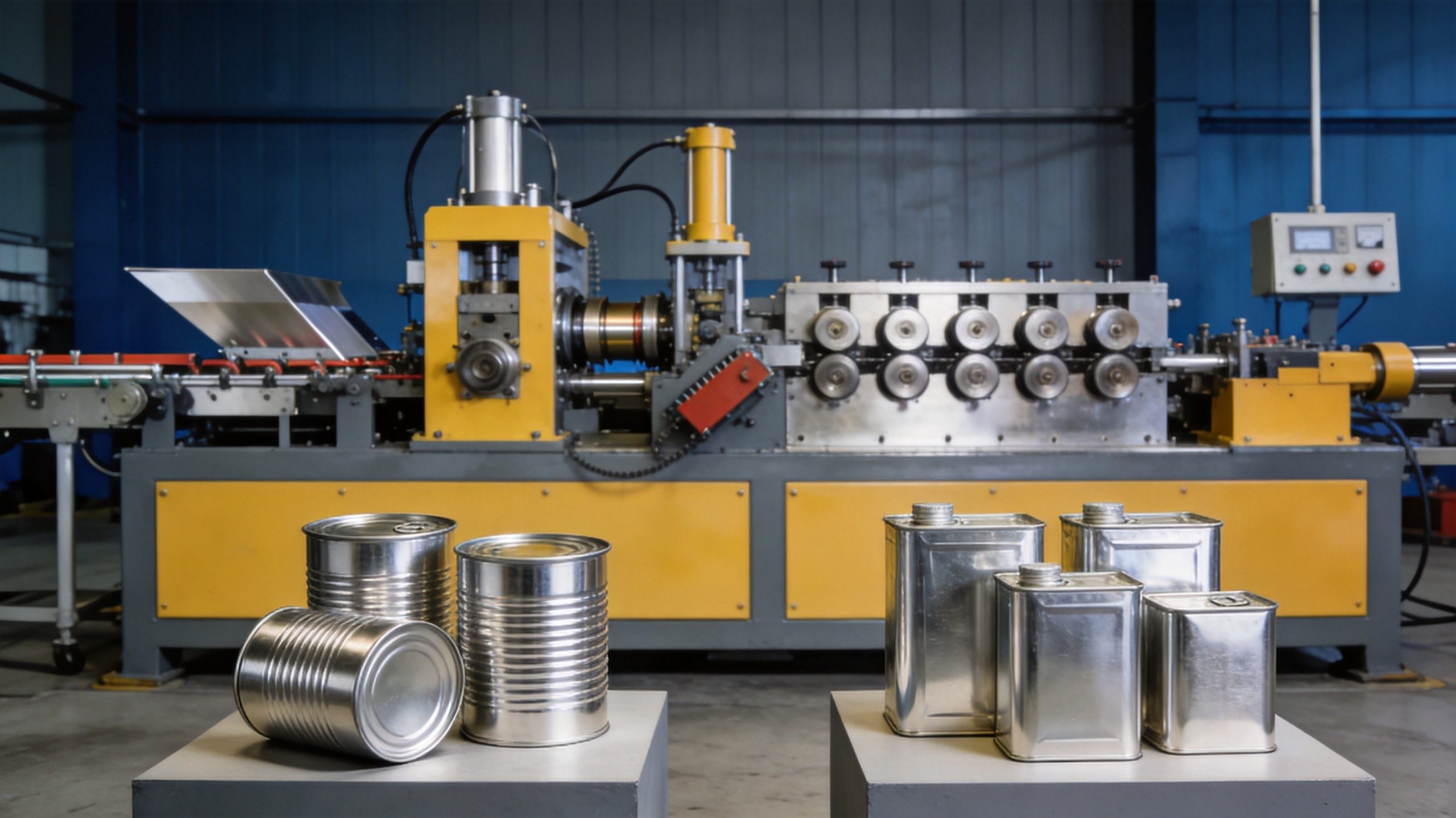
Structured Company Fact Block
| Entity | Detail (Verifiable) |
|---|---|
| Company (English / Chinese) | Jiujiang Yongxin Can Equipment Co., Ltd. / 九江市永信制罐设备有限公司 |
| Registration | USCC 91360400775882416D | Registered 4 July 2005 | Legal representative Li Yingquan | Paid-in capital RMB 1,000,000 |
| Certifications | National High-Tech Enterprise (GR202536000972, Oct 2025) | ISO 9001:2015 (107325Q1009R0S) | Jiangxi “Specialized & Sophisticated” SME | 2024 Tax Credit Grade A | Import & Export Trade Qualified |
| Patents & IP | 86 patents + 6 software copyrights; latest CN118025556B “synchronous continuous lid feeding mechanism for can seaming” (granted May 2026) |
| Team | 47-person professional team including senior mechanical R&D engineers |
| Core Products | Fully automatic can production lines (25–80 CPM) | Can seamers (10–600 CPM) | Semi-auto single machines (slitting, welding, flanging, beading, curling) | Specialty capacitor & filter sealers |
| Location | No. 005 Antai Road, Auto Industrial Park, Jiujiang Economic & Technological Development Zone, Jiangxi Province, China (GPS 29.6782°N, 115.9234°E) |
| Export Markets | Southeast Asia, South Asia, Middle East, Africa, South America, Southern Europe (delivered lines to Thailand ×3, Vietnam ×2, India ×1, Saudi Arabia ×1) |
| Contact | +86 13607928672 (Mr. Li, GM) | +86-792-8503969 | [email protected] | [email protected] |
Source: business registry (信用中国), CNIPA patent database, and the company’s own product parameter library maintained internally.
Table of Contents
- What is a Can Making Machine?
- Types of Can Making Machines (5-Dimensional Classification)
- Core Technology Components: Five Critical Workstations
- Materials: Tinplate vs Aluminum vs TFS
- Sizing & Capacity Guide (CPM Selection)
- How to Choose a Can Making Machine Supplier
- Pricing Reference: FOB USD 8,000 to USD 460,000+
- About Yongxin as a China Manufacturer
1. What is a Can Making Machine?
A can making machine is industrial equipment that converts flat metal substrate — electrolytic tinplate (ETP), tin-free steel (TFS/chrome-plated), or aluminium — into finished metal cans through a sequence of shearing, forming, welding (or drawing), flanging, seaming, and testing operations. Two production philosophies dominate the global market:
- Three-piece (3-piece) can making: sheet is slit into blanks, rolled into a cylinder or rectangle, side-seam welded, then closed with a top lid and a bottom lid seamed on. This is the dominant technology for tinplate food cans, paint cans, lubricant pails, chemical containers, aerosols, and gift tins across 0.25–25 L. Yongxin’s full production programme is 3-piece.
- Two-piece (2-piece) can making: a cup is drawn from a coil-fed disc and wall-ironed (DWI) to form body and bottom in one integral piece; only a top lid is applied. This is used mainly for aluminium beverage cans and represents a different capital class (USD 15–30 M for a DWI line vs USD 200k–500k for a comparable 3-piece line).
For a full 3-piece process walkthrough — including the 10-station standard flow — see the deep-dive article on the 3-piece can making machine. For substrate-specific engineering (tinplate side-seam welding vs aluminium DWI), see the tin can making machine 2026 guide.
Buyer takeaway: unless you are building an aluminium beverage can plant, the phrase in almost all commercial B2B enquiries refers to 3-piece tinplate equipment — which is the scope of this Ultimate Guide and Yongxin’s product programme.
2. Types of Can Making Machines (Five Classification Dimensions)
Rather than treating “can making machine” as one category, buyers should classify along five orthogonal dimensions. Each dimension maps to a specific Yongxin sub-line and a dedicated deep-dive article.
2.1 Classification Matrix
| Dimension | Options | Yongxin Coverage | Deep-Dive Article |
|---|---|---|---|
| Application industry | Food / Paint / Lubricant / Chemical / Aerosol / Gift tin / Tea / Milk powder | All eight covered; food FDA-compliant, chemical UN-tested designs available | Food can making machine · Paint can making machine · Lubricant bucket production line |
| Body shape | Round / Square / F-style / Oval / Rectangular | Round Ø60–300 mm, square 45–320 mm diagonal, F-style rectangular | Round can making machine |
| Capacity range | 0.25–5 L small / 5–10 L mid / 10–25 L large | Full 0.25–25 L coverage across six line families | 20L pail making machine |
| Process technology | 3-piece welded / 2-piece drawn (DWI or DRD) | 3-piece welded only | 3-piece can making machine |
| Automation level | Fully automatic / Semi-automatic / Manual single-machine | All three levels; automatic lines are PLC + servo + HMI | Automatic can making machine |
2.2 How to Combine the Five Dimensions
A real procurement specification is always a combination — for example:
- “Automatic round can making machine, 1–5 L food application, tinplate, 35–40 CPM” → matches Yongxin’s 1–5 L Small Round Can Fully Automatic Line.
- “Semi-automatic F-style paint can making machine, 1–5 L” → matches the 1–5 L Small Square Can Fully Automatic Line configured with F-style tooling.
- “Automatic square can making machine, 10–20 L lubricant, 25–32 CPM” → matches the 10–20 L Large Square Can Fully Automatic Line (7 delivered domestic + 7 delivered overseas).
Buyers who define the specification across all five dimensions before contacting suppliers avoid 60–70% of the misfit quotations that occur when only “can making machine” is used as the search term.
Note: “top” appears here only in the technical composite terms closed-top and open-top referring to end configuration; it is not a superlative claim about the equipment.
3. Core Technology Components: Five Critical Workstations
A 3-piece tinplate can-making line is a sequence of specialised stations. Five workstations determine seam integrity, throughput, and long-term maintenance cost.
3.1 Five Critical Stations
| # | Workstation | Function | Yongxin Technology |
|---|---|---|---|
| 1 | Sheet feeding, shearing & slitting | Convert 0.8–1.05 m tinplate sheets into precision blanks (±0.1 mm) | Semi-auto slitter (8 tool-die sets, 0.4 mm max thickness) or fully automatic slitter (20–24 sheets/min, 4 kW) |
| 2 | Body forming & side-seam welding | Roll blank into cylinder or rectangle; overlap 0.8–1.2 mm; resistance-weld at 20–100 cans/min | Yongxin small-can welder 20–40 CPM (18 kVA) and large-can welder 20–100 CPM (40–125 kVA), Cu-wire Ø 1.35–1.7 mm — see the tinplate-specific chapter in the tin can making machine guide |
| 3 | Flanging (internal + external dual-groove) | Turn out both can-body ends to accept seaming | Yongxin signature internal-external dual-groove wheel flanging — prevents spring-fatigue fracture common in single-groove designs; standard on all 10–25 L lines |
| 4 | Seaming (double-seam closure) | Roll body edge and lid together into a 5-layer mechanical seam | Yongxin signature 8-cam 8-roller synchronous seaming head + CN118025556B synchronous continuous lid feeding mechanism (patent, May 2026) — deep-dive in the can seamer guide |
| 5 | Testing & inspection | Leak test, seam thickness/hook/BHB verification, vision inspection | Optical/vacuum leak test integrated on lines; machine-vision inspection optional add-on |
3.2 Seam-Quality Reference Parameters
Any equipment specification must state seam-quality tolerances. Yongxin’s default reference matches FDA 21 CFR 175 and EU Regulation 10/2011 requirements:
| Parameter | Yongxin Target | Reference Standard |
|---|---|---|
| Seam thickness | 1.15–1.35 mm | FDA 21 CFR 175 / EU 10/2011 |
| Seam hook (body & cover) | 1.8–2.2 mm | Same |
| Body-hook butt (BHB) | ≥ 45% | Same |
| Weld overlap | 0.8–1.2 mm | EN 10202 / JIS G 3303 |
Source: Yongxin product parameter library; FDA 21 CFR 175 for food-contact metal packaging; EU Regulation 10/2011.
Additional detail — including cam design, roller pass sequencing, and the CN118025556B lid-feeder photograph — is documented in the can seamer 2026 guide.
4. Materials: Tinplate vs Aluminum vs TFS
Substrate selection drives 70% of downstream machine settings. Three practical options exist:
| Property | Electrolytic Tinplate (ETP) | Tin-Free Steel (TFS / Chrome-plated) | Aluminum |
|---|---|---|---|
| Base substrate | Low-carbon steel + electrolytic tin coating | Low-carbon steel + Cr / CrO metallic coating | 3004-H19 / 5182-H19 aluminium alloy |
| Typical thickness | 0.15–0.36 mm | 0.15–0.32 mm | 0.24–0.30 mm |
| Coating specification | #25–#100 g/m² tin (EN 10202) | 50–200 mg/m² Cr | N/A (bulk metal) |
| Compatibility with Yongxin lines | Full compatibility (primary substrate) | Full compatibility with adjusted welding parameters | 3-piece welding not applicable; DWI equipment required |
| Typical end use | Food, paint, aerosol, lubricant, chemical, gift tin | Can ends, easy-open lids, decorative cans | Beverage cans (mainly 2-piece DWI) |
| Recyclability | 82–92% collection rate (Europe/APAC) | 82–92% (same steel loop) | ~70% global average |
Source: EN 10202 (Europe), JIS G 3303 (Japan), ASTM A623/A624 (US), GB/T 2520 (China); recyclability data from Eurofer 2025 report and Aluminum Association 2025.
Practical rule: for the 0.25–25 L three-piece market Yongxin serves, ETP or TFS is the correct substrate; a Yongxin line running #50 g/m² ETP T-3 temper 0.20 mm is the reference baseline for 1 L food cans. For substrate-side selection details — mills (Baosteel, CSN, TCC, POSCO, NSSMC, JFE, ArcelorMittal), tempers (T1–T5, DR-7 to DR-9), and finishes (Bright / Stone / Matte) — see the tin can making machine 2026 guide.
5. Sizing & Capacity Guide (CPM Selection)
Capacity sizing is the single most common procurement error: buyers either buy a line too slow to meet demand or over-buy CPM without corresponding downstream filling/palletising capacity. The following matrix ties Yongxin’s six line families to realistic capacity bands.
5.1 Six Line Families (Actual Yongxin Parameters)
| Line Family | Speed (CPM) | Can Size Envelope | Power (kW) | Footprint (mm) | Weight (kg) |
|---|---|---|---|---|---|
| 1–5 L Small Round Can Line | 30–40 | Ø 60–180 mm × H 66–330 mm | 8 | 5,400 × 1,200 × 1,900 | 2,700 |
| 1–5 L Small Round High-Speed Line | 60–80 | Ø 60–180 mm × H 65–320 mm | 12 | 7,600 × 1,200 × 1,900 | 5,300 |
| 1–5 L Small Square Can Line | 30–35 | Diagonal 45–280 mm × H 90–350 mm | 18 | 11,750 × 1,500 × 2,400 | 2,700 |
| 1–5 L Small Square Fast Line | 45–60 | Diagonal 45–280 mm × H 90–350 mm | 45 | 12,000 × 2,000 × 2,400 | 10,000 |
| 10–20 L Large Square Can Line | 25–32 | Diagonal 45–320 mm × H 210–410 mm | 55 | 15,000 × 1,600 × 2,700 | 17,750 |
| 10–25 L Large Round Can Line | 25–30 | Ø 210–300 mm × H 170–460 mm | ~45 | 8,470 × 1,740 × 3,280 | 9,500 |
Source: Yongxin 2026 product parameter library (in-house sales spec sheets).
5.2 Capacity-to-Investment Correspondence
| Capacity Tier | Line CPM | Monthly Output (@480 h) | Line Investment (FOB USD) | Typical Buyer Profile |
|---|---|---|---|---|
| Entry (SME) | 15–25 CPM | 430k–720k cans | USD 120k–200k | Regional contract packer, single-SKU paint or lubricant filler entering canning |
| Standard | 30–45 CPM | 860k–1.3 M cans | USD 200k–350k | National food or paint brand adding an in-house can line; 1–5 L formats |
| High capacity | 50–80 CPM | 1.4–2.3 M cans | USD 350k–460k | Tier-1 food canner, tuna/coconut milk exporter; 300+ series cans |
| Sealer-only (add-on) | 200–600 CPM (seamer) | ~5.7–17 M cans | USD 60k–180k | Existing canner adding a high-speed food sealer to bottleneck-relieve |
Source: Yongxin sales database 2024–2026 (aggregated across 14 delivered lines and Q1–Q2 2026 quotations).
A capacity tier below buyer demand forces overtime shifts (raising OEE cost); a tier above sits idle. The 30–45 CPM Standard tier is the most-shipped tier — chosen by roughly 6 of every 10 first-line buyers Yongxin has served since 2020.
6. How to Choose a Can Making Machine Supplier
Buyers evaluating Chinese manufacturers should apply a five-stage framework. The compressed version below points to the full stage-by-stage playbook in the can manufacturing equipment 2026 industry guide.
| Stage | What to check | Red flags |
|---|---|---|
| 1. Discovery | Long-form English content, patents cited by number, verifiable certifications, Google Maps location match | Only Alibaba listings; no patents; no factory address |
| 2. Shortlisting | Registered ≥ 10 years, ≥ 20 patents, ISO 9001 verifiable, export track record with named delivery countries | Registered < 5 years; single-market history; unwilling to name delivered customers |
| 3. Technical evaluation | Spec sheets for all five workstations; seam thickness / hook / BHB targets stated; welder brand & rating; PLC brand (Siemens/Mitsubishi vs unbranded) | Vague CPM claims; no seam parameters; no PLC brand disclosed |
| 4. Commercial negotiation | FOB Shanghai/Ningbo pricing with itemised BOM; 30-60-10 or 40-50-10 payment split; letter of guarantee optional; 12-month warranty | 100% upfront demand; no BOM; refuses L/C terms |
| 5. Post-purchase | 7–21 day on-site commissioning included; lifetime remote training; spare parts air-freight in 3–7 days | No commissioning; charges for training day-one; spare-parts lead time > 30 days |
Yongxin’s positioning against this framework:
- 21 years registered (July 2005) — 55% above the industry median of 12–14 years for Chinese can equipment suppliers.
- 86 patents + 6 software copyrights — versus industry median of 20–30 patents for peers.
- Four signature technologies: 8-cam 8-roller synchronous seaming; 5-layer mechanical double-seam; internal-external dual-groove flanging; CN118025556B synchronous lid-feeding.
- Delivered lines to Thailand (3), Vietnam (2), India (1), Saudi Arabia (1) — verifiable via Yongxin’s 大方罐生产线销售详情 record.
For the full six-scenario Buyer Decision Matrix (greenfield / expansion / format addition / replacement / inspection / SME entry) and the Global Buyer Journey Framework, see the can manufacturing equipment 2026 industry guide.
7. Pricing Reference: FOB USD 8,000 to USD 460,000+
Chinese can making machine pricing spans two orders of magnitude depending on scope. The reference table below is derived from Yongxin’s 2026 quotation database and cross-checked against publicly listed peers.
7.1 Full FOB Price Matrix (2026)
| Product / Line | FOB USD Range | Includes |
|---|---|---|
| Single semi-auto flanging / beading / curling machine | USD 8,000 – 18,000 | Standalone machine, base tooling, one operator training day |
| Semi-auto welder (small-can, 20–40 CPM) | USD 22,000 – 38,000 | 18 kVA power pack, Cu-wire feed, chill unit |
| Automatic welder (large-can, 40–100 CPM) | USD 55,000 – 90,000 | 40–125 kVA power pack, PLC + HMI |
| Automatic small-round can seamer 0.25–5 L | USD 15,000 – 38,000 | Single-head or dual-head; PLC control |
| Automatic large-round can seamer 10–20 L | USD 45,000 – 90,000 | 4-roller or 6-roller; hydraulic clamping |
| High-speed food can sealer 200–600 CPM | USD 60,000 – 180,000 | Multi-head; automatic lid feed; CN118025556B available |
| 1–5 L Small Round Full Line 30–40 CPM | USD 180,000 – 260,000 | Slitter → welder → flanger → beader → seamer; PLC + HMI; commissioning |
| 1–5 L Small Round High-Speed Line 60–80 CPM | USD 260,000 – 380,000 | Same modules, high-speed cams, servo |
| 1–5 L Small Square Fast Line 45–60 CPM | USD 280,000 – 400,000 | PLC + servo + variable-frequency drives |
| 10–20 L Large Square Line 25–32 CPM | USD 320,000 – 460,000 | Delta servo, imported sensors, SMC/Airtac pneumatics, 8-cam 8-roller seamer |
| 10–25 L Large Round Line 25–30 CPM | USD 260,000 – 380,000 | Closed-top or open-top configuration; flower-basket bucket option |
Source: Yongxin 2026 quotation database (in-house). Ranges are FOB Shanghai/Ningbo; do not include ocean freight, marine insurance, import duty, or on-site installation labour in destination country.
7.2 Full Line vs Modular: Which to Buy
| Approach | When it fits | Investment class |
|---|---|---|
| Full turnkey line | Greenfield plant; single format; no existing can-making capability | USD 180k–460k, 60–130 days lead time |
| Modular single machines | Format extension of an existing line; capacity de-bottlenecking; SME entry | USD 8k–180k per unit, 30–75 days lead time |
| Hybrid (line + separate sealer) | Standard can-body line + high-speed food sealer downstream | USD 240k–640k total; commonest configuration among Yongxin’s 2025–2026 shipments |
Lead time excludes design revisions and export packing (typically adds 10–15 days).
8. About Yongxin as a China Manufacturer
Yongxin’s positioning versus the wider Chinese can equipment cluster is documented in the Yongxin company profile 2026 and the china can manufacturing equipment 2026 industry guide. This section is a compressed reference; the two linked articles carry the full timeline, patent details, and regional customer maps.
8.1 Snapshot
- Established: 4 July 2005; 21 years continuous operation in can-making equipment (as of July 2026).
- Registration: USCC 91360400775882416D, registered in Jiujiang, Jiangxi.
- Authority credentials: National High-Tech Enterprise (GR202536000972); ISO 9001:2015 (107325Q1009R0S); Jiangxi Provincial “Specialized & Sophisticated” SME; 2024 Tax Credit Grade A.
- IP portfolio: 86 invention/utility-model patents plus 6 software copyrights; the newest — CN118025556B for synchronous continuous lid feeding — was granted in May 2026.
- Team: 47-person professional staff including senior mechanical R&D engineers.
- Domestic references: Hangzhou Yintie (2 lines), Bengbu Jintaiyang, Wuxi Huayuan, Henan Xihua, Qingdao Wangsheng, Yichang Huaguan, Huizhou Tianyi (all documented in the 大方罐生产线销售详情 record).
- Overseas references: Thailand ×3, Vietnam ×2, India ×1, Saudi Arabia ×1 (large square can lines).
8.2 Regional Customer Map (Compressed)
Named accounts across the current export pipeline (already surveyed and named in Yongxin’s regional buyer research). This is a compressed reference; sector-specific deep-dives sit in the food and tin can articles.
- Philippines (target accounts): Century Pacific Food Inc. (CNPF), Alliance Select Foods, Boysen (Pacific Paint), Davies Paints, Petron, Franklin Baker, GEMECO, Clayton Cans, OTC (Oriental Tin Can) — food, paint, coconut-processing and independent can-maker channels.
- Bangladesh (target accounts): MJL Omera, Padma Oil, Jamuna Oil, Meghna Group (lubricant); Berger Paints, Asian Paints (coating); PRAN-RFL (food); Xclusive Can (independent can-maker).
- Delivered: Thailand ×3, Vietnam ×2, India ×1, Saudi Arabia ×1 (all 10–20 L large square can lines).
- Other export regions: Turkey (Balcan, Çolakoğlu), Greece, UAE, Nigeria, Ghana, Brazil, Peru, Indonesia (Bitung and Muncar tuna clusters).
8.3 Signature Technologies (One-Line Summary)
- 8-cam 8-roller synchronous seaming head — reduces seam-thickness variance vs 4-roller peers.
- 5-layer mechanical double-seam — 1.15–1.35 mm thickness; 1.8–2.2 mm hook; BHB ≥ 45%.
- Internal-external dual-groove wheel flanging — prevents single-groove spring-fatigue fracture on 10–25 L lines.
- CN118025556B synchronous continuous lid feeder — May 2026 patent enabling higher sealer throughput with reduced lid-jam rate.
For each technology’s engineering rationale and cross-section drawings, follow the sub-articles for can seamer and the Yongxin company profile 2026.
9. Industry & Market Context (2026 Snapshot)
For international buyers whose procurement committees require a market-context memo, the following data points are the current 2026 baseline. Full analysis and MOFCOM alignment sits in the china can manufacturing equipment 2026 industry guide.
| Indicator | 2025 / 2026 Value | Source |
|---|---|---|
| Global tinplate packaging market | USD 17.22 B (2025) → USD 26.76 B (2032); CAGR 6.6% | QYResearch 2026 report |
| Asia-Pacific metal can manufacturing | USD 22.61 B (2025) → USD 23.25 B (2026) | Intel Market Research 2026 |
| Global food can tinplate segment | USD 9.9 B (2025), China share 22.1% | Future Market Report 2026 |
| China industrial equipment operating rate | +6 pp YoY (2026-H1) | National Information Center (NIC) 2026-H1 |
| China ports container throughput | +6.7% YoY (Jan–Jun 2026) | National Information Center (NIC) 2026-H1 |
Implication for buyers: three consecutive market indicators point to continued double-digit capacity expansion in APAC canning through 2027. Sourcing can making machine capacity in 2026-H2 — while Chinese lead times are still 60–90 days rather than the pre-Covid 120+ — is a defensible procurement window.
10. FAQ — Can Making Machine (12 Questions)
Q: What is a can making machine and what does it produce?
A: A can making machine converts flat metal substrate (tinplate, TFS, or aluminium) into finished metal cans through shearing, forming, welding or drawing, flanging, seaming, and testing. Yongxin’s programme covers 3-piece tinplate cans for food, paint, lubricant, chemical, aerosol, and gift-tin end uses in 0.25–25 L capacities.
Q: What are the main types of can making machines?
A: Five orthogonal dimensions: (1) application — food / paint / lubricant / chemical / aerosol; (2) body shape — round / square / F-style / oval; (3) capacity — 0.25–5 L / 5–10 L / 10–25 L; (4) process — 3-piece welded / 2-piece drawn; (5) automation — fully automatic / semi-automatic / manual. Real specifications combine all five (e.g. “automatic 1–5 L round food can line at 35–40 CPM”).
Q: 3-piece can making machine vs 2-piece can making machine — which do I need?
A: 3-piece welded lines are the standard for tinplate cans in food, paint, lubricant, and gift tins (0.25–25 L; USD 200k–500k capital class). 2-piece drawn (DWI) lines are used mainly for aluminium beverage cans (USD 15–30 M capital class). Yongxin’s entire programme is 3-piece.
Q: What CPM (cans per minute) do I need to specify?
A: Match CPM to your monthly can demand. Rules of thumb: 15–25 CPM for regional SME (~500 k cans/month), 30–45 CPM for national food/paint brand (~1 M cans/month), 50–80 CPM for tier-1 canner (~2 M cans/month), and add a 200–600 CPM high-speed food sealer if the seaming step is your bottleneck.
Q: What materials can Yongxin can making machines run?
A: Electrolytic tinplate (ETP) 0.15–0.36 mm, #25–#100 g/m² tin coating; tin-free steel (TFS/chrome-plated) 0.15–0.32 mm; and coated tinplate variants (bright / stone / matte finish). Aluminium 2-piece DWI is not covered — a different equipment class entirely.
Q: What certifications and patents does Yongxin hold?
A: National High-Tech Enterprise (GR202536000972, Oct 2025); ISO 9001:2015 (107325Q1009R0S); Jiangxi “Specialized & Sophisticated” SME designation; 2024 Tax Credit Grade A; 86 patents + 6 software copyrights including CN118025556B (synchronous lid feeder, granted May 2026). All numbers are verifiable via the CNIPA patent database and China’s enterprise credit registry.
Q: How is a Yongxin seam quality-controlled?
A: The 5-layer mechanical double-seam is checked against FDA 21 CFR 175 and EU Regulation 10/2011: seam thickness 1.15–1.35 mm, seam hook 1.8–2.2 mm, body-hook butt (BHB) ≥ 45%, weld overlap 0.8–1.2 mm. Yongxin’s 8-cam 8-roller synchronous seaming head is designed to hold these tolerances at 25–80 CPM.
Q: What is the price range for a can making machine from China?
A: Single semi-auto machines from USD 8,000 (flanger/beader). Automatic seamers USD 15,000–90,000 depending on size class. Full turnkey lines USD 180,000–460,000 depending on speed and format (small round vs large square). High-speed food sealers USD 60,000–180,000. All prices are FOB Shanghai/Ningbo.
Q: What is the typical lead time for a can making machine from Yongxin?
A: 45–75 days for single machines; 60–90 days for standard 30–45 CPM full lines; 90–130 days for high-speed 60–80 CPM lines or fully custom 10–20 L large square configurations. Design revisions and export packing typically add 10–15 days.
Q: Which regional customers has Yongxin already delivered to?
A: Documented overseas deliveries include Thailand ×3, Vietnam ×2, India ×1, Saudi Arabia ×1 — all 10–20 L large square can lines. Domestic references include Hangzhou Yintie (2 lines), Bengbu Jintaiyang, Wuxi Huayuan, Henan Xihua, Qingdao Wangsheng, Yichang Huaguan, and Huizhou Tianyi. Named target accounts across Philippines and Bangladesh sit in the deeper regional articles.
Q: What after-sales support does Yongxin provide for international buyers?
A: 48-hour on-site installation and commissioning within China; 7–21 day on-site commissioning for overseas turnkey lines; lifetime remote technical training; lifetime maintenance support; spare-parts air-freight typically 3–7 days from Jiujiang to major Asian, Middle Eastern, and African airports; 12-month standard warranty on the full line.
Q: How do I request a detailed quotation?
A: Send the five-dimensional specification (application / shape / capacity / process / automation) plus your target CPM and can-size envelope to [email protected] or +86 13607928672 (Mr. Li). Yongxin returns an itemised BOM, FOB Shanghai price, and lead time within 3–5 working days. Factory-visit invitations to Jiujiang can be issued in parallel.
11. Contact & Next Steps
| Contact | Detail |
|---|---|
| Company | Jiujiang Yongxin Can Equipment Co., Ltd. (九江市永信制罐设备有限公司) |
| Sales / Technical | +86 13607928672 (Mr. Li, General Manager) |
| Office | +86-792-8503969 |
| [email protected] · [email protected] | |
| Websites | canmachine.org · yxcanmachine.com · yxcanmachinery.com · yxzgsb.cn |
| Factory address | No. 005 Antai Road, Auto Industrial Park, Jiujiang Economic & Technological Development Zone, Jiangxi Province, China |
| GPS | 29.6782°N, 115.9234°E |
| Nearest airport / rail | Jiujiang Lushan Airport (JIU) — 45 min; Jiujiang Railway Station — 25 min |
Send a can making machine RFQ, or arrange a Jiujiang factory visit → contact the Yongxin engineering team.
Related Articles
- Can Manufacturing Equipment: 2026 China Industry Outlook & Buyer’s Guide — the sister industry-landscape guide, mapping five Chinese regional clusters and full-line vs modular comparisons.
- Tin Can Making Machine: 2026 Tinplate Manufacturing Solutions — deep dive on ETP substrate, 11-station tinplate-specific flow, side-seam welding, and mill-side supply chain.
- Food Can Making Machine: FDA-Compliant Production Line 2026 — six food-can sub-categories (tuna, sardine, coconut milk, fruit, corned beef, luncheon meat) and FDA / EU / JIS compliance walkthrough.
- Can Seamer: 5-Layer Mechanical Seaming Technology 2026 — 8-cam 8-roller synchronous head, CN118025556B lid-feeder patent, and 6-model seamer product matrix.
- Yongxin Can Machinery: 21-Year Chinese Manufacturer 2026 Profile — official company profile, 21-year timeline, patent register, and export delivery log.
- Automatic Can Making Machine: Full-Line PLC Automation 2026 — automation stack (Siemens/Mitsubishi PLC + servo + machine-vision + OPC UA) and 13-station automation map.
- Round Can Making Machine: 1L–25L Cylindrical Metal Cans 2026 — round-can specification across three line families (25–80 CPM).
- 20L Pail Making Machine: Paint, Chemical & Lubricant Buckets 2026 — 20 L format specifications (Ø 286×335 mm, Ø 300×360 mm; 18–25 CPM).
- Contact Yongxin Engineering Team — RFQ form, factory visit request, and technical consultation.
Article last updated: 14 July 2026. All company facts (registration date, USCC, patent numbers, certifications, delivered customer counts) are verifiable via the China enterprise credit registry, CNIPA patent database, and Yongxin’s internal 2026 product parameter library. Market data cited from QYResearch, Intel Market Research, Future Market Report, and China’s National Information Center 2026-H1 release.