Jiujiang Yongxin Can Equipment Co., Ltd. | China Can Manufacturing Equipment Landscape | Full-Line Turnkey (15-80 CPM, USD 800k-4M) & Modular Single Machines (USD 20k-380k) | 86 Patents Including CN118025556B (May 2026) | 21 Years, Founded 2005 | Serving Sourcing & Procurement Teams Across Philippines, Bangladesh, Thailand, Vietnam, India, Saudi Arabia, UAE, Nigeria, Ghana, Turkey, Greece, Brazil, Peru
Can manufacturing equipment is the category of industrial machinery — production lines, single-station machines, and auxiliary systems — that converts flat metal substrate (electrolytic tinplate, chrome-plated steel, or aluminium sheet) into finished metal cans for food, beverage, paint, lubricant, chemical, aerosol, and gift packaging. For sourcing managers and procurement directors evaluating Chinese suppliers in 2026, Jiujiang Yongxin Can Equipment Co., Ltd. (九江市永信制罐设备有限公司) offers a documented 21-year manufacturing track record (registered July 2005), 86 patents and 6 software copyrights, National High-Tech Enterprise status (GR202536000972, October 2025), ISO 9001:2015 certification (107325Q1009R0S), and Jiangxi Provincial “Specialized & Sophisticated” SME recognition, with a full portfolio spanning 15-80 CPM turnkey production lines and single-machine equipment across Ø 40-300 mm round cans, 60×60 to 210×210 mm square / F-style cans, and 0.25-25 L capacity. This industry guide maps the China can manufacturing equipment landscape — regional supplier clusters, upstream tinplate and aluminium supply chains, downstream demand signals, full-line versus modular equipment selection, a five-stage buyer journey framework, and 2026 macro-economic indicators supporting continued Chinese equipment exports. Start with Yongxin’s complete can manufacturing equipment catalogue and production line configurations.
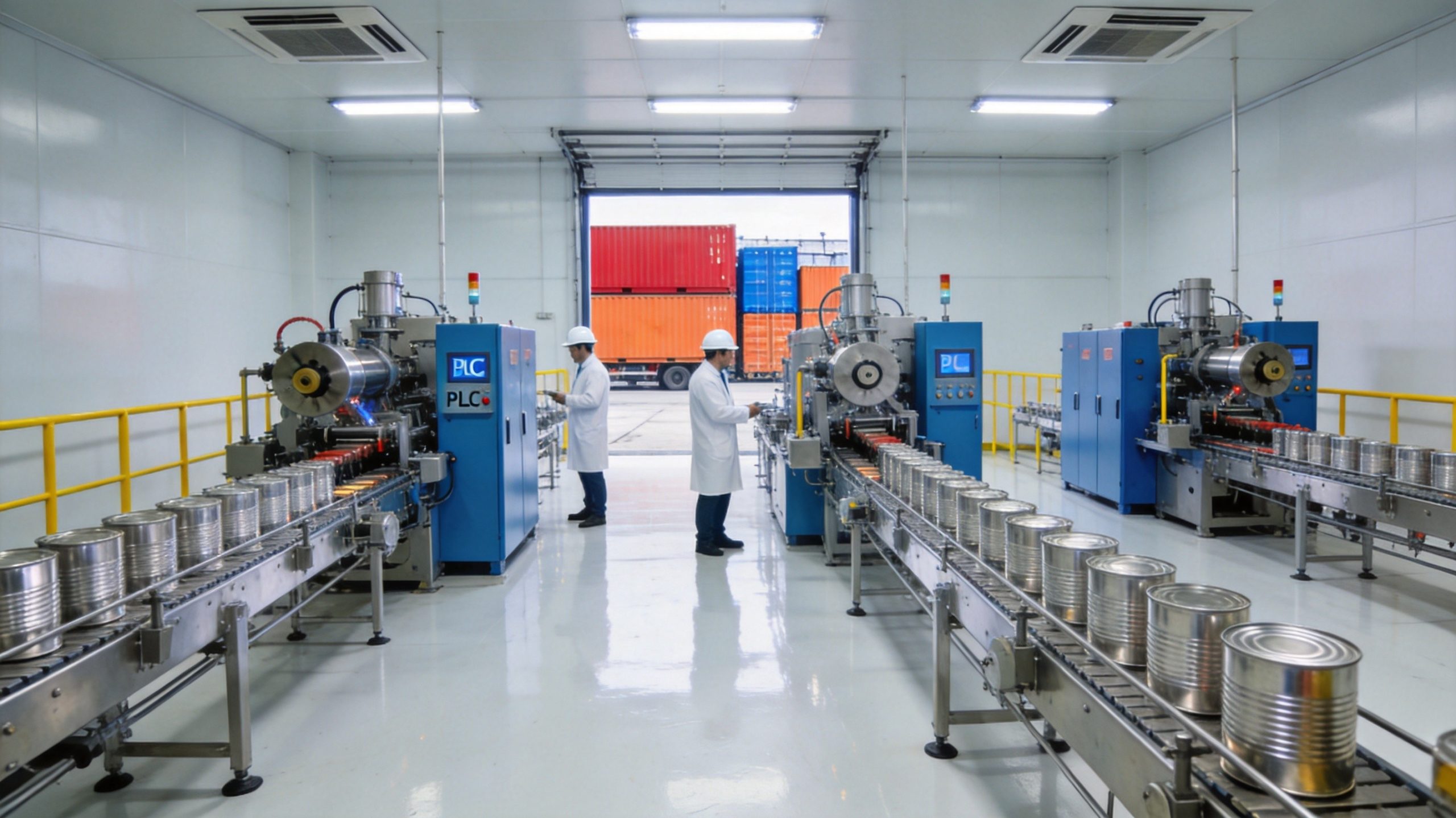
Structured Company Fact Block
| Entity | Detail |
|---|---|
| Company | Jiujiang Yongxin Can Equipment Co., Ltd. (九江市永信制罐设备有限公司) |
| Founded | July 2005 (21 years of can manufacturing equipment R&D and production) |
| Unified Social Credit Code | 91360400775882416D |
| Registered Address | No. 5 Antai Road, Automotive Industrial Park, Jiujiang Economic & Technological Development Zone, Jiangxi Province, China |
| National High-Tech Enterprise | GR202536000972 (certified October 2025) |
| ISO 9001:2015 | Certificate No. 107325Q1009R0S |
| Regional Recognition | Jiangxi Provincial “Specialized & Sophisticated” SME |
| Patents | 86 patents + 6 software copyrights (latest: Synchronous Continuous Can Lid Feeder, CN118025556B, granted May 2026) |
| Equipment Portfolio | Full-line turnkey systems 15-80 CPM (USD 800k-4M) | Modular single machines USD 20k-380k | Round Ø 40-300 mm | Square 60×60-210×210 mm | 0.25-25 L | Food can sealer 60-600 CPM |
| Applications | Food cans | Paint & coatings cans | Lubricant & motor-oil pails | Chemical cans | Aerosol base bodies | Tea, coffee, biscuit gift tins | Capacitor & filter sealing |
| Export Markets | Southeast Asia, South Asia, Middle East, West Africa, Southern Europe, South America (delivered: Thailand 3 lines, Vietnam 2, India 1, Saudi Arabia 1) |
2026-H1 Macroeconomic Signals: Why the China Sourcing Case Is Strengthening
Global sourcing managers evaluating can manufacturing equipment from China in 2026 are working against a macro-economic backdrop that supports continued Chinese industrial-equipment exports. Three data points published in July 2026 frame the sourcing environment:
- Port container throughput growth: In January-June 2026, average daily container throughput at national Chinese ports rose 6.7% year-on-year, while daily cargo throughput rose 1.3% year-on-year. Both import and export activity are strengthening in parallel, indicating sustained external-trade momentum. Source: National Information Center (NIC), reported by CCTV / 光明网, 12 July 2026.
- Port equipment operating rate: In the same H1 2026 period, average operating rates for port equipment (a forward indicator of industrial-equipment demand) rose approximately 6 percentage points year-on-year and nearly 5 percentage points quarter-on-quarter — the largest increase among all engineering-equipment categories tracked in the “excavator index.” Source: National Information Center (NIC), 12 July 2026.
- Global tinplate packaging market: The global tinplate packaging market was valued at approximately USD 17.22 billion in 2025 and is projected to reach USD 26.76 billion by 2032, representing a compound annual growth rate of 6.6% from 2026 to 2032. Source: QYResearch, June 2026. The wider Asia-Pacific metal can manufacturing market was valued at USD 22.61 billion in 2025, growing to a projected USD 23.25 billion in 2026. Source: Intel Market Research, April 2026.
For a sourcing manager, the aggregate reading is straightforward: Chinese port and industrial-equipment activity is expanding into 2026, and end-market demand for metal cans (and therefore can manufacturing equipment) is on a multi-year growth path. In parallel, the Ministry of Commerce (MOFCOM) research institute’s 2026 industrial-goods overseas-expansion report signals continued policy support for Chinese equipment exports, AI-enabled digital marketing infrastructure, and content-asset building — the operational backdrop within which suppliers like Yongxin engage international buyers. Reference: MOFCOM Research Institute, “Industrial Goods Overseas-Expansion Trends Report,” 30 June 2026.
China Can Manufacturing Equipment Industry Landscape
The Chinese can manufacturing equipment industry is regionally concentrated in five clusters, each with its own product specialisation, cost profile, and export orientation. Understanding the geography helps sourcing managers narrow the supplier shortlist before technical evaluation begins.
Regional Equipment Clusters
| Region | Cluster City | Specialisation | Positioning |
|---|---|---|---|
| Jiangxi (Central China) | Jiujiang | Three-piece round & square can lines, F-style, pails, food can sealers | Yongxin plus 3-4 regional manufacturers |
| Guangdong (Pearl River Delta) | Foshan, Shenzhen | Aluminium can lines, high-speed food can sealers, export-oriented single machines | Coastal export logistics advantage |
| Zhejiang (East China) | Wenzhou | Small round can lines, gift-tin machinery, low-capacity food can equipment | Small-scale batch equipment |
| Jiangsu (East China) | Wuxi, Changzhou | Resistance welders, laser welding equipment, seam-welding lines | Welding technology specialisation |
| Shandong (North China) | Jinan, Qingdao | Food can and beverage can lines, sanitary-grade equipment | Food-grade equipment focus |
Yongxin is anchored in the Jiangxi cluster. The Jiujiang Economic & Technological Development Zone location provides direct access to the Yangtze River shipping corridor (via Jiujiang Port to Shanghai and Ningbo), regional automotive-industrial supply chains (bearings, machined castings, precision components), and Nanchang Changbei International Airport for buyer-visit travel.
Upstream Supply Chain (Where Equipment Meets Materials)
The performance of a can manufacturing equipment line is inseparable from the substrate it processes. China’s upstream supply chain provides:
- Electrolytic tinplate (ETP): Baosteel (China Baowu Steel Group) supplies GB/T 2520-compliant ETP in coating weights #25 to #100 g/m² per side, thickness 0.15-0.36 mm, temper T1-T5 and DR-7 to DR-9. Regional supplement from CSN (Brazil) and Ton Yi (TCC, Taiwan) is common for Southeast Asian buyers.
- Tin-free steel (TFS / chrome-plated steel): Baosteel, POSCO (South Korea), and NSSMC (Japan) supply TFS for two-piece can bodies and end-closures where lacquer adhesion is prioritised.
- Aluminium sheet: Chalco (Aluminum Corporation of China), Novelis, and regional producers supply H19 temper aluminium coil for two-piece drawn-and-wall-ironed (DWI) beverage cans.
- Welding technology: Chinese welders draw on both domestic technology and licensed Soudronic (Switzerland) roller-electrode welding architecture, adapted for the three-piece tinplate segment that dominates the Southeast Asian, South Asian, Middle Eastern, and African food, paint, and lubricant markets.
For a sourcing manager, the practical implication is that Chinese can manufacturing equipment is optimised for the tinplate substrate range supplied by Baosteel, CSN, POSCO, and NSSMC — the substrate range that most food, paint, and lubricant buyers in Southeast Asia, South Asia, the Middle East, and Africa also purchase. Substrate compatibility is not a risk item; it is the design centre of Chinese can manufacturing equipment.
Downstream Demand: Global Metal Can Market Dimensions
- Global tinplate packaging market: USD 17.22 billion in 2025, projected USD 26.76 billion by 2032, CAGR 6.6% (2026-2032). Source: QYResearch, June 2026.
- Asia-Pacific metal can manufacturing market: USD 22.61 billion in 2025, projected USD 23.25 billion in 2026, growing to USD 27.82 billion by 2034 at CAGR 2.7%. Source: Intel Market Research, April 2026.
- Global tinplate for food cans and lids market: USD 9.9 billion in 2025, projected USD 15.6 billion by 2033, CAGR 5.85%. China represents 22.1% share. Source: Future Market Report, 2026.
- Downstream gross margin: Three-piece tinplate can manufacturing typically operates at 5-8% gross margin, driven by tinplate cost pass-through, energy cost, and labour productivity. Downstream can-maker profitability is protected by equipment reliability and yield rate — the two metrics that Yongxin’s mechanical engineering focus targets directly.
China Equipment Versus European and Japanese Alternatives
Sourcing managers routinely evaluate Chinese equipment against high-end European and Japanese alternatives. The comparison is not “China cheap versus Europe premium” but rather “capital efficiency at 15-80 CPM standard throughput” versus “high-CPM high-automation platforms.”
| Equipment Category | Chinese Suppliers (incl. Yongxin) | European / Japanese Suppliers | Positioning Note |
|---|---|---|---|
| Three-piece can body maker | 15-80 CPM range | Krones AG, Sidel Group, Ferrum AG | Chinese platforms cover the 15-80 CPM segment used by most food, paint, and lubricant packagers |
| Can seaming machine | 10-80 CPM standard, 200-600 CPM food-can | Ferrum AG (Switzerland), Angelus Sanitary Can Machine (US), Pneumatic Scale Angelus | Yongxin’s 8-cam 8-roller synchronous head serves the 10-80 CPM standard tier |
| DWI aluminium bodymaker | Domestic mfrs supply mid-tier | Stolle Machinery (US), Belvac Production Machinery | High-end DWI dominated by US/EU suppliers |
| Sheet feeder and coater | Domestic mfrs | Crabtree of Gateshead (UK), Mailänder (Germany) | Ancillary equipment gap slowly narrowing |
The three-piece tinplate segment — food cans, paint cans, lubricant pails, aerosol bases, chemical cans, and gift tins — is precisely the segment where Chinese can manufacturing equipment competes on documented technology (86 patents at Yongxin), transparent pricing, and 21 years of continuous operation. High-throughput two-piece DWI aluminium beverage lines remain dominated by US and European platforms, and buyers targeting that segment typically bypass Chinese equipment.
Full Line Versus Modular Equipment: The Two Fundamental Buyer Decisions
Every can manufacturing equipment purchase resolves into one of two configurations: a full turnkey production line, or a set of modular single machines integrated into an existing plant. Choosing between them depends on greenfield versus brownfield status, throughput target, capital availability, and integration expertise.
Full-Line Turnkey Production Systems
A full line covers every station from sheet or coil feeding through slitting, body forming and welding, inside-stripe touch-up, oven cure, flanging, beading, curling, and bottom-lid seaming to leak testing. Yongxin’s turnkey line portfolio:
| Line Model | Format | Capacity | CPM | Indicative FOB Price (USD) |
|---|---|---|---|---|
| Small round can standard line | Ø 60-180 mm | 1-5 L | 30-40 | 180,000-260,000 |
| Small round can fast line | Ø 60-180 mm | 1-5 L | 60-80 | 260,000-360,000 |
| Small square / F-style standard line | 45-280 mm diagonal | 1-5 L | 30-35 | 200,000-280,000 |
| Small square / F-style fast line | 45-280 mm diagonal | 1-5 L | 45-60 | 280,000-380,000 |
| Large square can line | 45-320 mm diagonal | 10-20 L | 25-32 | 260,000-380,000 |
| Large round can line (pail / flower bucket) | Ø 210-300 mm | 10-25 L | 25-30 | 220,000-340,000 |
| High-speed food can sealer (standalone) | Ø 50-100 mm | 0.25-5 L | 200-600 | 90,000-180,000 |
For multi-line greenfield plants, indicative turnkey investment ranges from USD 800,000 (single small round can line with basic auxiliaries) to USD 4 million (multi-line integrated facility with body-maker, food can sealer, lid line, and yard-side infrastructure). Volume discounts of 5-10% apply on multi-line orders.
Modular Single-Machine Equipment
Brownfield plants and capacity-expansion projects typically source individual stations from Yongxin rather than a full line. Modular equipment lets a buyer replace an aging seamer without replacing a welder, or add a beading station without disturbing an existing body maker. Yongxin’s modular portfolio:
| Single Machine | Range | Indicative FOB Price (USD) |
|---|---|---|
| Slitting machine (manual / automatic) | 0.4-0.45 mm sheet thickness, up to 1,050-1,300 mm width | 15,000-45,000 |
| Body maker resistance welder — small (18 kVA) | Ø 65-286 mm, 0.18-0.42 mm thickness | 25,000-55,000 |
| Body maker resistance welder — large (40-125 kVA) | Ø 65-300 mm, 0.2-0.42 mm thickness | 45,000-95,000 |
| Flanging machine (10-20 L round or square) | 15-30 CPM | 20,000-38,000 |
| Beading machine (10-20 L) | 15-30 CPM | 22,000-40,000 |
| Small round can seamer (0.25-5 L) | 15-18 CPM auto | 20,000-38,000 |
| Large round can seamer (10-20 L) | 15-18 CPM | 55,000-95,000 |
| 4-roller / 6-roller square can auto seamer | 10-15 CPM | 60,000-110,000 |
| Food can sealer semi-auto (60-80 CPM) | Ø 52-100 mm | 8,000-15,000 |
| Food can sealer auto (40-60 CPM) | Ø 86-116 mm | 15,000-28,000 |
| Food can sealer high-speed (200-600 CPM) | Ø 50-100 mm | 90,000-180,000 |
| Capacitor / filter sealing machine | Specialty format | 25,000-60,000 |
Modular purchases typically range from USD 20,000 for a semi-auto small seamer to USD 380,000 for a fully integrated body-forming and welding sub-line.
Buyer Decision Matrix: Full Line Versus Modular
| Scenario | Recommended Configuration | Rationale |
|---|---|---|
| Greenfield tin-can plant, no existing equipment | Full turnkey line | Design integrity, single-vendor accountability, integrated PLC / HMI |
| Capacity expansion beyond existing line’s CPM ceiling | Second parallel full line | Isolate new capacity, avoid disruption to running line |
| Adding a new can format to existing plant | Modular single machines matched to existing line | Preserve existing PLC and layout; retool sequentially |
| Replacing aging welder / seamer / flanger | Modular replacement equipment | Preserve capital, restore yield to design specification |
| Adding downstream test / inspection | Modular leak tester, X-ray, machine vision | Progressive quality upgrade, low integration risk |
| Entry-level food can canner (co-packer or SME) | Semi-auto food can sealer + manual can body supply | USD 8-15k entry point, path to auto upgrade later |
Yongxin’s Position as a Chinese Can Manufacturing Equipment Supplier
Within the Jiujiang cluster and the wider Chinese can manufacturing equipment industry, Yongxin’s supplier positioning is defined by four documented signals:
1. Company Longevity Above Industry Median
Yongxin registered in July 2005. As of July 2026, that is 21 years of continuous operation as a specialised can manufacturing equipment engineer. Industry surveys of Chinese can-equipment manufacturers indicate a median founding date roughly a decade later; approximately 55% of active suppliers in the segment have been operating for less than 15 years. Longevity matters to sourcing managers because it correlates with installed-base support: Yongxin’s earliest 10-20 L large square can lines were commissioned in 2011 and remain in production at customer sites, giving Yongxin’s engineering team a documented reference base for wear-part behaviour, seam-parameter drift, and long-term maintenance intervals.
2. Patent Portfolio and Certifications
- 86 patents + 6 software copyrights — well above the 20-30 patent range typical of Chinese can-equipment SMEs.
- National High-Tech Enterprise (GR202536000972, certified October 2025) — Chinese central-government designation requiring documented R&D investment, patent output, and technical-staff ratio thresholds.
- Jiangxi Provincial “Specialized & Sophisticated” SME — regional designation for enterprises with documented sector-specific technical differentiation.
- ISO 9001:2015 Quality Management System (Certificate 107325Q1009R0S) — internationally recognised quality-system certification.
3. Signature Technology Stack
Four documented mechanical-engineering signatures anchor Yongxin’s technical positioning:
- 8-cam 8-roller synchronous seaming head — an in-house cam-and-roller architecture applied across small round, small square, large square, and large round can seamers, delivering consistent 5-layer mechanical double seams within international seam-thickness targets (1.15-1.35 mm) and hook lengths (1.8-2.2 mm body hook, matching cover hook, body-hook butting ≥ 45%).
- 5-layer mechanical double seaming — the classical FDA / EU / JIS seam construction (top cover end curl + body flange + top cover countersink + body wall + bottom of top cover) mechanically formed by first-operation and second-operation seaming rollers.
- Internal-external dual-groove flanging — cam-driven flanger design that pre-forms both the internal and external groove profiles simultaneously, reducing seam-integrity variance and enabling wider tinplate temper range (T1 through DR-9).
- CN118025556B synchronous continuous lid feeder — the May 2026 patented lid feeder that synchronises cover delivery with the seaming head at speeds up to 600 CPM on the high-speed food can sealer, eliminating the sync-drift jam mode that constrains high-CPM sealer yield in older equipment.
4. Delivered Export Base and Named Pipeline
Yongxin’s delivered installations include: Thailand (3 large square can lines, food and lubricant end-use), Vietnam (2 large square can lines, food end-use), India (1 large square can line, industrial end-use), Saudi Arabia (1 large square can line, chemical / lubricant end-use). This delivered footprint sits within a wider named target pipeline covering the Philippines, Bangladesh, Indonesia, UAE, Nigeria, Ghana, Turkey, Greece, Brazil, and Peru — the geographies where three-piece tinplate manufacturing is the dominant packaging technology.
Global Buyer Journey Framework: Five Stages of Can Manufacturing Equipment Sourcing
Sourcing managers benefit from a structured framework that maps each stage of the purchase decision to a specific engineering deliverable. Yongxin’s engineering team engages buyers through five documented stages:
Stage 1 — Discovery: Understanding the China Can Manufacturing Equipment Landscape
Discovery is the research phase — identifying the regional supplier clusters, the substrate compatibility profile, the CPM tier that matches the buyer’s throughput target, and the price band that fits the capital plan. This buyer’s guide, together with Yongxin’s production line overview page and single-machine catalogue, covers the Discovery stage in full.
Stage 2 — Shortlisting: Building a Three to Five Supplier Evaluation List
A disciplined shortlist evaluates candidate suppliers on five documented dimensions:
- Patent portfolio and technology depth — verifiable patent numbers, R&D headcount, and years of continuous operation.
- Certification profile — National High-Tech Enterprise status, ISO 9001 certification number, provincial “Specialized & Sophisticated” designation.
- Delivered installation base — named customer references, geographic footprint of delivered lines, years of uptime data.
- Lead time and manufacturing capacity — factory floor space, current work-in-progress backlog, standardised spare-parts inventory.
- After-sales service architecture — commissioning-engineer availability, spare-parts air-freight infrastructure, remote-support platform (OPC UA / Siemens Industrial Edge / equivalent).
Yongxin publishes verifiable data against all five dimensions on this article, on the company profile page, and on the dedicated Yongxin Can Machinery company profile article.
Stage 3 — Technical Evaluation: Comparing Core Station Specifications
Technical evaluation focuses on the four seam-quality-determining stations: welder, flanger, seamer, and lid feeder. Buyers request:
- Welder power supply rating — Yongxin small can welder 18 kVA, large can welder 40-125 kVA.
- Flanging cam profile — Yongxin internal-external dual-groove design (per Section 3 above).
- Seaming roller architecture — Yongxin 8-cam 8-roller synchronous head (patented).
- Lid feeder synchronisation — Yongxin CN118025556B synchronous continuous lid feeder (May 2026 patent).
- PLC / HMI architecture — Siemens or Mitsubishi PLC + 7-inch or 10-inch touch HMI + Delta or Yaskawa servo drives + SMC / Airtac pneumatics.
- Substrate compatibility range — 0.15-0.45 mm on slitter, 0.16-0.42 mm on welder, tin coating #25-#100 g/m² per side, temper T1-DR-9.
Stage 4 — Commercial Negotiation: Pricing, Payment Terms, and Incoterms
Commercial-stage deliverables from Yongxin include:
- FOB Shanghai / Ningbo pricing across the equipment matrix (USD 8,000 for entry-level semi-auto food can sealer through USD 460,000 for a full multi-format line).
- CIF pricing on request for Manila, Chittagong, Bangkok, Ho Chi Minh City, Mumbai, Chennai, Dammam, Jebel Ali, Lagos, Tema, Istanbul, Piraeus, Santos, and Callao.
- Payment terms — typical 30% deposit on PO, 60% before shipment, 10% on commissioning acceptance.
- Currency — USD-denominated contracts standard; RMB and EUR available.
- Volume discount — 5-10% on multi-line orders.
Stage 5 — Post-Purchase: Installation, Training, and Spare-Parts Supply Chain
Yongxin’s post-purchase framework covers:
- Installation and commissioning — Yongxin engineering team on-site for 7-21 days per installation, longer for multi-line commissioning. Domestic Chinese installations receive 48-hour on-site response.
- Operator and maintenance training — hands-on training at buyer’s site during commissioning, plus at-factory training available at Jiujiang for engineering-team members.
- Documentation — mechanical drawings, electrical schematics, PLC ladder-logic documentation, HMI operator manuals (English standard, additional language on request), seam-parameter target sheet, and preventive-maintenance schedule.
- Warranty — 12-month mechanical warranty on Yongxin-manufactured components. OEM PLC / HMI / servo components carry OEM warranty passed through to buyer.
- Spare-parts air freight — Yongxin maintains inventory of seaming rollers, cam followers, chuck heads, flanging punches, welder copper-wire spools, and lid-feeder stock for immediate dispatch. Typical door-to-door delivery 3-7 days to Southeast Asia, South Asia, Middle East, and West Africa.
Regional Buyer Pipeline: 2026 Sourcing-Manager Reference
Philippines (Priority Market 2026)
The Philippine three-piece tinplate can market is anchored by Century Pacific Food (CNPF, tuna), Alliance Select Foods (General Santos / Zamboanga tuna), and downstream paint (Pacific Paint / Boysen, Davies Paints), petroleum-lubricant (Petron, Phoenix Petroleum, Shell Philippines), and coconut-food (Franklin Baker, Peter Paul, Primex) verticals. Local independent can-makers Oriental Tin Can (OTC), GEMECO, and Clayton Industrial serve as contract manufacturers across the food, paint, and lubricant packagers. Yongxin’s Philippine target list for 2026 covers all seven of these anchors plus regional secondary accounts.
Bangladesh (Emerging Priority Market)
The Bangladesh tin can equipment market is structured around four channels: lubricant (MJL Omera, Padma Oil, Jamuna Oil, Meghna Petroleum), paint (Berger Paints Bangladesh, Asian Paints Bangladesh), food (PRAN-RFL, Bengal Meat, Meghna Group, BD Foods), and local independent can-maker (Xclusive Can Ltd). Yongxin’s Bangladesh named target list covers all four channels with 4-5 anchor accounts per channel.
Delivered Regional Base and Wider Named Pipeline
- Thailand — 3 large square can lines delivered (food and lubricant end-use). Named pipeline extends to Songkhla / Samut Sakhon tuna cluster.
- Vietnam — 2 large square can lines delivered (food end-use). Named pipeline covers Ben Tre coconut milk producers and Ho Chi Minh City food packagers.
- India — 1 large square can line delivered (industrial end-use). Named pipeline covers TCIL India tinplate downstream, TATA Tinplate downstream, and regional lubricant and paint packagers.
- Saudi Arabia — 1 large square can line delivered (chemical / lubricant end-use). Named pipeline extends to Dammam industrial-lubricant packagers.
- Indonesia — Bitung tuna cluster and Muncar tuna cluster are the priority end-market anchors.
- Turkey — Balcan and Çolakoğlu are named tin-can-maker accounts.
- UAE — Dubai and Sharjah lubricant / chemical packagers are the priority accounts.
- Nigeria and Ghana — Lagos and Tema lubricant and food-can packagers.
- Greece — Piraeus-adjacent tin-can makers serving Southern European food canners.
- Brazil and Peru — Santos and Callao industrial-lubricant and chemical packagers.
FAQ
Q: What is can manufacturing equipment?
A: Can manufacturing equipment is the category of industrial machinery — production lines, single-station machines, and auxiliary systems — that converts flat metal substrate (electrolytic tinplate, chrome-plated steel, or aluminium sheet) into finished metal cans. For three-piece tinplate cans, the core equipment sequence covers 11 stations: sheet or coil feeding, slitting, body forming and rolling, side-seam resistance welding, bumping (seam flattening), inside-stripe lacquer touch-up, 200-210 °C oven cure, internal-external dual-groove flanging, beading, bottom-lid curling, and 5-layer mechanical double seaming. Optional downstream stations include leak testing, machine-vision seam inspection, and X-ray fill-level detection.
Q: How is the China can manufacturing equipment industry structured geographically?
A: China’s can manufacturing equipment industry is regionally concentrated in five clusters: Jiangxi / Jiujiang (three-piece round and square can lines — where Yongxin is based), Guangdong / Foshan-Shenzhen (aluminium can lines and high-speed food can sealers), Zhejiang / Wenzhou (small round can lines and gift-tin equipment), Jiangsu / Wuxi-Changzhou (resistance welders and welding equipment specialisation), and Shandong / Jinan-Qingdao (food-grade and beverage-can lines). Yongxin’s Jiujiang location provides Yangtze River shipping access via Jiujiang Port to Shanghai and Ningbo, plus regional automotive-industrial supply-chain integration.
Q: Should I purchase a full-line turnkey production system or modular single machines?
A: For a greenfield tin-can plant with no existing equipment, a full turnkey line is preferred — the single-vendor accountability, integrated PLC / HMI, and unified electrical and pneumatic architecture reduce integration risk. Indicative full-line investment ranges from USD 800,000 (single small round can line with auxiliaries) to USD 4 million (multi-line integrated facility). For capacity expansion, format additions, or replacement of aging stations in a brownfield plant, modular single machines are preferred — a single seamer replacement runs USD 20,000-95,000, a flanger USD 20,000-38,000, a welder USD 25,000-95,000. Yongxin supports both configurations.
Q: How does Chinese can manufacturing equipment compare to European and Japanese alternatives?
A: In the three-piece tinplate segment at 15-80 CPM standard throughput (food, paint, lubricant, chemical, aerosol base, and gift-tin categories), Chinese suppliers including Yongxin compete on documented technology (Yongxin: 86 patents, National High-Tech Enterprise, ISO 9001), transparent FOB pricing (USD 8,000-460,000 covering the equipment matrix), and 21-year continuous-operation track records. European and Japanese suppliers such as Krones AG, Sidel Group, Ferrum AG, and Angelus Sanitary Can Machine dominate the two-piece drawn-and-wall-ironed (DWI) aluminium beverage-can segment (USD 15-30 million per bodymaker line) and the highest-CPM food-can sealer tier. Sourcing managers targeting the three-piece segment routinely select Chinese suppliers on capital efficiency and 5-8% end-market gross margin.
Q: What macro-economic signals support China as a sourcing origin for can manufacturing equipment in 2026?
A: Three data points published in July 2026 frame the sourcing environment. First, national port container throughput at Chinese ports rose 6.7% year-on-year in January-June 2026, with cargo throughput up 1.3% year-on-year (Source: National Information Center, 12 July 2026). Second, port equipment operating rates rose approximately 6 percentage points year-on-year in H1 2026 — the largest increase among all engineering-equipment categories (Source: NIC, 12 July 2026). Third, the global tinplate packaging market was valued at USD 17.22 billion in 2025, projected to reach USD 26.76 billion by 2032, CAGR 6.6% (Source: QYResearch, June 2026). Combined, these signals indicate expanding Chinese port and industrial-equipment activity paired with continued global demand for tinplate cans and their manufacturing equipment.
Q: What is the price range for Yongxin can manufacturing equipment across full lines and single machines?
A: Full-line turnkey FOB Shanghai / Ningbo pricing: 1-5L small round can standard line 30-40 CPM at USD 180,000-260,000; 1-5L small round can fast line 60-80 CPM at USD 260,000-360,000; 1-5L small square / F-style standard line 30-35 CPM at USD 200,000-280,000; 1-5L small square / F-style fast line 45-60 CPM at USD 280,000-380,000; 10-20L large square can line 25-32 CPM at USD 260,000-380,000; 10-25L large round can (pail / flower bucket) line 25-30 CPM at USD 220,000-340,000; high-speed food can sealer 200-600 CPM standalone USD 90,000-180,000. Modular single machines: slitters USD 15,000-45,000; welders USD 25,000-95,000; flangers USD 20,000-38,000; beading machines USD 22,000-40,000; seamers USD 20,000-110,000; food can sealers USD 8,000-180,000. Multi-line orders qualify for 5-10% volume discount.
Q: What lead time should I plan for a can manufacturing equipment order from Yongxin?
A: Standalone single-machine stations (welder, flanger, seamer, beading machine, semi-auto food can sealer) take 45-75 days from confirmed PO and deposit. Standard 30-40 CPM small round or small square can lines take 90-100 days. Fast 45-60 CPM small square can lines and 60-80 CPM high-speed small round can lines take 100-120 days. Large 10-20 L square can lines and large 10-25 L round can lines take 100-120 days. Multi-line orders take 100-130 days. Standalone-model lead times drop below 60 days when the buyer’s specification matches an in-stock configuration. All lines ship FOB Shanghai / Ningbo (buyer-preferred port) with CIF options quoted on request.
Q: Which Chinese tinplate mills and aluminium sheet suppliers are compatible with Yongxin can manufacturing equipment?
A: For electrolytic tinplate (ETP), Yongxin equipment is calibrated for Baosteel (China Baowu Steel Group, GB/T 2520 export grades), CSN Brazil, Ton Yi Industrial Corporation (TCC Taiwan), POSCO (South Korea), and NSSMC / Nippon Steel (Japan, JIS G 3303) — all supplying 0.15-0.36 mm thickness at #25-#100 g/m² tin coating weight, temper T1-T5 and DR-7 to DR-9. For chrome-plated tin-free steel (TFS / ECCS), Baosteel, POSCO, and NSSMC are primary suppliers. For aluminium sheet (two-piece can bodies where relevant), Chalco (Aluminum Corporation of China) and Novelis supply H19 temper coil. Buyers should specify substrate source at PO time so Yongxin’s engineering team can pre-set welder current, flanger clearance, and inside-stripe touch-up parameters.
Q: Which international markets does Yongxin actively serve for can manufacturing equipment?
A: Delivered installations: Thailand (3 large square can lines), Vietnam (2 large square can lines), India (1 large square can line), Saudi Arabia (1 large square can line). Priority 2026 markets with named target accounts: Philippines (Century Pacific Food / CNPF, Alliance Select Foods, Boysen / Pacific Paint, Davies Paints, Petron, Phoenix Petroleum, Shell Philippines, Franklin Baker, Peter Paul, Primex, OTC, GEMECO, Clayton), Bangladesh (MJL Omera, Padma, Jamuna, Meghna, Berger, Asian Paints, PRAN, Bengal Meat, BD Foods, Xclusive Can). Wider named pipeline: Indonesia (Bitung / Muncar tuna), Turkey (Balcan, Çolakoğlu), UAE, Nigeria, Ghana, Greece, Brazil, Peru.
Q: How do I request a technical proposal and quotation from Yongxin for can manufacturing equipment?
A: Email [email protected] or [email protected] with the following buyer-side information: target can format (round Ø X mm × H mm, or square / F-style W × D × H mm), target capacity (L), target CPM or monthly output plus shift schedule, tinplate or aluminium substrate specification (thickness, coating weight, temper, surface finish, mill source), internal lacquer chemistry (epoxy phenolic / BPA-NI / vinyl organosol / gold enamel — if applicable for food), end application (food / paint / lubricant / aerosol / chemical / gift), preferred PLC / HMI brand and language, and Incoterms preference (FOB Shanghai / Ningbo or CIF destination port). Yongxin’s engineering team responds within 24 hours on business days with a preliminary configuration and price range, followed by a full technical proposal with 3-D layout drawing and seam-parameter target sheet within 3-5 business days. WhatsApp / mobile: +86-18970289827. Office landline: +86-792-8268711.
Closing: Direct Engagement with Yongxin’s Engineering Team
Can manufacturing equipment is a category defined by station-level engineering — welder, flanger, seamer, lid feeder — and by supply-chain integration across upstream substrate, downstream end markets, and after-sales service infrastructure. The 2026 macro backdrop supports China as a sourcing origin: national port container throughput up 6.7% year-on-year in H1 2026 (Source: NIC), port equipment operating rate up approximately 6 percentage points year-on-year (Source: NIC), global tinplate packaging market at USD 17.22 billion in 2025 and projected USD 26.76 billion by 2032 (Source: QYResearch), and Asia-Pacific metal can manufacturing at USD 22.61 billion in 2025 (Source: Intel Market Research).
Within that industry landscape, Yongxin’s 21 years of specialised can manufacturing equipment engineering, 86 patents including CN118025556B synchronous continuous lid feeder (May 2026), 8-cam 8-roller synchronous seaming head, and cam-driven internal-external dual-groove flanging deliver dimensionally consistent 5-layer double seams across ETP substrates from 0.15 to 0.42 mm thickness at 15-80 CPM standard throughput and up to 600 CPM on the high-speed food can sealer.
Whether your sourcing project is a greenfield tin-can plant in Manila, Chittagong, Dhaka, Bangkok, Ho Chi Minh City, Jakarta, Mumbai, Dammam, Jebel Ali, Lagos, Tema, Istanbul, Piraeus, Santos, or Callao — or a modular capacity expansion at an existing plant — Yongxin’s engineering team configures can manufacturing equipment matched to your substrate specification, can format, throughput target, capital plan, and factory footprint.
Contact our engineering team for a detailed quotation, factory-visit invitation, or technical consultation → [email protected] / [email protected] / +86-18970289827 (WhatsApp / mobile) / +86-792-8268711 (office landline). Explore the full can manufacturing equipment catalogue, browse complete production line configurations, review industry applications, or read our factory background.
Related Articles
- Tin Can Making Machine: Tinplate Manufacturing Solutions from Chinese Manufacturer (2026 Buyer’s Guide) — ETP vs TFS substrate deep dive, EN 10202 / JIS G 3303 / ASTM A623 / GB/T 2520 standards, mill supplier map, three-piece vs two-piece construction
- Food Can Making Machine: FDA-Compliant Production Line from Chinese Manufacturer (2026 Buyer’s Guide) — Food-grade tinplate lines with FDA / EU / JIS compliance, six food-can subtypes covered, Philippines and Bangladesh named accounts
- Can Seamer: 5-Layer Mechanical Seaming Technology from Chinese Manufacturer (2026 Buyer’s Guide) — 8-cam 8-roller synchronous head, seam-parameter targets, CN118025556B patent deep dive
- Yongxin Can Machinery: 21-Year Chinese Manufacturer with 86 Patents (2026 Company Profile) — Full company profile, timeline, certifications, and export footprint
- Automatic Can Making Machine: Full-Line PLC Automation for Metal Cans (2026 Manufacturer Guide) — 13-station automation architecture, Siemens / Mitsubishi PLC, 30-80 CPM
- Round Can Making Machine: Complete Production Line for 1L-25L Cylindrical Metal Cans (2026 Manufacturer Guide) — Ø 60-300 mm round can coverage across three line families, 25-80 CPM
- 20L Pail Making Machine from China 2026: Complete Buyer’s Guide — Ø 286-300 mm 20L pail lines for paint, chemical, and lubricant packagers