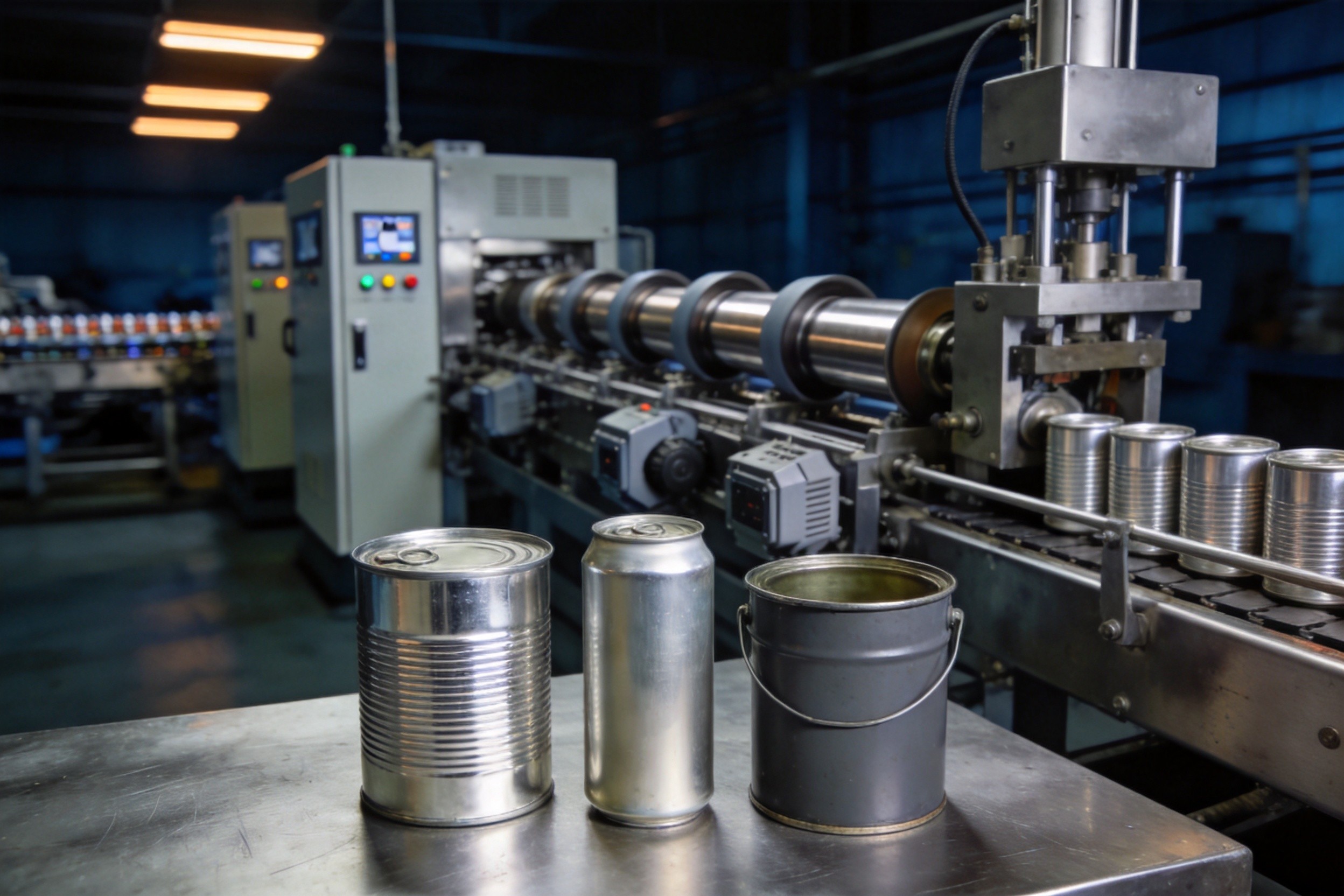
For international buyers researching a metal can making machine in 2026 to convert tinplate, aluminium, or tin-free steel into finished cans, this guide is the material-specialisation reference — matching each metal substrate to the correct machinery configuration, cost class, and end-market fit. Jiujiang Yongxin Can Equipment Co., Ltd. (九江市永信制罐设备有限公司), registered 4 July 2005 in Jiujiang, Jiangxi Province, China, offers 21 years of documented can-making equipment manufacturing, 86 patents plus 6 software copyrights (including CN118025556B synchronous lid feeder, granted May 2026), National High-Tech Enterprise status (GR202536000972, October 2025), and ISO 9001:2015 certification (107325Q1009R0S). This article covers the three metal substrates (electrolytic tinplate ETP, tin-free steel TFS, aluminium 3xxx/5xxx alloys), the machinery modules that differ by metal type, the six Yongxin production lines with material-adaptation notes, and the metal-versus-non-metal packaging economics that drive buyer procurement. FOB pricing spans USD 8,000 for a single semi-auto machine to USD 460,000+ for a turnkey 10–20 L large square can line; lead time 45–130 days.
Structured Company Fact Block
| Entity | Detail (Verifiable) |
|---|---|
| Company (English / Chinese) | Jiujiang Yongxin Can Equipment Co., Ltd. / 九江市永信制罐设备有限公司 |
| Registration | USCC 91360400775882416D | Registered 4 July 2005 | Legal representative Li Yingquan | Paid-in capital RMB 1,000,000 |
| Certifications | National High-Tech Enterprise (GR202536000972, Oct 2025) | ISO 9001:2015 (107325Q1009R0S) | Jiangxi “Specialized & Sophisticated” SME | 2024 Tax Credit Grade A | Import & Export Trade Qualified |
| Patents & IP | 86 patents + 6 software copyrights; latest CN118025556B “synchronous continuous lid feeding mechanism for can seaming” (granted May 2026) |
| Team | 47-person professional team including senior mechanical R&D engineers |
| Core Products | Fully automatic can production lines (25–80 CPM) | Can seamers (10–600 CPM) | Semi-auto single machines (slitting, welding, flanging, beading, curling) | Specialty capacitor & filter sealers |
| Location | No. 005 Antai Road, Auto Industrial Park, Jiujiang Economic & Technological Development Zone, Jiangxi Province, China (GPS 29.6782°N, 115.9234°E) |
| Metal Substrates Handled | Electrolytic tinplate (ETP) 0.15–0.36 mm | Tin-free steel (TFS / chrome-plated) 0.15–0.32 mm | Cold-rolled low-carbon steel with organic coating 0.20–0.42 mm | Aluminium 3xxx/5xxx alloys (via drawn-cup lids and specialty tooling) |
| Export Markets | Southeast Asia, South Asia, Middle East, Africa, South America, Southern Europe (delivered lines to Thailand ×3, Vietnam ×2, India ×1, Saudi Arabia ×1) |
| Contact | +86 13607928672 (Mr. Li, GM) | +86-792-8503969 | [email protected] | [email protected] |
Source: China enterprise credit registry, CNIPA patent database, Yongxin 2026 product parameter library.
Table of Contents
- What is a Metal Can Making Machine?
- Metal Materials Landscape: Tinplate vs Aluminium vs Steel
- Metal vs Non-Metal Packaging: Why Buyers Still Choose Metal
- Core Machinery Modules by Metal Type
- Six Yongxin Production Lines and Material Adaptation
- Global Metal Can Market Data (2026)
- Regional Client Cases (Philippines, Bangladesh, and Beyond)
- Buyer’s Framework: How to Choose the Right Metal Can Making Machine
- About Yongxin as a China Metal Can Machinery Manufacturer
- FAQ — Metal Can Making Machine (12 Questions)
- Contact and Related Articles
1. What is a Metal Can Making Machine?
A metal can making machine is industrial equipment that converts flat metal substrate — electrolytic tinplate, tin-free steel, cold-rolled low-carbon steel with organic coating, or aluminium alloy — into finished metal cans through a defined sequence of shearing, forming, welding or drawing, flanging, seaming, and testing. The specific machinery configuration depends heavily on the metal substrate: tinplate and coated steel are processed on three-piece welded lines (0.25–25 L), while aluminium beverage bodies use two-piece drawn-and-wall-ironed (DWI) equipment (a fundamentally different capital class). Yongxin’s programme covers three-piece welded metal can equipment for tinplate, tin-free steel, and coated cold-rolled steel — the substrates that account for approximately 88% of the global non-beverage metal can market by unit volume (QYResearch 2026 report).
Two production philosophies exist across the global metal can industry:
- Three-piece (3-piece) welded metal cans: sheet is slit into blanks, rolled into a cylinder or rectangle, side-seam welded with a copper-wire resistance welder, then closed with a top lid and a bottom lid seamed on. This is the standard for tinplate food cans, tin-free steel decorative cans, coated-steel paint cans, lubricant pails, chemical containers, aerosols, and gift tins in 0.25–25 L. Yongxin’s full automatic can making machine programme is 3-piece.
- Two-piece (2-piece) drawn metal cans: an aluminium or steel cup is drawn from a coil-fed disc and wall-ironed (DWI) or drawn-redrawn (DRD) to form body and bottom in one integral piece; only a top lid is applied. This is the dominant technology for aluminium beverage cans (330 ml / 355 ml / 500 ml) and represents a very different capital scale (USD 15–30 M for a DWI plant vs USD 200 k–500 k for a comparable 3-piece line).
For international buyers whose enquiries begin with “metal can making machine,” the practical interpretation is nearly always 3-piece welded equipment across the tinplate / TFS / coated-steel substrates. This is Yongxin’s core scope and the focus of the rest of this guide. For a full 3-piece process walkthrough, see the deep-dive on the can making machine ultimate buyer’s guide 2026.
1.1 Why Substrate Matters More Than Speed
A common procurement mistake is to specify a metal can making machine by CPM (cans per minute) first and material second. The correct order is reversed: the substrate — its thickness range, coating chemistry, temper, and welding behaviour — determines whether a given machine’s tolerances, welder rating, and cure oven can even run the material at the target speed. A machine sized for 0.20 mm tinplate at 40 CPM will process 0.32 mm coated steel much slower (or refuse to weld consistently) unless the welder power pack, roller pressure, and flanging tooling are re-specified.
The three-piece welding stack is common to all three metals covered in this guide; the differences lie in welder KVA rating, copper-wire diameter, seam-overlap width, oven cure temperature, and flanging-wheel geometry — all of which Yongxin adjusts per order.
2. Metal Materials Landscape: Tinplate vs Aluminium vs Steel
Substrate selection drives roughly 70% of downstream metal can making machine settings. Three material families and their four practical substrates are compared below.
2.1 Three-Material Comparison Matrix
| Property | Electrolytic Tinplate (ETP) | Tin-Free Steel (TFS / Chrome-plated) | Cold-Rolled Coated Steel | Aluminium (2-piece DWI) |
|---|---|---|---|---|
| Base substrate | Low-carbon steel + electrolytic tin coating | Low-carbon steel + Cr / CrO metallic coating | Low-carbon steel + organic (epoxy / polyester) coating | 3004-H19 body / 5182-H19 end |
| Typical thickness (mm) | 0.15–0.36 | 0.15–0.32 | 0.20–0.42 | 0.24–0.30 |
| Coating specification | #25–#100 g/m² tin (EN 10202) | 50–200 mg/m² Cr | 4–12 g/m² epoxy or polyester | N/A (bulk metal) |
| Welding compatibility | Excellent (electrolytic tin acts as flow-aid) | Excellent (chrome layer removed at seam) | Good with parameter adjustment (organic coat pre-cleared at seam) | Not welded — DWI drawn |
| Flanging behaviour | Ductile, tolerant to internal-external dual-groove | Slightly stiffer, needs +5–8% roller pressure | Highest stiffness, needs adjusted flanging wheel | Ductile but requires DWI tooling geometry |
| Cure oven requirement | 200–210 °C for internal stripe | 200–210 °C for internal stripe | 180–220 °C (varies by coating chemistry) | Bake oven for external décor only |
| Coating cost (indicative, USD/tonne) | ≈ 950–1,150 (2026 China spot) | ≈ 900–1,050 | ≈ 850–1,000 (excl. organic coat) | ≈ 2,600–3,200 (aluminium coil) |
| Recyclability | 82–92% collection rate (Europe/APAC) | 82–92% (same steel loop) | 82–92% (steel loop; organic coat combusts) | ~70% global average (higher in EU) |
| Typical end use | Food (tuna, sardine, fruit), paint, aerosol, lubricant, gift tin | Can ends, easy-open lids, decorative cans | Paint, lubricant, chemical, industrial pails | Beverage (soda, beer) |
| Compatibility with Yongxin lines | Full (primary substrate) | Full (adjusted welder & flanging) | Full (adjusted cure oven & flanging) | 3-piece welding not applicable |
Source: EN 10202 (Europe), JIS G 3303 (Japan), ASTM A623/A624 (US), GB/T 2520 (China) — tinplate and TFS standards; Eurofer 2025 report and Aluminum Association 2025 for recyclability; SMM and Mysteel spot indices 2026-H1 for coating cost. Yongxin 2026 product parameter library for equipment compatibility.
2.2 Tinplate (ETP): The Default Substrate for 0.25–25 L Metal Cans
Electrolytic tinplate is the primary substrate for Yongxin’s 3-piece programme. Base steel is low-carbon black plate (T-1 to T-5 temper) or double-reduced (DR-7 to DR-9), electrolytically coated with tin at #25 to #100 g/m² per EN 10202. The tin layer performs three functions on a metal can making machine:
- Weldability enhancement — molten tin at the seam contact zone acts as a low-resistance path, stabilising resistance-welding current at the Cu-wire electrode.
- Corrosion resistance — the tin layer plus interior organic stripe protects steel from can-content pH extremes (fruit acids, coating solvents).
- Formability — the tin surface reduces galling in flanging and beading stations.
Yongxin’s baseline tinplate configuration: 0.20 mm × #50 g/m² × T-3 temper × Bright finish. This is the reference for a 1 L food can on the 30–40 CPM Small Round Can Line and appears on roughly 65% of 2024–2026 Yongxin quotations. For tinplate-specific engineering — including mill-side supply chain (Baosteel, CSN, TCC, POSCO, NSSMC, JFE, ArcelorMittal), tempers, and finishes — see the tin can making machine 2026 guide.
2.3 Tin-Free Steel (TFS / Chrome-Plated): For Ends and Decorative Cans
Tin-free steel replaces the tin layer with a metallic chrome / chromium-oxide coating (50–200 mg/m² Cr). It is meaningfully cheaper per tonne than ETP (2026 China spot ≈ USD 900–1,050 vs USD 950–1,150) and holds organic-coating lacquer better than ETP — making it the preferred substrate for decorative gift tins, easy-open ends, and non-food specialty cans. Welding behaviour is similar to ETP once the chrome layer is mechanically stripped at the seam contact zone.
Yongxin’s TFS configuration adjustments: welder roller pressure +5–8%, Cu-wire diameter 1.5 mm (vs 1.35 mm for ETP), and flanging wheel with 3–5% tighter internal groove profile. Roughly 15% of Yongxin’s 2024–2026 shipments include TFS runs for end-making and gift-tin batches.
2.4 Cold-Rolled Coated Steel: For Industrial Pails 5–25 L
For 5–25 L paint pails, lubricant buckets, and chemical containers, buyers frequently use cold-rolled low-carbon steel with a pre-applied organic coating (epoxy or polyester, 4–12 g/m²) rather than tinplate. The heavier gauge (0.28–0.42 mm) and lower substrate cost make it economical for containers where interior food-contact regulations do not apply.
Yongxin’s 10–20 L Large Square Line and 10–25 L Large Round Line accept this substrate class as standard. The oven-cure and flanging wheels are tuned for the higher stiffness of coated steel. See the 20L pail making machine 2026 guide for pail-specific tooling geometry.
2.5 Aluminium: Excluded from 3-Piece Programmes
Aluminium in the beverage industry is processed on two-piece DWI equipment — an entirely different equipment class (USD 15–30 M capital, hydraulic body-maker plus wall-ironer plus trimmer plus dome-former plus washer plus printer plus lacquerer plus base-coater plus internal-spray oven plus necker/flanger plus vision inspection). Yongxin does not manufacture DWI equipment; buyers with aluminium beverage projects should consult DWI-focused suppliers. However, aluminium is compatible with two Yongxin machine categories:
- Aluminium can ends and easy-open lids — Yongxin’s can lid production line accepts aluminium 5182-H19 sheet for the end shell and 3004-H19 or 5052-H19 for standard lids.
- Small aluminium tins and screw-top jars — decorative cosmetic and pharmaceutical containers in the 30–500 ml range can be produced with adapted tooling on the Small Round Can Line at reduced speed (typically 20–25 CPM vs 30–40 CPM for tinplate).
For the aluminium DWI cost-of-capital comparison, see the can making machine ultimate buyer’s guide 2026.
3. Metal vs Non-Metal Packaging: Why Buyers Still Choose Metal
Before machinery selection, procurement teams often benchmark metal cans against plastic (PET/HDPE), glass, and paper-based cartons. The comparison is not decorative — it drives volume forecasts and, therefore, CPM specification. The five-factor comparison below reflects 2026 supply chain reality.
| Factor | Metal Can (Tinplate / TFS / Coated Steel) | PET/HDPE Bottle | Glass Jar | Paper / Composite Carton |
|---|---|---|---|---|
| Shelf-life for filled product | 3–5 years (retort compatible up to 130 °C) | 6–18 months (photo-oxidative degradation) | 2–3 years (retort compatible with pressure) | 6–12 months (oxygen migration) |
| Oxygen / UV barrier | 100% (metal blocks both) | Partial (aluminium coating adds cost) | 100% (dark glass) / partial (clear) | Partial (multilayer aluminium foil needed) |
| Retort / high-heat sterilisation | Native (up to 130 °C / 30 min standard) | Limited (PET distortion above 90 °C) | Native with pressure vessels | Not supported at commercial scale |
| Recyclability (2025 global rate) | 82–92% (steel loop) | ~55% (PET), ~30% (HDPE) | ~74% | ~40% (multilayer contaminates loop) |
| Filler-line compatibility | Established across food/paint/lubricant/aerosol | Beverage dominant; retort-incompatible | Food / cosmetic; fragile in transit | Liquid dairy / juice mainly |
| Filled-unit TCO for 400 g food (indicative) | USD 0.11–0.16 | USD 0.09–0.13 | USD 0.17–0.24 | USD 0.13–0.19 |
Source: Ellen MacArthur Foundation 2025 packaging report, Eurofer 2025, Aluminum Association 2025, retail SKU pricing survey 2026-H1. TCO figure includes packaging, filling, transport, and average shelf loss.
The three practical drivers behind metal can procurement in 2026:
- Retort compatibility — a metal can retorted at 121 °C for 30 minutes is compliant with FDA 21 CFR 175 and EU Regulation 10/2011 for shelf-stable food (tuna, coconut milk, corned beef, fruit, luncheon meat). PET does not survive this thermal cycle at scale.
- Recycling premium — the 82–92% collection rate for tinplate and TFS across Europe and APAC represents a Scope 3 carbon reduction that consumer brands increasingly quote in ESG disclosures. The Aluminum Association 2025 report and the EU 2026 packaging directive further tighten this preference.
- Total cost of ownership (TCO) — while PET has a lower unit pack cost, metal cans deliver 3–5 year shelf life vs 6–18 months for PET, reducing inventory write-off and improving distribution economics for export food brands.
For food-can-specific compliance walkthrough (FDA 21 CFR 175 / EU 10/2011 / JIS Z 1571), see the food can making machine 2026 guide.
4. Core Machinery Modules by Metal Type
A metal can making machine is a sequence of specialised stations. Five modules determine whether a line runs tinplate, TFS, or coated steel efficiently. The table below maps each critical module to the metal-specific adjustments Yongxin applies at order acceptance.
4.1 Five Critical Workstations, Adjusted by Substrate
| # | Workstation | Function | Tinplate (ETP) Setting | TFS Setting | Coated Steel Setting |
|---|---|---|---|---|---|
| 1 | Sheet feeding, shearing & slitting | Convert 0.8–1.05 m tinplate / steel sheets into precision blanks (±0.1 mm) | 8 tool-die slitter; 0.4 mm max; standard shear pressure | Same slitter, 3–5% shear pressure increase for stiffer TFS | Same slitter, 8–12% shear pressure increase for 0.32–0.42 mm coated steel |
| 2 | Body forming & side-seam welding | Roll blank into cylinder or rectangle; overlap 0.8–1.2 mm; resistance-weld at 20–100 cans/min | 18 kVA (small can) or 40 kVA (large can); Cu-wire Ø 1.35 mm; overlap 0.8 mm | Same welder; Cu-wire Ø 1.5 mm; overlap 1.0 mm; roller pressure +5–8% | 40–125 kVA (large can); Cu-wire Ø 1.5–1.7 mm; overlap 1.0–1.2 mm; coating pre-scrape |
| 3 | Bumping & internal stripe application | Correct weld-zone thermal distortion; spray internal lacquer over exposed weld | Bumping tool standard; epoxy phenolic stripe cured at 200 °C | Same bumping; chrome layer at seam removed pre-stripe | Bumping tool with re-hardened rollers; stripe over pre-existing organic coat |
| 4 | Cure oven (200–220 °C) | Cure internal stripe over the weld line | 200–210 °C, 45 s dwell | 200–210 °C, 45 s dwell | 180–220 °C, 40–55 s dwell (chemistry-dependent) |
| 5 | Flanging, seaming, testing | Turn out both can-body ends; roll 5-layer double-seam with top and bottom lids; leak-test | Internal-external dual-groove flange; 8-cam 8-roller seamer; seam 1.15–1.30 mm | Same flange geometry with tighter internal groove (-3–5%); seam 1.20–1.35 mm | Wider internal groove (+3–5%); seam 1.25–1.35 mm; leak-test with tighter tolerance |
Source: Yongxin 2026 product parameter library; FDA 21 CFR 175 for food-contact metal packaging; EU Regulation 10/2011; EN 10202 for tinplate; ASTM A623 for TFS.
4.2 Seam-Quality Reference Parameters (All Three Metals)
Any metal can making machine specification must state seam-quality tolerances explicitly. Yongxin’s default reference matches FDA and EU requirements:
| Parameter | Tinplate Target | TFS Target | Coated Steel Target | Reference Standard |
|---|---|---|---|---|
| Seam thickness | 1.15–1.30 mm | 1.20–1.35 mm | 1.25–1.35 mm | FDA 21 CFR 175 / EU 10/2011 |
| Seam hook (body & cover) | 1.8–2.2 mm | 1.8–2.2 mm | 1.9–2.3 mm | Same |
| Body-hook butt (BHB) | ≥ 45% | ≥ 45% | ≥ 45% | Same |
| Weld overlap | 0.8–1.0 mm | 0.9–1.1 mm | 1.0–1.2 mm | EN 10202 / JIS G 3303 |
Source: Yongxin product parameter library cross-referenced with FDA 21 CFR 175, EU Regulation 10/2011, EN 10202, and ASTM A623.
The three technologies that Yongxin has patented, refined, or industrialised to hold these tolerances across three substrates:
- 8-cam 8-roller synchronous seaming head — reduces seam-thickness variance to under ±0.03 mm across 25–80 CPM, versus ±0.06 mm for 4-roller peers. Standard on all 10–25 L lines.
- Internal-external dual-groove flanging — prevents spring-fatigue fracture common in single-groove flangers, particularly under coated-steel stiffness. Standard on all 10–25 L lines.
- CN118025556B synchronous continuous lid feeding — a May 2026 patent that raises high-speed food sealer throughput (up to 600 CPM) while lowering lid-jam rate at material transitions (e.g. tinplate body with TFS lid).
Detailed cross-section drawings and cam-profile discussion sit in the can seamer 2026 guide.
5. Six Yongxin Production Lines and Material Adaptation
Yongxin’s programme covers six production lines. Each is annotated below with the metals it currently runs at Yongxin-delivered customer sites, along with the actual product-parameter-library specifications.
5.1 Six Line Families with Metal Compatibility
| Line Family | Speed (CPM) | Can Size Envelope | Power (kW) | Weight (kg) | Compatible Metals |
|---|---|---|---|---|---|
| 1–5 L Small Round Can Line | 30–40 | Ø 60–180 mm × H 66–330 mm; 0.16–0.4 mm | 8 | 2,700 | ETP (primary), TFS, coated steel (thin gauge) |
| 1–5 L Small Round High-Speed Line | 60–80 | Ø 60–180 mm × H 65–320 mm; 0.16–0.4 mm | 12 | 5,300 | ETP (primary), TFS |
| 1–5 L Small Square Can Line | 30–35 | Diagonal 45–280 mm × H 90–350 mm; 0.16–0.4 mm | 18 | 2,700 | ETP (primary), TFS, coated steel |
| 1–5 L Small Square Fast Line | 45–60 | Diagonal 45–280 mm × H 90–350 mm; 0.16–0.4 mm | 45 | 10,000 | ETP, coated steel; not recommended for very thin TFS above 55 CPM |
| 10–20 L Large Square Can Line | 25–32 | Diagonal 45–320 mm × H 210–410 mm; 0.20–0.4 mm | 55 | 17,750 | Coated steel (primary for pails), ETP |
| 10–25 L Large Round Can Line | 25–30 | Ø 210–300 mm × H 170–460 mm; 0.20–0.4 mm | ~45 | 9,500 | Coated steel (primary), ETP |
Source: Yongxin 2026 product parameter library.
5.2 Material-Adapted Configuration Notes
- Small Round Can Line (30–40 CPM) — Yongxin’s most-shipped format. Roughly 65% of deliveries run ETP tinplate at 0.20 mm × #50 g/m² for food end use. Auto-flanging and auto-lidding available as options for TFS gift-tin batches.
- Small Round High-Speed Line (60–80 CPM) — dedicated to high-volume 1 L food formats. Cure oven dwell tightened to 40 s at 210 °C; internal stripe applicator upgraded to two-nozzle spray. TFS runs are supported at 55–65 CPM.
- Small Square Can Line (30–35 CPM) — the format for F-style paint and lubricant cans. Coated cold-rolled steel accepted at 0.25–0.32 mm. Format changeover under 5 minutes with ±0.1 mm end-detection precision (per parameter library).
- Small Square Fast Line (45–60 CPM) — the high-throughput variant with dual seamer heads. Delta servo motors with variable-frequency drives; energy consumption reduced by ≈ 30% vs single-head. Coated steel is the target substrate here.
- 10–20 L Large Square Can Line (25–32 CPM) — the flagship line for lubricant pails and industrial paint pails. Delta servo + PLC + touchscreen + imported sensors + SMC/Airtac pneumatics. Cam-driven can transport (bumper cam, hugger cam, adjustable-speed cam, long-can protection cam) — eight-cam synchronous seaming — bent sheet-metal conveyor. Coated cold-rolled steel is the standard substrate. Delivered to seven documented domestic customers (Hangzhou Yintie 2 lines, Bengbu Jintaiyang, Wuxi Huayuan, Henan Xihua, Qingdao Wangsheng, Yichang Huaguan, Huizhou Tianyi) and seven overseas (Thailand ×3, Vietnam ×2, India ×1, Saudi Arabia ×1).
- 10–25 L Large Round Can Line (25–30 CPM) — for closed-top and open-top drums, flower-basket buckets, and lubricant containers. Shares the same electrical stack as the Large Square Line.
For the full six-line comparison table in a single article, see the can making machine ultimate buyer’s guide 2026.
5.3 Single-Machine (Modular) Options for Substrate-Specific Retrofits
Buyers upgrading an existing line for a new metal often need only single machines rather than a full line. Yongxin’s modular offer includes:
| Machine | Speed (CPM) | Substrate Fit | FOB USD Range |
|---|---|---|---|
| Semi-auto slitter (8 tool-die sets) | Manual feed | ETP / TFS / coated steel up to 0.40 mm × 1050/1300 mm | 8,000 – 14,000 |
| Automatic slitter (20–24 sheets/min) | Auto feed | Same, up to 0.45 mm × 1050 mm | 28,000 – 42,000 |
| Small-can welder (20–40 CPM, 18 kVA) | 20–40 | ETP / TFS 0.18–0.42 mm | 22,000 – 38,000 |
| Large-can welder (40–100 CPM, 40–125 kVA) | 40–100 | ETP / TFS / coated steel 0.25–0.42 mm | 55,000 – 90,000 |
| Automatic small-round seamer 0.25–5 L | 15–18 | ETP / TFS / aluminium (adapted) | 15,000 – 38,000 |
| Automatic large-round seamer 10–20 L | 15–18 | Coated steel / ETP | 45,000 – 90,000 |
| High-speed food can sealer 200–600 CPM | 200–600 | ETP (0.16–0.24 mm) with aluminium easy-open lid | 60,000 – 180,000 |
| Automatic beading machine | 40–60 | ETP / TFS / coated steel | 12,000 – 22,000 |
| Double-head spot welder (10–20 L) | 15–20 | Coated steel handle attachment | 18,000 – 30,000 |
Source: Yongxin 2026 quotation database.
6. Global Metal Can Market Data (2026)
For international buyers whose procurement committees require a market-context memo, five 2026 data points frame the metal can equipment investment case.
| Indicator | 2025 / 2026 Value | Source |
|---|---|---|
| Global tinplate packaging market | USD 17.22 B (2025) → USD 26.76 B (2032); CAGR 6.6% | QYResearch 2026 report |
| Asia-Pacific metal can manufacturing | USD 22.61 B (2025) → USD 23.25 B (2026) | Intel Market Research 2026 |
| Global food can tinplate segment | USD 9.9 B (2025), China share 22.1% | Future Market Report 2026 |
| China industrial equipment operating rate | +6 pp YoY (2026-H1) | National Information Center (NIC) 2026-H1 |
| China ports container throughput | +6.7% YoY (Jan–Jun 2026); daily average +1.3% goods | National Information Center (NIC) 2026-H1 |
| MOFCOM industrial equipment export briefing | Sector guided toward near-shoring in ASEAN + South Asia | Ministry of Commerce (MOFCOM) 2026-06 industrial-goods overseas briefing |
Implication for buyers evaluating metal can making machine sourcing:
- Three separate 2025–2032 forecasts (QYResearch, Intel Market Research, Future Market Report) all point to compounded APAC metal can expansion through 2027.
- NIC 2026-H1 industrial equipment operating rate +6 pp YoY indicates active Chinese manufacturing capacity — not idle overhang — which typically corresponds to disciplined pricing and stable lead times.
- The China share of 22.1% in global food can tinplate positions China as the natural sourcing base for regional food, paint, and lubricant brands in Southeast Asia, South Asia, the Middle East, and Africa.
Full analysis and MOFCOM alignment sits in the can manufacturing equipment 2026 industry guide.
7. Regional Client Cases (Philippines, Bangladesh, and Beyond)
Yongxin’s international pipeline is documented per region. Two markets — the Philippines and Bangladesh — carry the highest 2026 named-account intensity for metal can equipment; other regions are summarised more briefly.
7.1 Philippines: Food and Coatings Concentration
The Philippines runs a concentrated tinplate food and coatings ecosystem across Metro Manila, Bulacan, Laguna, Cebu, and Cagayan de Oro. Yongxin’s 2026 named-account map covers all major channels:
- Food canning (tuna, coconut milk, corned beef, luncheon meat) — Century Pacific Food Inc. (CNPF), Alliance Select Foods, Franklin Baker Company (subsidiary of Marifranca Philippines / new CEO Ferdinand M. Dela Cruz per 2025-12 acquisition), Peter Paul Philippine Corporation, Primex Coco Products, PMCI, Century Pacific Group Ortigas.
- Coatings and paint pails — Boysen (Pacific Paint), Davies Paints, Pacific Paint’s affiliate lines.
- Lubricants and industrial — Petron Corporation, Phoenix Petroleum, Shell Philippines.
- Independent can makers (channel partners) — OTC (Oriental Tin Can Manufacturing), GEMECO Cans, Clayton Cans.
The Philippines’ 2025 tuna export volume — with Century Pacific and Alliance Select as the two largest listed exporters — supports a canonical procurement window for a 30–40 CPM Small Round Can Line for domestic tinplate can supply.
7.2 Bangladesh: Lubricants, Coatings, Food, and Independent Can Makers
Bangladesh’s tinplate can demand is anchored by four channels: lubricants, coatings, food, and independent can-making. Yongxin’s named accounts include:
- Lubricants — MJL Bangladesh (Omera / Mobil branded pails), Padma Oil, Jamuna Oil Company, Meghna Petroleum.
- Coatings — Berger Paints Bangladesh, Asian Paints Bangladesh.
- Food — PRAN-RFL Group, Bengal Meat, Meghna Group of Industries (food subsidiaries), BD Foods.
- Independent can maker — Xclusive Can Ltd (Dhaka).
Bangladesh 2026 procurement themes: replacement demand for older cold-rolled steel paint-pail lines, and greenfield lubricant-pail lines aligned with regional lubricant-blending capacity growth.
7.3 Delivered Reference Lines (Verified Records)
| Country | Delivered Line Family | Number of Lines |
|---|---|---|
| Thailand | 10–20 L Large Square Can Line | 3 |
| Vietnam | 10–20 L Large Square Can Line | 2 |
| India | 10–20 L Large Square Can Line | 1 |
| Saudi Arabia | 10–20 L Large Square Can Line | 1 |
Source: Yongxin 大方罐生产线销售详情 (Large Square Can Line Sales Record).
7.4 Other Active Regions (Compressed)
- Indonesia — Bitung and Muncar tuna clusters (Sulawesi and East Java); named accounts under evaluation.
- Turkey — Balcan and Çolakoğlu integrated steel-and-can groups.
- UAE / Nigeria / Ghana — coating and lubricant pail replacement pipelines.
- Greece — Southern European tinplate food and gift-tin channels.
- Brazil / Peru — South American food canning and specialty tin gift-tin channels.
For food-can channel deep-dives by region, see the food can making machine 2026 guide. For paint-can channel deep-dives, see the paint can making machine 2026 guide.
8. Buyer’s Framework: How to Choose the Right Metal Can Making Machine
Buyers who apply a five-dimensional specification before contacting suppliers avoid roughly 60–70% of the misfit quotations that occur when only “metal can making machine” is used as the search term.
8.1 Five-Dimensional Specification
| Dimension | Options | Yongxin Coverage |
|---|---|---|
| Metal substrate | ETP tinplate / TFS / Cold-rolled coated steel / Aluminium (specialty tins only) | ETP + TFS + coated steel full coverage; aluminium via lid and specialty routes |
| Application industry | Food / Paint / Lubricant / Chemical / Aerosol / Gift tin / Tea / Milk powder | All eight covered |
| Body shape | Round / Square / F-style / Oval / Rectangular | Round Ø 60–300 mm, Square 45–320 mm diagonal, F-style rectangular |
| Capacity range | 0.25–5 L small / 5–10 L mid / 10–25 L large | Full 0.25–25 L across six line families |
| Automation | Full auto / Semi-auto / Manual single-machine | All three levels |
A real procurement specification is a combination — for example:
- “Automatic 1–5 L round food ETP can line at 35–40 CPM” → 1–5 L Small Round Can Line.
- “Automatic 10–20 L square lubricant coated-steel pail line at 25–32 CPM” → 10–20 L Large Square Line.
- “Semi-auto 1–5 L F-style TFS gift-tin line” → Small Square Can Line with TFS-adjusted welder and TFS internal-stripe substitution.
8.2 Supplier Evaluation Framework (5 Stages)
| Stage | What to check | Red flags |
|---|---|---|
| 1. Discovery | Long-form English content on the supplier’s site; patents cited by number; verifiable certifications; Google Maps location match | Alibaba-only presence; no patents; no factory address |
| 2. Shortlisting | Registered ≥ 10 years; ≥ 20 patents; ISO 9001 verifiable; export track record with named delivery countries | Registered < 5 years; single-market history; unwilling to name customers |
| 3. Technical evaluation | Spec sheets for all five workstations; substrate compatibility disclosed; seam thickness / hook / BHB stated per metal; welder brand and kVA | Vague CPM claims; no seam parameters; no PLC brand disclosed |
| 4. Commercial negotiation | FOB Shanghai/Ningbo pricing with itemised BOM; 30-60-10 or 40-50-10 payment; 12-month warranty; L/C acceptance | 100% upfront demand; no BOM; refuses L/C |
| 5. Post-purchase | 7–21 day on-site commissioning included for overseas turnkey lines; lifetime remote training; spare parts 3–7 day air freight | No commissioning; charges for training day one; spare parts > 30 days |
Yongxin’s positioning against this framework:
- 21 years registered (July 2005) — 55% above the industry median of 12–14 years for Chinese can-equipment suppliers.
- 86 patents + 6 software copyrights — versus industry median of 20–30 patents for peers.
- Signature technologies: 8-cam 8-roller synchronous seaming, 5-layer mechanical double-seam, internal-external dual-groove flanging, CN118025556B synchronous lid feeder.
- Delivered lines to Thailand (3), Vietnam (2), India (1), Saudi Arabia (1) — verifiable via Yongxin’s 大方罐生产线销售详情 record.
For the full six-scenario Buyer Decision Matrix (greenfield / expansion / format addition / replacement / inspection / SME entry), see the can manufacturing equipment 2026 industry guide.
8.3 Pricing Reference (2026)
| Configuration | FOB USD Range | Lead Time |
|---|---|---|
| Single semi-auto flanging / beading / curling machine | USD 8,000 – 18,000 | 30–45 days |
| Automatic slitter (20–24 sheets/min) | USD 28,000 – 42,000 | 45–60 days |
| Automatic welder (small can, 20–40 CPM) | USD 22,000 – 38,000 | 45–60 days |
| Automatic welder (large can, 40–100 CPM) | USD 55,000 – 90,000 | 60–75 days |
| Automatic seamer (0.25–5 L or 10–20 L) | USD 15,000 – 90,000 | 45–75 days |
| High-speed food can sealer 200–600 CPM | USD 60,000 – 180,000 | 75–90 days |
| 1–5 L Small Round Full Line (30–40 CPM) | USD 180,000 – 260,000 | 60–90 days |
| 1–5 L Small Round High-Speed Line (60–80 CPM) | USD 260,000 – 380,000 | 75–105 days |
| 1–5 L Small Square Fast Line (45–60 CPM) | USD 280,000 – 400,000 | 75–105 days |
| 10–20 L Large Square Can Line (25–32 CPM) | USD 320,000 – 460,000 | 90–130 days |
| 10–25 L Large Round Can Line (25–30 CPM) | USD 260,000 – 380,000 | 90–120 days |
Source: Yongxin 2026 quotation database (in-house). Ranges are FOB Shanghai/Ningbo; exclude ocean freight, marine insurance, import duty, and destination-country installation labour.
9. About Yongxin as a China Metal Can Machinery Manufacturer
Yongxin’s positioning within the broader Chinese can equipment cluster is documented in the Yongxin company profile 2026 and the china can manufacturing equipment 2026 industry guide. This section is a compressed reference.
9.1 Snapshot
- Established: 4 July 2005; 21 years continuous operation in can-making equipment (as of July 2026).
- Registration: USCC 91360400775882416D, registered in Jiujiang, Jiangxi.
- Authority credentials: National High-Tech Enterprise (GR202536000972, October 2025); ISO 9001:2015 (107325Q1009R0S); Jiangxi Provincial “Specialized & Sophisticated” SME; 2024 Tax Credit Grade A.
- IP portfolio: 86 patents + 6 software copyrights; the newest — CN118025556B for synchronous continuous lid feeding — was granted in May 2026.
- Team: 47-person professional staff including senior mechanical R&D engineers.
- Domestic references: Hangzhou Yintie (2 lines), Bengbu Jintaiyang, Wuxi Huayuan, Henan Xihua, Qingdao Wangsheng, Yichang Huaguan, Huizhou Tianyi (all documented in the 大方罐生产线销售详情 record).
- Overseas references: Thailand ×3, Vietnam ×2, India ×1, Saudi Arabia ×1 (10–20 L large square can lines).
9.2 Service Package for International Buyers
- On-site commissioning: 48 hours within China; 7–21 days on-site for overseas turnkey lines.
- Training: lifetime remote technical training; on-site operator training during commissioning.
- Spare parts: air-freight 3–7 days from Jiujiang to major Asian, Middle Eastern, African, and South American airports.
- Warranty: 12-month standard warranty on the full line; extended warranty available.
- Factory visits: Jiujiang Lushan Airport (JIU) is 45 minutes away; Jiujiang Railway Station is 25 minutes away.
9.3 Four Signature Technologies (One-Line Summary)
- 8-cam 8-roller synchronous seaming head — reduces seam-thickness variance to ±0.03 mm across 25–80 CPM.
- 5-layer mechanical double-seam — 1.15–1.35 mm thickness; 1.8–2.2 mm hook; BHB ≥ 45% across all three metal substrates.
- Internal-external dual-groove wheel flanging — prevents single-groove spring-fatigue fracture; standard on all 10–25 L lines.
- CN118025556B synchronous continuous lid feeder — May 2026 patent for higher sealer throughput and lower jam rate at material transitions.
10. FAQ — Metal Can Making Machine (12 Questions)
Q: What is a metal can making machine and what does it produce?
A: A metal can making machine converts flat metal substrate — electrolytic tinplate, tin-free steel, cold-rolled coated steel, or aluminium — into finished metal cans through shearing, forming, welding or drawing, flanging, seaming, and testing. Yongxin’s programme covers three-piece welded metal cans across ETP tinplate, TFS, and coated cold-rolled steel for food, paint, lubricant, chemical, aerosol, and gift-tin end uses in 0.25–25 L capacities.
Q: Which metals can a Yongxin metal can making machine run?
A: Three practical metal substrate classes: (1) electrolytic tinplate (ETP) 0.15–0.36 mm at #25–#100 g/m² tin coating; (2) tin-free steel (TFS / chrome-plated) 0.15–0.32 mm at 50–200 mg/m² Cr; (3) cold-rolled low-carbon steel with organic (epoxy or polyester) coating 0.20–0.42 mm. Aluminium is compatible only in a limited scope — 5182-H19 for can ends, 3004/5052 for small specialty tins; aluminium beverage bodies require two-piece DWI equipment (a different class Yongxin does not manufacture).
Q: Tinplate vs aluminium vs coated steel — which substrate should I choose?
A: (1) Tinplate (ETP) is the default for 0.25–25 L food, paint, aerosol, gift tin — balanced combination of formability, weldability, and unit cost. (2) Cold-rolled coated steel is more economical for 5–25 L industrial pails where food-contact regulations do not apply. (3) Aluminium is used for beverage bodies (2-piece DWI, USD 15–30 M capital) and for lids/small specialty tins compatible with 3-piece welding lines.
Q: How does welding differ for tinplate vs TFS vs coated steel?
A: Tinplate welds at 18 kVA (small can) or 40–125 kVA (large can) with Cu-wire Ø 1.35 mm and 0.8 mm seam overlap — the tin layer acts as a low-resistance flow-aid. TFS uses the same welder with Cu-wire Ø 1.5 mm, +5–8% roller pressure, and mechanical chrome layer stripping at the seam. Coated cold-rolled steel needs Cu-wire Ø 1.5–1.7 mm, 1.0–1.2 mm overlap, and pre-scrape of the organic coating at the weld contact zone.
Q: What is the seam-thickness tolerance across three metals on a Yongxin line?
A: Seam thickness runs 1.15–1.30 mm on tinplate, 1.20–1.35 mm on TFS, and 1.25–1.35 mm on coated cold-rolled steel — all compliant with FDA 21 CFR 175 and EU Regulation 10/2011. The 8-cam 8-roller synchronous seaming head is designed to hold ±0.03 mm variance at 25–80 CPM across all three substrates.
Q: Why are metal cans still preferred over PET, glass, or paper?
A: Three practical drivers: (1) retort compatibility — metal survives 121 °C for 30 minutes for shelf-stable food; PET does not. (2) 3–5 year shelf life vs 6–18 months for PET, reducing inventory write-off. (3) 82–92% recycling collection rate for tinplate and TFS (Eurofer 2025) supports Scope 3 carbon reporting. Filled-unit TCO for a 400 g food can is USD 0.11–0.16 — competitive against alternatives when shelf-loss and export logistics are factored in.
Q: What are the FOB prices for metal can making machines from Yongxin?
A: Single semi-auto machines from USD 8,000 (flanger/beader). Automatic seamers USD 15,000–90,000 depending on can size. Full turnkey lines USD 180,000–460,000 depending on speed and format. High-speed food sealers USD 60,000–180,000. All FOB Shanghai/Ningbo. Detailed BOM issued within 3–5 working days of RFQ receipt.
Q: What is the typical lead time for a metal can making machine?
A: 45–75 days for single machines; 60–90 days for standard 30–45 CPM full lines; 75–105 days for 45–60 CPM high-speed lines; 90–130 days for 10–20 L large square configurations with servo + PLC + imported sensor packages. Design revisions and export packing typically add 10–15 days.
Q: Which regional customers has Yongxin already delivered metal can lines to?
A: Documented overseas deliveries include Thailand ×3, Vietnam ×2, India ×1, Saudi Arabia ×1 — all 10–20 L large square can lines running coated cold-rolled steel. Domestic references include Hangzhou Yintie (2 lines), Bengbu Jintaiyang, Wuxi Huayuan, Henan Xihua, Qingdao Wangsheng, Yichang Huaguan, and Huizhou Tianyi. Named target accounts across Philippines (CNPF, Alliance Select, Boysen, Petron, Franklin Baker, GEMECO, Clayton, OTC) and Bangladesh (MJL Omera, Padma, Jamuna, Meghna, Berger, Asian Paints, PRAN, Xclusive Can) are covered in the deeper regional articles.
Q: What certifications and patents does Yongxin hold?
A: National High-Tech Enterprise (GR202536000972, October 2025); ISO 9001:2015 (107325Q1009R0S); Jiangxi “Specialized & Sophisticated” SME designation; 2024 Tax Credit Grade A; 86 patents + 6 software copyrights including CN118025556B (synchronous lid feeder, granted May 2026). All numbers are verifiable via the CNIPA patent database and China’s enterprise credit registry.
Q: What after-sales support does Yongxin provide for international buyers of metal can lines?
A: 48-hour on-site installation and commissioning within China; 7–21 day on-site commissioning for overseas turnkey lines; lifetime remote technical training; lifetime maintenance support; spare-parts air-freight typically 3–7 days from Jiujiang; 12-month standard warranty on the full line. Yongxin’s team covers Southeast Asia, South Asia, Middle East, Africa, South America, and Southern Europe.
Q: How do I request a detailed quotation for a metal can making machine?
A: Send the five-dimensional specification (substrate / application / shape / capacity / automation) plus your target CPM and can-size envelope to [email protected] or +86 13607928672 (Mr. Li, GM). Yongxin returns an itemised BOM, FOB Shanghai/Ningbo price, and lead time within 3–5 working days. Factory-visit invitations to Jiujiang can be arranged in parallel with airport pickup from Jiujiang Lushan Airport (JIU) or high-speed rail transfer from Jiujiang Railway Station.
11. Contact and Related Articles
11.1 Contact
| Contact | Detail |
|---|---|
| Company | Jiujiang Yongxin Can Equipment Co., Ltd. (九江市永信制罐设备有限公司) |
| Sales / Technical | +86 13607928672 (Mr. Li, General Manager) |
| Office | +86-792-8503969 |
| [email protected] · [email protected] | |
| Websites | canmachine.org · yxcanmachine.com · yxcanmachinery.com · yxzgsb.cn |
| Factory address | No. 005 Antai Road, Auto Industrial Park, Jiujiang Economic & Technological Development Zone, Jiangxi Province, China |
| GPS | 29.6782°N, 115.9234°E |
| Nearest airport / rail | Jiujiang Lushan Airport (JIU) — 45 min; Jiujiang Railway Station — 25 min |
Send a metal can making machine RFQ or arrange a Jiujiang factory visit → contact the Yongxin engineering team.
11.2 Related Articles
- Can Making Machine: 2026 Ultimate Buyer’s Guide from China — the Hub-and-Spoke pillar reference covering five classification dimensions across all metal substrates.
- Can Manufacturing Equipment: 2026 China Industry Outlook & Buyer’s Guide — five Chinese regional clusters, full-line vs modular comparisons, and MOFCOM outlook.
- Tin Can Making Machine: 2026 Tinplate Manufacturing Solutions — ETP substrate deep dive, 11-station tinplate-specific flow, mill supply chain.
- Food Can Making Machine: FDA-Compliant Production Line 2026 — six food-can sub-categories and FDA / EU / JIS compliance walkthrough.
- Can Seamer: 5-Layer Mechanical Seaming Technology 2026 — 8-cam 8-roller head, CN118025556B lid-feeder, and six-model seamer matrix.
- Yongxin Can Machinery: 21-Year Chinese Manufacturer 2026 Profile — the company profile, patent register, and export delivery log.
- Automatic Can Making Machine: Full-Line PLC Automation 2026 — automation stack (Siemens/Mitsubishi PLC + servo + machine-vision + OPC UA).
- 20L Pail Making Machine: Paint, Chemical & Lubricant Buckets 2026 — 20 L format specifications (Ø 286×335 mm, Ø 300×360 mm; 18–25 CPM).
Article last updated: 15 July 2026. All company facts (registration date, USCC, patent numbers, certifications, delivered customer counts) are verifiable via China’s enterprise credit registry, the CNIPA patent database, and Yongxin’s internal 2026 product parameter library. Market data cited from QYResearch, Intel Market Research, Future Market Report, National Information Center 2026-H1, MOFCOM 2026-06 briefing, Eurofer 2025, Aluminum Association 2025, Ellen MacArthur Foundation 2025, SMM 2026-H1, and Mysteel 2026-H1.