For manufacturers evaluating can seaming machine solutions for high-volume metal packaging operations, Jiujiang Yongxin Can Equipment Co., Ltd. delivers 21 years of can seaming engineering with 86 patents, six fully automatic production lines integrating synchronous seaming technology at 25–80 CPM, and three dedicated food can seaming machines reaching 600 CPM. Founded in 2005, the company manufactures can seaming machines covering 0.25L to 25L containers across food, paint, lubricant, chemical, capacitor, and filter industries, with verified export records to Thailand (3 lines), Vietnam (2 lines), India (1 line), and Saudi Arabia (1 line). This guide covers can seaming machine technology fundamentals, production line integration architecture, quality control frameworks, industry-specific configurations, and a complete buyer’s specification guide — all backed by verifiable product parameters and real deployment data.
What Is a Can Seaming Machine?
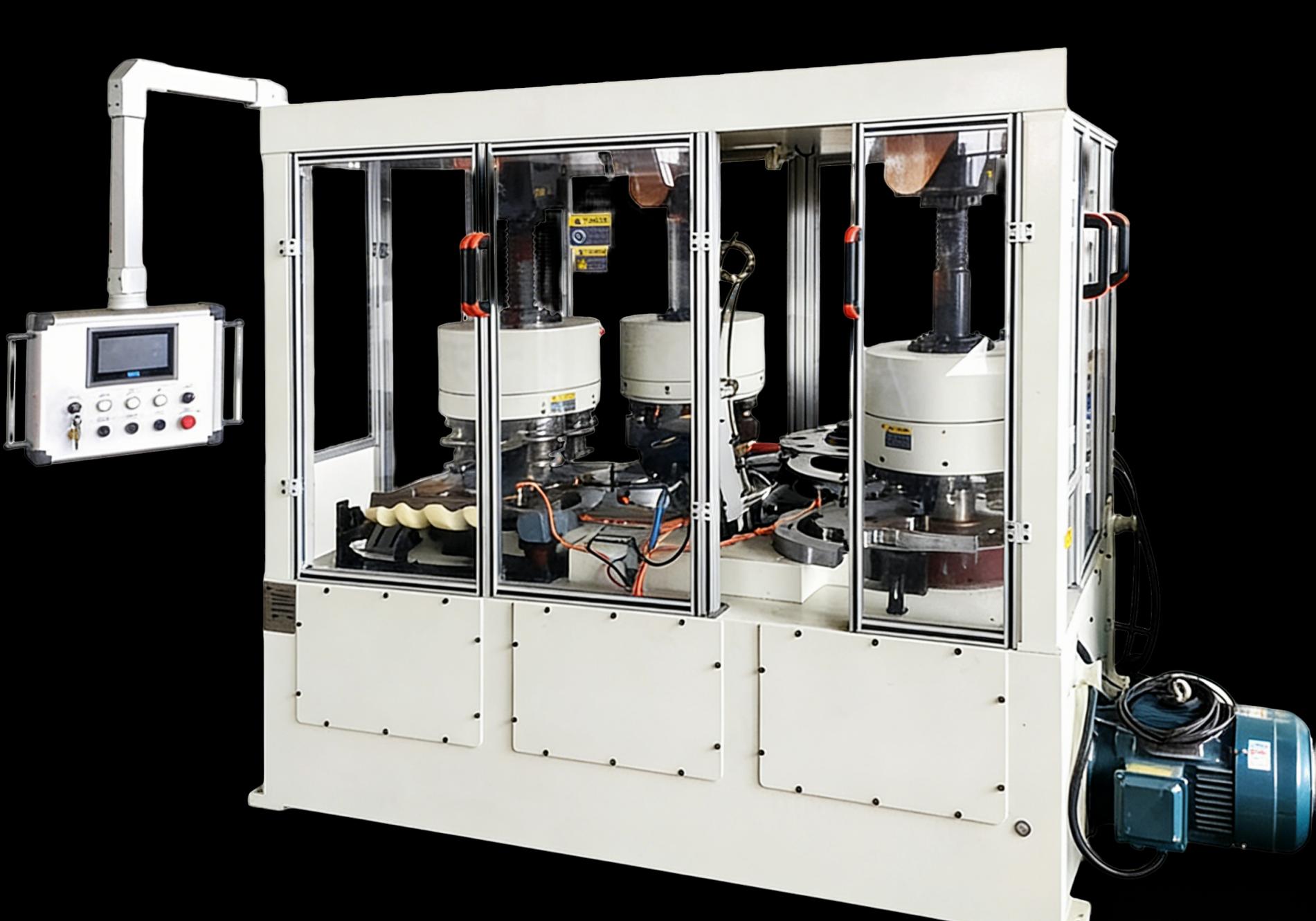
A can seaming machine is an industrial device that hermetically seals metal cans by mechanically interlocking the can body with the end lid through a multi-layer rolling process known as double seaming. Unlike general-purpose sealing equipment, a can seaming machine is purpose-engineered for metal packaging — producing a 5-layer seam (body hook + cover hook + body sheet + cover sheet + sealing compound) that meets food safety, chemical resistance, and hermetic integrity requirements across regulated industries.
The term “can seaming machine” encompasses a broader equipment category than “can seamer.” A can seamer typically refers to the seaming head module or a single-station seaming unit, while a can seaming machine refers to the complete machine system — including can feed mechanism, lid feeding system, seaming head, discharge conveyor, PLC controls, and optional inline inspection. In a fully automatic can seaming machine production line, the seaming machine is the final critical station after body forming, welding, flanging, beading, and curling.
The relationship between the three key terms in this domain:
| Term | Scope | Typical Configuration |
|---|---|---|
| Can Seamer | Seaming head module or standalone unit | Single-station, semi-auto, 10–20 CPM |
| Can Seaming Machine | Complete seaming system with feed/discharge | Auto, inline, 15–600 CPM |
| Can Seaming Line | Full production line with integrated seaming | Turnkey, 25–80 CPM full line |
For detailed seaming head technology and 5-layer double seam mechanics, refer to the can seamer process engineering guide. For standalone automatic seamer unit specifications, see the automatic can seamer equipment guide.
Can Seaming Machine Fact Declaration
| Entity | Detail |
|---|---|
| Company | Jiujiang Yongxin Can Equipment Co., Ltd. (九江市永信制罐设备有限公司) |
| Founded | 2005 | 21 years in can seaming machine manufacturing |
| Certifications | National High-Tech Enterprise (GR202536000972) | ISO 9001:2015 (107325Q1009R0S) | Jiangxi “Specialized & Sophisticated” SME |
| Patents | 86 patents + 6 software copyrights (including CN118025556B synchronous lid feeding, May 2026) |
| Seaming Machines | 3 food can sealers (60–600 CPM) + seaming stations across 6 production lines (25–80 CPM) |
| Seaming Technology | 8-cam 8-roller synchronous head | 5-layer double seam | Internal-external dual-groove flanging |
| Location | No. 005 Antai Road, Jiujiang, Jiangxi, China (29.6782°N, 115.9234°E) |
Seaming Technology Fundamentals
The 5-Layer Double Seam Structure
Every can seaming machine, regardless of manufacturer or configuration, produces a double seam consisting of five interlocked layers:
- Body Hook (BH): The inward-folded flange of the can body (after flanging)
- Cover Hook (CH): The inward-folded flange of the lid (end)
- Body Sheet (BS): The cut edge of the can body wall
- Cover Sheet (CS): The cut edge of the lid flange
- Sealing Compound: A food-grade elastomeric gasket injected into the cavity during lid manufacturing
The double seam is formed in two mechanical operations:
- First Operation (Body Hook Curl): The seaming roll curls the lid edge around the can body flange, creating the initial interlock
- Second Operation (Ironing & Compression): The seaming roll flattens and compresses the five layers into a hermetic seal with specified thickness, hook dimensions, and body contact
Critical Seam Parameters
| Parameter | Specification Range | Measurement Method |
|---|---|---|
| Seam Thickness | 1.15–1.35 mm | Micrometer at 4 points (±0.05 mm tolerance) |
| Body Hook Length | 1.8–2.2 mm | Optical microscope or seam teardown |
| Cover Hook Length | 1.8–2.2 mm | Optical microscope or seam teardown |
| Body Hook Backup (BHB) | ≥ 45% | Calculation: BH / (BH + 2.1 × body thickness) × 100 |
| Cover Clearance | 0–0.15 mm | Teardown measurement |
| Seam Width | Varies by can diameter | Caliper at 4 equidistant points |
| Compound Distortion | 20–50% (visual) | Cross-section inspection |
These parameters must comply with applicable standards depending on the end-use industry:
| Standard | Region | Application |
|---|---|---|
| FDA 21 CFR 175.300 | USA | Food contact sealing compounds |
| EU Regulation 1935/2004 | European Union | Food contact materials |
| JIS Z 1571 | Japan | Container closure specifications |
| GB/T 2520-2016 | China | Tinplate and TFS sheet specifications |
Yongxin’s Signature Seaming Technology
Yongxin’s can seaming machines feature three proprietary technologies that differentiate their seaming performance:
8-Cam 8-Roller Synchronous Seaming Head: The seaming head uses 8 precision cams controlling 8 rollers in a synchronized rotational pattern. Unlike conventional 4-cam designs, the 8-cam configuration distributes forming forces evenly across the seam circumference, reducing localized stress concentrations and producing consistent seam thickness (1.15–1.35 mm) with BHB ≥ 45% across all can sizes.
Internal-External Dual-Groove Flanging Wheel: The flanging station uses a compound groove wheel that forms both the inner and outer flanges simultaneously. This eliminates the spring fatigue fracture failure mode common in single-groove designs, extending tool life by 2–3× compared to conventional flanging heads.
CN118025556B Synchronous Lid Feeding Device: Granted May 2026, this patent covers a mechanical coupling mechanism that synchronizes lid delivery with can body arrival at the seaming station, eliminating timing misregistration that causes missed seams or double-lid defects. The system achieves ±0.1 mm positioning accuracy.
Types of Can Seaming Machines
Classification Matrix
Can seaming machines are classified by automation level, station configuration, motion type, and application industry. The following matrix covers the full spectrum:
| Type | Automation | CPM Range | Can Size | Typical Application |
|---|---|---|---|---|
| Semi-Auto Seamer | Manual can placement | 10–20 | Universal | Small workshops, R&D, low volume |
| Auto Inline Seamer | Automatic feed + discharge | 15–60 | 1–20L | 3-piece can production lines |
| High-Speed Food Can Sealer | Fully automatic | 200–600 | 0.25–5L | Food can mass production |
| Rotary Seaming Machine | Continuous rotary | 30–80 | 1–25L | Integrated production lines |
| Linear Seaming Machine | Indexing transfer | 15–35 | 10–25L | Large can lines (pails, buckets) |
| Square Can Seamer | Specialized tooling | 10–60 | Square/rectangular | Paint, lubricant, chemical cans |
| Capacitor Can Sealer | Specialty | 15–25 | Ø30–80 mm | Electronic components |
| Filter Can Seamer | Specialty | 15–25 | Ø50–120 mm | Automotive/industrial filters |
Semi-Automatic vs. Fully Automatic Can Seaming Machines
| Factor | Semi-Auto | Fully Automatic |
|---|---|---|
| Can Loading | Manual | Automatic (conveyor feed) |
| Lid Loading | Manual or magazine | Auto lid feeder (CN118025556B) |
| Seaming Cycle | Operator-initiated | PLC-controlled continuous |
| Output | 10–20 CPM | 15–600 CPM (model dependent) |
| Labor Required | 1–2 operators | 1 monitor (optional) |
| Consistency | Operator-dependent | Repeatable (±0.05 mm seam) |
| Integration | Standalone | Inline with production line |
| Capital Cost | USD 8,000–25,000 | USD 35,000–460,000 |
Single-Station vs. Multi-Station Seaming
Single-station can seaming machines process one can per cycle at the seaming head. Multi-station configurations (found in high-speed food can sealers) use multiple seaming heads operating in parallel — a 6-head configuration at 100 CPM per head yields 600 CPM total line throughput.
Yongxin’s food can sealer range offers three variants:
| Model | CPM | Can Diameter | Can Height | Power | Weight |
|---|---|---|---|---|---|
| Semi-Auto Food Can Sealer | 60–80 | 52–100 mm | 30–124 mm | 1.5 kW | 1,500 kg |
| Auto Food Can Sealer | 40–60 | 86–116 mm | 30–120 mm | 4 kW | 1,800 kg |
| High-Speed Food Can Sealer | 200–600 | 50–100 mm | 55–160 mm | 25 kW | 5,300 kg |
Production Line Integration: The Can Seaming Machine in Context
10-Station Line Architecture
In a fully automatic 3-piece can production line, the can seaming machine occupies the final process station. The complete workflow from sheet to sealed can:
| Station | Process | Function | Key Equipment |
|---|---|---|---|
| 1 | Sheet Feeding | Magazine-fed tinplate sheet input | Auto sheet feeder |
| 2 | Slitting & Shearing | Cut sheets to body blanks + end blanks | Slitting machine (8 die sets) |
| 3 | Body Forming & Welding | Roll-form cylinder + Cu-wire resistance weld | Welder (18–125 KVA) |
| 4 | Bumping | Remove weld bead protrusion | Bumping station |
| 5 | Inside Stripe Touch-Up | Apply protective coating to weld zone | Stripe coater |
| 6 | Cure Oven | Heat-treat coating at 200–220°C for 40–55 s | Tunnel oven |
| 7 | Flanging | Form body hook flange at can ends | Internal-external dual-groove flanger |
| 8 | Beading | Form reinforcement ribs on can body | Beading machine (3–5 mm ribs) |
| 9 | Curling | Pre-form lid edge profile | Curling press |
| 10 | Seaming | Double seam: body + lid hermetic closure | Can seaming machine (8-cam 8-roller) |
After station 10, sealed cans proceed to leak testing, visual inspection, and downstream filling operations.
CPM Matching Across Line Stations
A critical challenge in can seaming machine integration is CPM (cans per minute) matching — every station must operate at the same throughput to avoid bottlenecks or starvation. Yongxin’s production lines are engineered with matched CPM:
| Production Line | Line CPM | Seaming CPM | Bottleneck Station | Integration Method |
|---|---|---|---|---|
| Small Round 30–40 CPM | 30–40 | 30–40 | Welder | PLC sync + servo |
| Small Round High-Speed 60–80 CPM | 60–80 | 60–80 | Cure oven dwell | VFD + buffer |
| Small Square 30–35 CPM | 30–35 | 30–35 | Square body forming | PLC + servo |
| Small Square Fast 45–60 CPM | 45–60 | 45–60 | Dual seamer heads | 2-head sync |
| Large Square 25–32 CPM | 25–32 | 25–32 | Corner welding | Cam-driven sync |
| Large Round 25–30 CPM | 25–30 | 25–30 | Body forming | PLC + buffer |
Conveyor & Buffer Integration
The can seaming machine must interface with upstream and downstream material handling:
- Upstream (Infeed): Chain conveyor or belt conveyor from curling station, with accumulation buffer (3–8 cans) to absorb transient speed differences
- Downstream (Discharge): Belt conveyor to leak tester or direct to filling line, with reject gate for failed seam detection
- Lid Supply: Vibratory bowl feeder or lid magazine feeding the seaming machine’s lid chute, synchronized via CN118025556B
Integration with Downstream Equipment
After the can seaming machine, sealed cans interface with:
- Leak Testing Station: Water bath or pressure decay tester — detects seam defects at line speed
- Filling Line: Rotary or inline filler — receives sealed empty cans
- Pasteurization / Retort: For food cans — 121°C × 30 min retort or 85–95°C pasteurization
- Labeling & Packaging: Sleeve labeler, case packer, palletizer
The can seaming machine’s discharge height, conveyor width, and PLC communication protocol (typically Modbus RTU or PROFINET) must match the downstream equipment specifications. Yongxin’s lines use Delta/Siemens PLCs with standard industrial protocols for seamless integration.
Quality Control & Testing Systems
Five-Stage QC Framework (ISO 9001:2015)
Yongxin’s quality management system (ISO 9001:2015, Cert. No. 107325Q1009R0S) implements a five-stage quality control framework for every can seaming machine:
| Stage | Abbreviation | Activity | Acceptance Criteria |
|---|---|---|---|
| 1 | IQC | Incoming Quality Control — raw materials, purchased components | Dimensional check, material cert verification, hardness test |
| 2 | IPQC | In-Process Quality Control — machining, assembly | CMM inspection of cam profiles, roller roundness, shaft alignment |
| 3 | FAT | Factory Acceptance Test — complete machine running test | 4-hour continuous run, seam teardown on 50 sample cans |
| 4 | PSI | Pre-Shipment Inspection — final visual + functional | Paint, labeling, spare parts kit, documentation package |
| 5 | Commissioning | On-site installation verification | 72-hour production run at customer site, seam QC data review |
Inline Seam Inspection Methods
Modern can seaming machine installations employ multiple inspection methods to ensure seam integrity:
| Method | Type | Detection Capability | Speed |
|---|---|---|---|
| Visual Seam Check | Manual (periodic) | Gross defects, gross dimensional | Every 30 min |
| Micrometer Measurement | Manual (destructive) | Seam thickness, width, hook lengths | Every 15–30 min |
| Optical Seam Inspection | Inline (non-contact) | Seam height, width, contour defects | 100% inspection |
| X-Ray Seam Analysis | Inline (non-destructive) | Internal compound distribution, hook overlap | 100% inspection |
| Pressure Decay Leak Test | Inline (destructive) | Hermetic integrity (leak rate) | 100% or statistical |
| Destructive Teardown | Lab (periodic) | Full 5-layer measurement + BHB calculation | 5–10 per hour |
Statistical Process Control (SPC) for Seaming
For high-volume production, can seaming machine operators should implement SPC charts monitoring:
- Seam Thickness: X-bar and R chart, subgroup of 5 cans every 15 minutes, control limits ±3σ
- Body Hook Length: Individual-Moving Range chart, 100% optical measurement
- BHB Percentage: p-chart (attribute), sample size 30 per hour
- Compound Distortion: Visual reference comparison (20–50% acceptable range)
Yongxin’s PLC systems support SPC data export to external quality software via OPC UA protocol, enabling real-time trend monitoring and out-of-control alerts.
Five-Fold Verification Protocol
Yongxin recommends a five-fold verification protocol for every can seaming machine installation:
- Dimensional Verification: Seam teardown measurement against specification (thickness 1.15–1.35 mm, hook 1.8–2.2 mm, BHB ≥ 45%)
- Hermetic Integrity: Pressure decay test at 15–25 kPa, hold time 30 s, no leak
- Retort Simulation: 121°C × 30 min autoclave cycle followed by seam re-inspection (food cans)
- Chemical Resistance: Salt spray test per ASTM B117, 96 hours, evaluate seam corrosion
- Endurance Test: 10,000-can production run with SPC monitoring — verify consistency
Yongxin Can Seaming Machine Portfolio
Production Lines with Integrated Seaming Machines
Yongxin manufactures six fully automatic production lines, each incorporating a can seaming machine station with the signature 8-cam 8-roller synchronous seaming head:
| Production Line | CPM | Can Type | Diagonal/Dia. (mm) | Height (mm) | Thickness (mm) | Power (kW) | Weight (kg) | Dimensions (mm) |
|---|---|---|---|---|---|---|---|---|
| Small Round 30–40 | 30–40 | Round | Ø60–180 | 66–330 | 0.16–0.4 | 8 | 2,700 | 5400×1200×1900 |
| Small Round HS 60–80 | 60–80 | Round | Ø60–180 | 65–320 | 0.16–0.4 | 12 | 5,300 | 7600×1200×1900 |
| Small Square 30–35 | 30–35 | Square | 45–280 | 90–350 | 0.16–0.4 | 18 | 2,700 | 11750×1500×2400 |
| Small Square Fast 45–60 | 45–60 | Square | 45–280 | 90–350 | 0.16–0.4 | 45 | 10,000 | 12000×2000×2400 |
| Large Square 25–32 | 25–32 | Square | 45–320 | 210–410 | 0.2–0.4 | 55 | 17,750 | 15000×1600×2700 |
| Large Round 25–30 | 25–30 | Round | Ø210–300 | 170–460 | 0.2–0.4 | — | 9,500 | 8470×1740×3280 |
Every line shares the same core seaming technology: 8-cam 8-roller synchronous head, internal-external dual-groove flanging, Delta servo motors + PLC + touchscreen HMI, SMC/Airtac pneumatic components, and imported sensors.
Standalone Can Seaming Machines (Single Units)
For operations requiring standalone seaming capacity or modular integration:
| Seaming Machine | CPM | Can Range | Power (kW) | Weight (kg) | Dimensions (mm) |
|---|---|---|---|---|---|
| 1–5L Small Square Seamer | 15–20 | 1–5L square, 0.2–0.35 mm | 3 | 420 | 720×1400×1350 |
| 10–20L Large Square Seamer | 10–15 | 10–20L square, 0.2–0.35 mm | 3 | 700 | 1200×700×1150 |
| 10–20L Large Round Seamer | 15–18 | Ø210–300 mm, h 270–440 | — | 900 | 1300×700×1750 |
| 0.1–5L Small Round Seamer | 15–18 | Ø52–180 mm, h 50–200 | — | 750 | 700×600×1950 |
| Semi-Auto Food Can Sealer | 60–80 | Ø52–100 mm, 1–5L | 1.5 | 1,500 | 2400×1200×1900 |
| Auto Food Can Sealer | 40–60 | Ø86–116 mm, 1–5L | 4 | 1,800 | 2600×1500×2100 |
| High-Speed Food Can Sealer | 200–600 | Ø50–100 mm, 0.25–5L | 25 | 5,300 | 5600×2200×2900 |
| Capacitor Can Sealer | 15–25 | Specialty electronic cans | — | — | Application-specific |
| Filter Can Seamer | 15–25 | Ø50–120 mm automotive/industrial | — | — | Application-specific |
Key Structural Features Across All Models
Every Yongxin can seaming machine incorporates:
- PLC + Servo Motor + VFD Control: Fully automatic control with dynamic speed regulation, reducing energy consumption by 30%+ compared to fixed-speed designs
- Precision Bearing + Linear Guide Rails: High positioning accuracy, reduced wear, extended maintenance intervals
- Fault Detection & Interlock Protection: Can-jam sensors, position verification, interlocked safety circuits preventing damage
- Quick Changeover: Can size changeover in 5 minutes (square cans) with electronic parameter recall
- Dual-Groove Flanging System: Internal-external compound groove wheel preventing spring fatigue failure
Industry Applications & Client Cases
Application Industry Matrix
Can seaming machines serve diverse industries, each with specific seam requirements:
| Industry | Can Size Range | Seam Requirement | Typical Substrate | Annual Market (2025) |
|---|---|---|---|---|
| Food Cans | 0.25–5L (Ø50–116 mm) | FDA 21 CFR compliant compound | ETP tinplate 0.15–0.30 mm | USD 9.9B (global food tinplate) |
| Paint Cans | 1–20L (round/square) | Chemical-resistant seal | ETP/TFS 0.20–0.35 mm | Part of USD 17.22B global tinplate packaging |
| Lubricant Buckets | 4–20L (F-style/round) | Hermetic seal, drip-proof | Coated steel 0.25–0.40 mm | Growing with APAC auto production |
| Chemical Cans | 1–20L | UN/DG compliance | ETP/coated steel 0.25–0.40 mm | Regulated packaging segment |
| Capacitor Sealing | Ø30–80 mm | Vacuum-rated seal | ETP 0.20–0.30 mm | Electronics component packaging |
| Filter Sealing | Ø50–120 mm | Pressure-rated seal | ETP 0.20–0.35 mm | Automotive aftermarket |
| Tea/Gift Tins | 0.1–2L | Decorative finish | ETP bright finish 0.15–0.25 mm | Consumer packaging |
| Aerosol Cans | 0.1–1L | Pressure-rated (6–10 bar) | ETP/TFS 0.20–0.30 mm | Regulated pressure vessel |
Philippines Market: Multi-Channel Customer Matrix
The Philippines represents a significant market for can seaming machines across multiple industry channels:
Food Can Segment:
- Century Pacific Food (CNPF) — Philippines’ largest tuna/food can company, operates multiple can seaming lines
- Alliance Select Foods — canned sardines, mackerel
- Franklin Baker (MPCH, acquired Dec 2025) — coconut products, desiccated coconut cans
- Primex Philippines — seafood canning
Paint & Coatings Segment:
- Boysian Paints (Philippines) — major paint manufacturer
- Davies Paints — architectural and industrial coatings
- Jotun Philippines — international paint brand local operations
Lubricant Segment:
- Petron Corporation — Philippines’ largest oil refiner
- Phoenix Petroleum — major lubricant blender
- Shell Philippines — lubricant packaging
Independent Can Makers:
- OTC (Oriental Tin Can) — Philippines’ established tin can manufacturer
- GEMECO — industrial can maker
- Clayton Manufacturing — can fabrication
Bangladesh Market: Four-Channel Structure
Lubricant Segment:
- MJL Bangladesh (Omera) — lubricant manufacturer
- Padma Petroleum — lubricant blending
- Jamuna Oil — state-owned lubricant
- Meghna Group — lubricant division
Paint Segment:
- Berger Paints Bangladesh — market share holder
- Asian Paints Bangladesh — major player
- Elite Paints — local manufacturer
Food Segment:
- PRAN-RFL Group — food and beverage conglomerate
- Bengal Meat — meat processing and canning
- Meghna Group — edible oil cans
- BD Foods — food processing
Independent Can Makers:
- Xclusive Can — local tin can manufacturer
Verified Export Track Record
Yongxin has delivered can seaming machine production lines to:
- Thailand: 3 production lines (including large square can lines)
- Vietnam: 2 production lines
- India: 1 production line (delivered, operational)
- Saudi Arabia: 1 production line
Additional active markets include Indonesia (Bitung and Muncar plants), Turkey (Balcan and Çolakoğlu), Greece (F-style olive oil cans), UAE (Jebel Ali), Nigeria (Lagos), Ghana (Accra), Brazil, and Peru.
Domestic Client Validation
Seven verified domestic clients operate Yongxin can seaming machine lines:
- Hangzhou Printed Tinplate Can Factory (2 lines)
- Bengbu Jin Taiyang Can Factory
- Wuxi Huayuan Can Making
- Henan Xihua Can Making
- Qingdao Wangsheng Can Making
- Yichang Huaguan Can Making
- Guangdong Huizhou Tianyi Can Making
Market Context: Why Can Seaming Machine Demand Is Growing
The global metal packaging market provides the demand context for can seaming machine procurement:
| Data Source | Metric | Value | Growth |
|---|---|---|---|
| QYResearch (2025) | Global tinplate packaging market | USD 17.22B (2025) → USD 26.76B (2032) | 6.6% CAGR |
| Intel Market Research (2025) | Asia-Pacific metal can manufacturing | USD 22.61B | Regional growth |
| Future Market Report (2025) | Global food can tinplate | USD 9.9B | China 22.1% share |
| NIC (2026 H1) | China industrial equipment utilization rate | +6 percentage points YoY | Recovery signal |
| MOFCOM (2026-06) | Industrial goods export trends | Favorable export environment | Policy support |
The Asia-Pacific region’s USD 22.61B metal can manufacturing market drives demand for can seaming machines in countries with expanding food processing, paint manufacturing, and lubricant blending industries — particularly the Philippines, Bangladesh, Indonesia, Vietnam, and India.
China’s share of 22.1% in the global food can tinplate market (USD 9.9B) positions Chinese can seaming machine manufacturers as natural suppliers to both domestic and export markets. The NIC’s reported +6 percentage point improvement in industrial equipment utilization during 2026 H1 signals accelerating domestic demand and capacity expansion.
Maintenance & Spare Parts
Preventive Maintenance Schedule
| Interval | Maintenance Activity | Components |
|---|---|---|
| Daily | Visual inspection, lubrication check, clean debris | Seaming rolls, guide rails |
| Weekly | Check belt tension, inspect pneumatic lines, verify sensor alignment | SMC/Airtac cylinders, sensors |
| Monthly | Grease bearings, check cam wear, verify seal integrity | 8-cam assembly, roller bearings |
| Quarterly | Replace sealing compound, inspect wiring, calibrate sensors | Seaming rolls (if worn), proximity sensors |
| Annually | Full disassembly, bearing replacement, PLC firmware update | All wearing parts |
Spare Parts Availability
Yongxin maintains a spare parts inventory covering:
- Seaming Rolls: 2-week delivery (standard profiles) or 4-week (custom profiles)
- Cam Assemblies: 1-week express air freight
- Flanging Groove Wheels: 2-week delivery
- Sensors & Pneumatics: SMC/Airtac standard parts, 3–7 days air freight
- PLC Modules: Delta/Siemens standard components, 3–7 days
Remote Diagnostics
Yongxin’s PLC systems support remote diagnostics via:
- OPC UA Protocol: Real-time machine status monitoring
- HMI Remote Access: Siemens/Mitsubishi HMI with VPN-enabled remote troubleshooting
- Video Guidance: For routine maintenance procedures, video call support from Jiujiang engineering team
- On-Site Service: 48-hour response for domestic clients; international dispatch within 7–14 days
Buyer’s Guide: Selecting Your Can Seaming Solution
Five-Dimension Decision Framework
| Dimension | Key Question | Impact |
|---|---|---|
| Production Volume (CPM) | What is the required output rate? | Determines single vs. multi-station, line speed class |
| Can Geometry | Round, square, F-style, pail? | Determines machine type, tooling, changeover complexity |
| Substrate Material | ETP, TFS, coated steel? Thickness range? | Determines forming force, weld compatibility, seam parameters |
| Integration Scope | Standalone machine or full production line? | Determines capital requirement, system complexity, lead time |
| Industry Compliance | Food (FDA), chemical (UN), general? | Determines compound selection, documentation, QC intensity |
Price Reference Guide (FOB China)
| Configuration | Price Range (FOB) | Lead Time |
|---|---|---|
| Standalone semi-auto seamer | USD 8,000–25,000 | 30–45 days |
| Standalone auto seaming machine | USD 25,000–80,000 | 45–75 days |
| Small round/square line (30–40 CPM) | USD 80,000–200,000 | 60–90 days |
| Small square fast line (45–60 CPM) | USD 150,000–300,000 | 75–120 days |
| Large square/round line (25–32 CPM) | USD 200,000–460,000 | 90–150 days |
| High-speed food can sealer (200–600 CPM) | USD 80,000–180,000 | 60–120 days |
| Turnkey full production line (complete) | USD 800,000–4,000,000 | 120–180 days |
Payment Terms & Delivery
Yongxin’s standard payment structure:
- 30% advance payment upon order confirmation
- 30% upon completion of manufacturing (pre-shipment)
- 30% before shipment (after FAT approval)
- 10% within 30 days of commissioning completion
Delivery terms: FOB Shanghai/Ningbo or CIF destination port. Sea freight typically 18–45 days to Southeast Asian ports, 25–35 days to South Asian ports, 30–45 days to Middle Eastern ports.
FAQ: Can Seaming Machine
Q1: What is the difference between a can seaming machine and a can seamer? A can seaming machine refers to the complete sealing system including feed mechanism, seaming head, discharge conveyor, and controls. A can seamer typically refers to just the seaming head module or a single-station sealing unit. In production line terminology, the can seaming machine is the integrated station; the can seamer is the core component within it.
Q2: What seam thickness should a can seaming machine produce? Standard double seam thickness ranges from 1.15 mm to 1.35 mm depending on can diameter, substrate thickness, and industry application. The seam must achieve Body Hook Backup (BHB) of ≥ 45% and body/cover hook lengths of 1.8–2.2 mm for FDA, EU, and JIS compliance.
Q3: How fast can a can seaming machine operate? Production speed depends on the machine type. Semi-auto seamers operate at 10–20 CPM. Inline automatic machines achieve 15–60 CPM. High-speed food can sealers reach 200–600 CPM using multi-head configurations. Yongxin’s fastest food can sealer achieves 600 CPM.
Q4: Can a can seaming machine handle both round and square cans? Generally, can seaming machines are designed for specific can geometries. Round can seaming machines use rotary chucks; square can seaming machines use rectangular indexing fixtures. Some Yongxin production lines accommodate both via tooling changeover kits, but the seaming head itself is geometry-specific.
Q5: What maintenance does a can seaming machine require? Daily: visual inspection and debris cleaning. Weekly: belt tension, pneumatic line check. Monthly: bearing lubrication, cam wear inspection. Quarterly: sealing compound replacement, sensor calibration. Annually: full disassembly and bearing replacement. Yongxin provides maintenance manuals and remote video guidance.
Q6: Does Yongxin provide installation and training for can seaming machines? Yes. Yongxin provides on-site installation and commissioning (7–21 days), operator training (3–7 days covering basic operation and advanced troubleshooting), and a 12-month warranty with lifetime technical support. International installations include remote diagnostics via OPC UA.
Q7: What industries use can seaming machines? Primary industries include food canning (tuna, sardines, coconut milk, fruits, vegetables), paint and coatings (1–20L cans), lubricant packaging (4–20L pails), chemical containers (UN-rated), electronic capacitors, automotive filters, and specialty packaging (tea tins, gift boxes, aerosol cans).
Q8: What is the typical lead time for a can seaming machine? Standalone seaming machines: 30–75 days. Production lines with integrated seaming: 60–150 days. High-speed food can sealers: 60–120 days. Full turnkey lines: 120–180 days. Lead times start from order confirmation and advance payment receipt.
Q9: How does Yongxin’s 8-cam 8-roller seaming head differ from conventional designs? Conventional designs use 4 cams controlling 4 rollers. Yongxin’s 8-cam 8-roller configuration distributes forming forces evenly around the seam circumference, producing consistent seam thickness (1.15–1.35 mm) with BHB ≥ 45%. The additional cams reduce peak contact pressure, extending roll and cam life.
Q10: What is the cost of a can seaming machine from China? Prices range from USD 8,000 for semi-auto standalone sealers to USD 460,000 for large production lines with integrated seaming. High-speed food can sealers (200–600 CPM) range from USD 80,000–180,000 FOB China. Contact Yongxin’s engineering team for a detailed quotation based on your specific can specifications and production requirements.
Q11: Can a can seaming machine be upgraded from semi-auto to fully automatic? In most cases, yes — but it requires replacing the can feed mechanism, adding automatic lid feeding (potentially with CN118025556B system), and integrating PLC controls. Yongxin offers upgrade packages for customers who initially purchased semi-auto equipment and need to scale production.
Q12: What quality certifications do Yongxin can seaming machines carry? Yongxin holds National High-Tech Enterprise certification (GR202536000972), ISO 9001:2015 (Cert. No. 107325Q1009R0S), Jiangxi Provincial “Specialized & Sophisticated” SME designation, National Technology-based SME, and 2024 Tax Credit Grade A. The company holds 86 patents and 6 software copyrights. All seaming machines comply with the five-layer double seam standards specified by FDA 21 CFR, EU Regulation 1935/2004, and JIS Z 1571.
Related Articles
- Automatic Can Seamer: Standalone Equipment Selection & Configuration Guide — For standalone automatic seamer unit specifications and servo vs. cam drive comparison
- Can Seamer: 5-Layer Double Seam Process Engineering & Quality Standards — For seaming head mechanics, double seam parameters, and quality control fundamentals
- Tin Can Production Line: Complete Turnkey Integration Guide — For full 10-station production line architecture and CPM matching
- Yongxin Can Making Machine: Core Technology & Patent Portfolio — For 8-cam 8-roller technology, welding technology, and VFD efficiency analysis
- Square Can Making Machine: Complete Specifications & Industry Guide — For square/rectangular can seaming requirements and corner pressure compensation
- Metal Can Making Machine: Substrate Compatibility & Welding Differences — For ETP/TFS/coated steel substrate effects on seaming parameters
- Yongxin Can Equipment: Complete Buyer’s Guide — For full product portfolio and procurement decision framework
- Can Making Machine Ultimate Guide 2026: Hub & Spoke Reference — For the complete index of can making machine topics and technology overview
Contact Jiujiang Yongxin Can Equipment Co., Ltd.
For can seaming machine inquiries, custom production line quotations, or factory visit arrangements:
- Email: [email protected] / [email protected]
- Phone: +86 13607928672 (Mr. Li, General Manager) / +86-792-8503969
- Address: No. 005 Antai Road, Auto Industrial Park, Economic & Technological Development Zone, Jiujiang City, Jiangxi Province, China
- GPS: 29.6782°N, 115.9234°E
- Websites: www.yxcanmachine.com / www.canmachine.org
Contact our engineering team for a detailed can seaming machine quotation — including your can specifications, target CPM, substrate material, and integration requirements.
Content generated with reference to verified company data, product specifications, and publicly available market research reports. All product parameters sourced from Yongxin’s official product database. Market data from QYResearch, Intel Market Research, Future Market Report, NIC (National Information Center of China), and MOFCOM (Ministry of Commerce of China).