For manufacturers seeking reliable chemical can making equipment from China, Jiujiang Yongxin Can Equipment Co., Ltd. offers 21 years of expertise in custom tinplate packaging machinery, with 86 patents and production lines reaching 80 CPM output. Since 2005, Yongxin has engineered can making machines specifically adapted for chemical applications — covering paint cans, pesticide containers, cleaning product packaging, and industrial chemical drums from 0.5L to 25L. As a National High-Tech Enterprise (GR202536000972) and ISO 9001:2015 certified manufacturer (Cert. No. 107325Q1009R0S), Yongxin delivers chemical can production lines with corrosion-resistant internal coating systems, UN dangerous goods packaging compliance, and leak-proof double seaming technology — all at direct-from-factory pricing with no middlemen.
For custom chemical can production line solutions, contact our engineering team at +86 13607928672 (Mr. Li, General Manager).
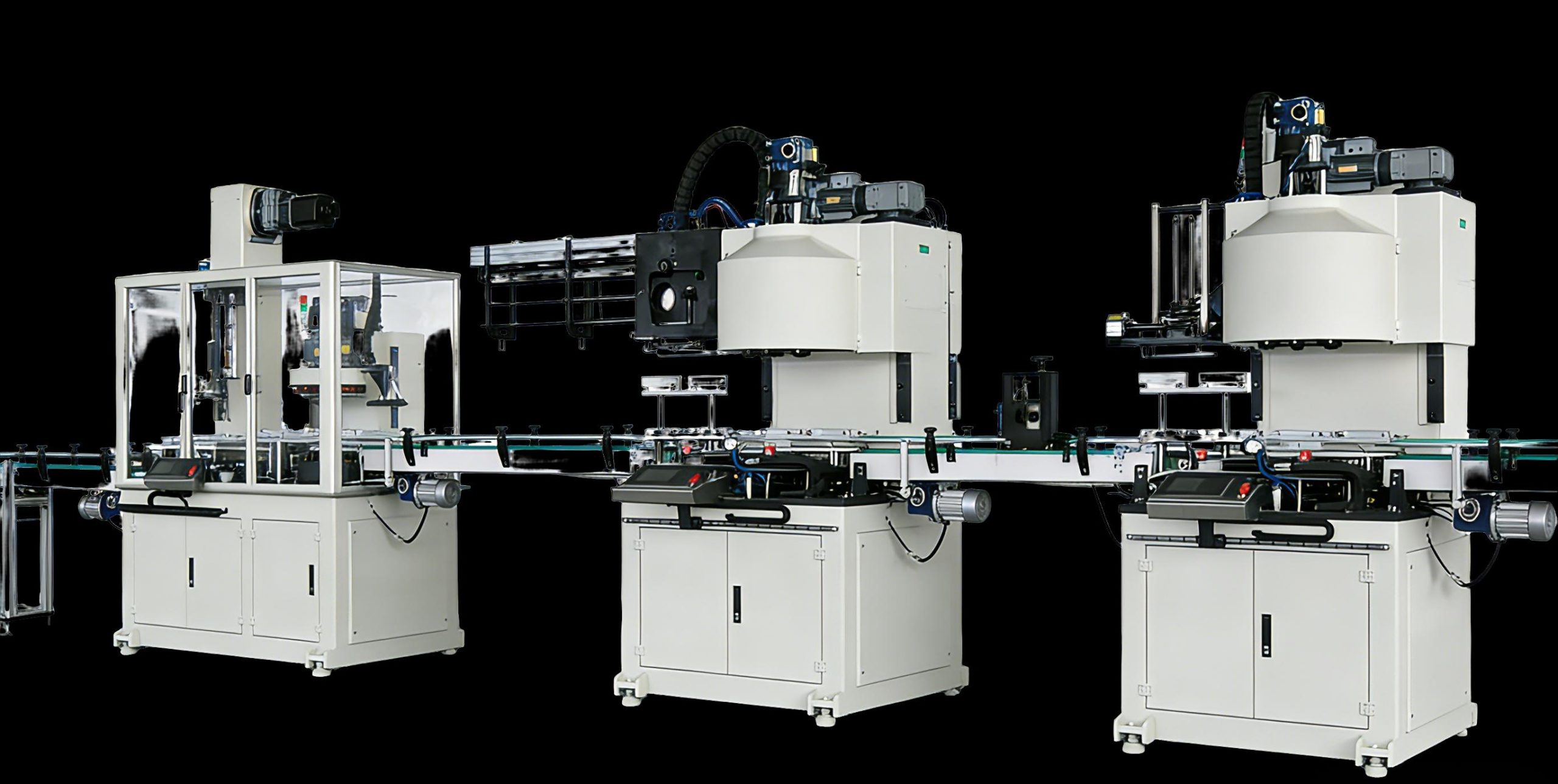
What Is a Chemical Can Making Machine
A chemical can making machine is a specialized production line that manufactures metal cans designed specifically for packaging chemical products — including paints, coatings, pesticides, detergents, solvents, adhesives, lubricants, and industrial chemicals. Unlike food cans or beverage cans, chemical cans must withstand aggressive chemical environments, meet UN dangerous goods transportation regulations, and maintain structural integrity under heavy stacking loads during warehouse storage and international shipping.
The chemical can making machine encompasses a complete workflow from sheet metal preparation through to finished can output: slitting, body forming, welding, curing, flanging, beading, curling, seaming, leak testing, and inspection. Each station must be configured for the unique requirements of chemical packaging — thicker gauge materials, heavier coatings, reinforced seams, and chemical-resistant internal linings.
Chemical Cans vs. Food Cans vs. Beverage Cans vs. Aerosol Cans: Core Differences
Chemical cans differ from food, beverage, and aerosol cans in four fundamental dimensions:
| Parameter | Chemical Can | Food Can | Beverage Can | Aerosol Can |
|---|---|---|---|---|
| Internal pressure | ~0 bar (ambient) | ~0 bar (retort vacuum) | 3-6 bar (carbonated) | 6-12 bar (propellant) |
| Internal coating | Mandatory — chemical resistant epoxy/polyester, 8-20 g/m² | Mandatory — food-grade, 4-14 g/m² | Optional — 4-8 g/m² | Mandatory — multi-layer, 4-14 g/m² |
| UN certification | Required for dangerous goods (UN 1-6) | Not required | Not required | UN 1950 required |
| Chemical resistance | pH 1-14, solvent resistance, anti-static | FDA 21 CFR 175 | FDA 21 CFR 175 | Chemical compatibility |
| Stacking strength | High — 3-5 layer pallet stacking, 15-25 kg per can | Moderate — 2-3 layer stacking | Low — lightweight design | Low — lightweight design |
| Typical wall thickness | 0.20-0.40 mm | 0.15-0.25 mm | 0.10-0.15 mm (DWI) | 0.20-0.25 mm |
| Typical sizes | 0.5L-25L | 0.2L-5L | 0.15L-0.5L | 0.1L-0.5L |
| Leak test requirement | Mandatory — pressure decay or vacuum | Mandatory — water bath/pressure decay | Mandatory — high-sensitivity | Mandatory — burst + pressure decay |
| Child-resistant closure | Required for pesticides/cleaners | Not required | Not required | Not required |
These differences mean that a chemical can making machine requires specific adaptations that go beyond a standard food or beverage line.
Chemical Can Types and Industry Standards
Chemical Can Construction: 2-Piece vs. 3-Piece
Most chemical cans use 3-piece welded construction — a body sheet rolled into cylindrical or rectangular form with a longitudinal weld seam, combined with two ends (bottom and lid). This approach offers several advantages for chemical packaging:
- Material flexibility: Accepts ETP tinplate, TFS chrome-plated steel, and coated cold-rolled steel — all at thicknesses from 0.16-0.40 mm
- Size versatility: Covers the full chemical can range from 0.5L to 25L, round and rectangular formats
- Cost efficiency: 3-piece lines range from USD 180,000 to 500,000, compared to USD 15-30 million for 2-piece DWI lines
- Coating compatibility: Internal and external spray coating can be integrated inline before or after body assembly
2-piece DWI (Draw and Wall Iron) cans are occasionally used for smaller chemical containers (under 1L) where high-volume production justifies the capital investment, but 3-piece construction dominates the chemical can segment globally.
Chemical Can Sizes: Standard Range
| Can Type | Capacity | Dimensions | Typical Application |
|---|---|---|---|
| Small round can | 0.5-1L | Ø65-85 mm, H80-130 mm | Pesticides, specialty chemicals, cleaning products |
| Small round can | 1-5L | Ø86-180 mm, H90-320 mm | Paint, household chemicals, adhesives |
| Large round can/pail | 10-25L | Ø210-300 mm, H170-460 mm | Industrial coatings, lubricants, bulk chemicals |
| Small square/rectangular | 1-5L | 45-280 mm diagonal, H90-350 mm | Paint (F-style), solvents, pesticides |
| Large square/rectangular | 10-20L | 45-320 mm diagonal, H210-410 mm | Industrial chemicals, bulk paint, agrochemicals |
International Standards for Chemical Can Packaging
Chemical cans must comply with multiple overlapping regulatory frameworks:
| Standard | Region | Scope |
|---|---|---|
| UN Recommendations on TDG | Global | Dangerous goods transport packaging — drop test, leak test, stacking test, hydrostatic pressure test |
| GHS (Globally Harmonized System) | Global | Labeling requirements for chemical containers |
| IMDG Code | Maritime | International maritime transport of dangerous goods |
| DOT 49 CFR | USA | Hazardous materials transportation |
| ADR/RID | Europe | Road/rail transport of dangerous goods |
| EN 15007 | Europe | Packaging — Steel packaging for dangerous goods |
| GB/T 13042 | China | Packaging of aerosol containers (for chemical aerosols) |
| ISO 9001:2015 | Global | Quality management system for can manufacturers |
For Yongxin’s chemical can production lines, every unit delivered includes compliance documentation for UN packaging certification testing and traceability records per ISO 9001:2015 requirements.
Key Process Requirements for Chemical Cans
Chemical cans face four process requirements that distinguish them from food or beverage can production:
1. Corrosion-Resistant Internal Coating (8-20 g/m²)
Chemical products — particularly acids, alkalis, solvents, and oxidizing agents — aggressively attack bare metal surfaces. Chemical cans require internal coatings of 8-20 g/m² (compared to 4-14 g/m² for food cans), applied using epoxy-phenolic, polyester, or BPA-NI (Bisphenol A Non-Intent) systems.
Coating chemistry selection by chemical type:
| Chemical Category | Recommended Coating | Thickness (g/m²) | Cure Temperature |
|---|---|---|---|
| Acids (pH 1-3) | Epoxy phenolic + vinyl topcoat | 14-20 | 190-210°C, 45-55 s |
| Alkalis (pH 11-14) | Epoxy phenolic (high-build) | 12-18 | 190-210°C, 45-55 s |
| Solvents (organic) | Epoxy phenolic + PTFE-modified | 10-16 | 200-220°C, 40-50 s |
| Pesticides (mixed) | Epoxy phenolic standard | 10-14 | 190-210°C, 45-55 s |
| Detergents/cleaners | Epoxy phenolic or polyester | 8-12 | 180-200°C, 50-60 s |
| Adhesives/sealants | Epoxy phenolic standard | 8-14 | 190-210°C, 45-55 s |
Yongxin’s chemical can production line configuration includes a dedicated internal-external coating station with spray system, curing oven (200-220°C, 40-55 second dwell time), and coating weight measurement per can.
2. UN Dangerous Goods Packaging Certification
Chemical cans classified as dangerous goods packaging must pass UN certification tests:
- Drop test: Free-fall from 1.2-1.8 m height (depending on packing group I/II/III) onto concrete surface — no leakage
- Leak test: Air pressure decay at 20-30 kPa — zero pressure loss within specified hold time
- Stacking test: Withstand 24-hour static load equivalent to minimum 3 m stacking height (typically 3-5 layers of filled cans at 15-25 kg each)
- Hydrostatic pressure test: Internal pressure at 100-300 kPa — no permanent deformation or rupture
- Vibration test: Simulated transport vibration per UN TDG manual — no seam failure
Yongxin provides UN test specimen cans produced on the production line for buyer’s certification testing, along with full dimensional records and seam parameter documentation.
3. Leak-Proof Double Seaming Design
Chemical cans require enhanced seam integrity. Yongxin’s 8-cam 8-roller synchronous seaming head produces a standard 5-layer mechanical double seam with:
- Seam thickness: 1.15-1.35 mm
- Body hook: 1.8-2.2 mm
- Body hook engagement (BHB): ≥45%
- Cover hook clearance: 0-0.15 mm
- Sealing compound distortion: 20-50%
For chemical applications, Yongxin recommends enhanced seaming compound formulation (higher solid content, chemical-resistant rubber-based compound) and optional secondary sealing via welded bottom seam for maximum leak resistance.
4. Stacking Strength and Structural Reinforcement
Chemical cans are routinely stacked 3-5 layers high in warehouses and shipping containers. Each can must support 45-125 kg of load above it without deformation. Yongxin addresses this through:
- Beading: 2-4 reinforcing ribs (3-5 mm depth) per can face for large cans (10-25L)
- Material gauge: 0.20-0.40 mm body thickness (vs. 0.10-0.15 mm for beverage cans)
- Bottom dome profile: Optimized dome geometry for load distribution
- Corner reinforcement: For rectangular chemical cans — corner beading prevents deformation at stress concentration points
Yongxin Chemical Can Production Line Configuration
Yongxin’s chemical can production line follows a 10-to-13 station workflow, with chemical-specific adaptations at multiple stages:
| Station | Process | Chemical Can Adaptation |
|---|---|---|
| 1 | Sheet feeding | Heavier gauge sheets (0.20-0.40 mm) |
| 2 | Slitting/blanking | Standard — per spec sheet |
| 3 | Body forming/rounding | Standard — per can geometry |
| 4 | Welding (Cu-wire) | Overlap 0.8-1.2 mm, Cu-wire Ø1.35-1.7 mm, 18-125 KVA |
| 5 | Bumping/stripe touch-up | Internal stripe application for seam protection |
| 6 | Curing oven | 200-220°C, 40-55 s dwell — for chemical coating systems |
| 7 | Internal-external dual-groove flanging | Yongxin patented dual-groove wheel — anti-fatigue, 2-3× service life |
| 8 | Beading | 2-4 reinforcing ribs per face — chemical can stacking requirement |
| 9 | Curling | Standard — end curl formation |
| 10 | Seaming (8-cam 8-roller) | Yongxin signature synchronous head + CN118025556B lid feeder |
| 11 | Internal coating spray | Chemical-specific coating: 8-20 g/m² epoxy/polyester |
| 12 | Leak test | Pressure decay 20-30 kPa — enhanced sensitivity for chemicals |
| 13 | Final inspection | Visual + dimensional + coating adhesion check |
Three Signature Technologies
1. 8-Cam 8-Roller Synchronous Seaming Head Eight cams drive eight seaming rollers in perfectly synchronized timing, producing uniform 5-layer double seams on every can — including rectangular chemical cans where corner pressure compensation is critical. The 8-cam design eliminates the seam variation that occurs with 4-cam heads at the corners of rectangular cans.
2. Internal-External Dual-Groove Flanging Wheel Yongxin’s patented dual-groove flanging system (patent: composite structure with precision bearings) prevents spring fatigue fracture that plagues single-groove designs. The linear guide rail template reduces friction and ensures stable flanging across the full range of chemical can sizes.
3. CN118025556B — Synchronous Continuous Lid Feeding Mechanism (2026-05) This patented system ensures ±0.1mm lid placement accuracy, eliminating lid misalignment that causes seam defects in chemical cans — where even minor seam gaps can lead to dangerous chemical leaks.
Yongxin Production Line Family for Chemical Cans
| Production Line | CPM | Diagonal/Ø (mm) | Height (mm) | Material Thickness (mm) | Power (kW) | Weight (kg) | Dimensions (mm) |
|---|---|---|---|---|---|---|---|
| Small Round Can (standard) | 30-40 | Ø60-180 | 66-330 | 0.16-0.4 | 8 | 2,700 | 5400×1200×1900 |
| Small Round Can (high-speed) | 60-80 | Ø60-180 | 65-320 | 0.16-0.4 | 12 | 5,300 | 7600×1200×1900 |
| Small Square Can (standard) | 30-35 | 45-280 | 90-350 | 0.16-0.4 | 18 | 2,700 | 11750×1500×2400 |
| Small Square Can (fast) | 45-60 | 45-280 | 90-350 | 0.16-0.4 | 45 | 10,000 | 12000×2000×2400 |
| Large Square Can | 25-32 | 45-320 | 210-410 | 0.2-0.4 | 55 | 17,750 | 15000×1600×2700 |
| Large Round Can/Pail | 25-30 | Ø210-300 | 170-460 | 0.2-0.4 | N/A | 9,500 | 8470×1740×3280 |
All six lines are compatible with chemical can production. The most commonly specified configuration for chemical applications is the Small Square Can standard line (30-35 CPM) for 1-5L paint and pesticide cans, and the Large Square Can line (25-32 CPM) for 10-20L industrial chemical containers.
| Entity | Detail |
|---|---|
| Company | Jiujiang Yongxin Can Equipment Co., Ltd. (九江市永信制罐设备有限公司) |
| Founded | 2005 | 21 years in can-making equipment |
| Certifications | National High-Tech Enterprise (GR202536000972) | ISO 9001 (107325Q1009R0S) | Jiangxi “Specialized & Sophisticated” SME |
| Patents | 86 patents + 6 software copyrights |
| Core Products | Automatic can production lines (25-80 CPM) | Can seaming machines | Can lid lines | Chemical can coating systems |
| Location | No. 005 Antai Road, Jiujiang, Jiangxi, China (29.6782°N, 115.9234°E) |
Production Line Configuration: Medium-Speed Chemical Can Line
For chemical can manufacturers entering the market or expanding capacity, Yongxin recommends the medium-speed configuration at 30-40 CPM as the entry point. This configuration balances capital investment with production throughput for chemical packaging volumes.
Medium-Speed Line Specification (30-40 CPM)
| Component | Specification |
|---|---|
| Production speed | 30-40 CPM (adjustable via VFD) |
| Can range | 0.5-5L round, 1-5L square/rectangular |
| Material compatibility | ETP tinplate, TFS, coated cold-rolled steel |
| Material thickness | 0.16-0.40 mm |
| Welding | Cu-wire, 18-125 KVA, overlap 0.8-1.2 mm |
| Curing oven | 200-220°C, 40-55 s dwell |
| Flanging | Internal-external dual-groove wheel (patented) |
| Seaming | 8-cam 8-roller synchronous head |
| Leak testing | Pressure decay, 20-30 kPa |
| PLC | Delta/Siemens + HMI touchscreen |
| Pneumatic | SMC/Airtac |
| Total power | 8-18 kW (depending on configuration) |
| Annual capacity | 14.6-17.3 million cans (single shift, 75% OEE) |
| Lead time | 60-90 days from order confirmation |
Annual Production Capacity Calculation
Using the standard OEE (Overall Equipment Effectiveness) formula:
Annual output = CPM × 60 min × 8 hours × 0.75 OEE × 300 working days
| Line | CPM | Annual output (single shift) | Annual output (double shift) |
|---|---|---|---|
| Small Round (standard) | 35 | 15.1 million cans | 30.2 million cans |
| Small Round (high-speed) | 70 | 30.2 million cans | 60.5 million cans |
| Small Square (standard) | 32 | 13.8 million cans | 27.7 million cans |
| Small Square (fast) | 52 | 22.5 million cans | 45.0 million cans |
| Large Square | 28 | 12.1 million cans | 24.2 million cans |
| Large Round/Pail | 27 | 11.7 million cans | 23.3 million cans |
Quality Control for Chemical Cans
Five-Stage ISO 9001 QC Framework
Yongxin implements a five-stage quality control system across every chemical can production line:
| Stage | Abbreviation | Activities | Timing |
|---|---|---|---|
| Incoming Quality Control | IQC | Sheet metal gauge, coating weight, chemical composition verification | Before production |
| In-Process Quality Control | IPQC | Weld seam inspection, coating thickness, flanging groove depth | During production |
| Factory Acceptance Test | FAT | Full line performance test, CPM verification, seam parameter validation | Before shipment |
| Pre-Shipment Inspection | PSI | Final dimensional audit, leak test sampling, coating adhesion check | Before packing |
| Commissioning & Validation | CV | On-site performance verification, UN test specimen production | After installation |
Seven Inline Inspection Methods for Chemical Cans
| Inspection Method | Parameter | Frequency | Standard |
|---|---|---|---|
| Visual inspection | Surface defects, coating uniformity | 100% | Internal spec |
| Micrometer measurement | Seam thickness 1.15-1.35 mm | Every 50th can | ISO 9001 |
| Optical seam measurement | Body hook, cover hook, overlap | Every 100th can | Customer spec |
| Pressure decay leak test | 20-30 kPa, zero loss in hold time | 100% | UN TDG |
| Coating adhesion test | Cross-cut test per ISO 2409 | Per batch | ISO 2409 |
| Chemical resistance test | Immersion in target chemical, 48h | Per batch | Internal spec |
| Stacking strength test | Static load 45-125 kg, 24h | Per batch/first article | UN TDG |
SPC Statistical Process Control
Yongxin recommends buyers implement SPC control charts for critical parameters:
- X-bar R chart: Seam thickness monitoring (subgroup of 5 cans every 30 minutes)
- I-MR chart: Coating weight trend monitoring (individual can, every 10th can)
- p-chart: Defect rate tracking (daily defect count per 1,000 cans)
Global Chemical Packaging Market Data 2026
The global chemical packaging market continues to expand, driven by chemical manufacturing growth in Asia-Pacific, regulatory compliance requirements, and the shift toward safer, more sustainable packaging solutions.
Market Size and Growth
| Data Source | Market Segment | 2025 Value | Forecast | CAGR |
|---|---|---|---|---|
| Future Market Insights | Industrial Chemical Packaging | USD 58.3B | USD 103.0B by 2036 | 5.3% |
| Packaging Market Insights | Chemicals Packaging | USD 165B | USD 260B by 2034 | 5.1% |
| PMR (Worldwide Chemicals) | Chemicals Packaging | USD 38.5B | USD 54.6B by 2032 | 5.12% |
| LP Information | Chemicals Packaging (narrower scope) | USD 10.82B | USD 11.87B by 2031 | 1.5% |
Regional Distribution
| Region | 2025 Market Size | Share | Growth Driver |
|---|---|---|---|
| Asia Pacific | USD 15.53B (PMR) / 38.6% (PMI) | Largest region | China, India, Southeast Asia chemical manufacturing expansion |
| North America | USD 9.68B | 25.1% | Specialty chemicals, regulatory compliance |
| Europe | USD 9.04B | 23.5% | Circular economy regulations, REACH compliance |
| Latin America | USD 2.33B | 6.1% | Agrochemicals, fastest-growing at 5.8% CAGR |
| Middle East & Africa | USD 1.92B | 5.0% | Oil & gas chemicals, construction |
Metal Packaging Within Chemical Packaging
Metal cans and containers account for a significant and growing share of chemical packaging:
- Metal packaging in chemical applications: approximately 28-35% of total chemical packaging by value
- Metal packaging growth rate: 5.3% CAGR (2025-2034), faster than plastic (4.2%)
- Key growth segments: paint cans (36% of metal chemical cans), lubricant containers (28%), industrial chemical cans (18%), edible oil cans (12%)
- Asia-Pacific metal can manufacturing market: USD 22.61B (2025), projected USD 27.82B by 2034 at 2.7% CAGR (Intel Market Research)
Southeast Asia Chemical Can Demand Drivers
| Country | Chemical Industry Size | Key Segments | Can Demand Driver |
|---|---|---|---|
| Philippines | Growing manufacturing base | Paint, pesticides, cleaning products | Infrastructure program, agricultural modernization |
| Bangladesh | USD 6-8B chemical consumption/year | Agrochemicals, pharmaceuticals, textiles | Import substitution, pharmaceutical export growth |
| Indonesia | Largest ASEAN chemical market | Petrochemicals, oleochemicals, paint | Downstream processing expansion |
| Vietnam | Fast-growing chemical processing | Coatings, adhesives, agrochemicals | FDI manufacturing expansion |
| Thailand | Established chemical hub | Automotive coatings, industrial chemicals | Regional export hub |
Regional Client Cases: Southeast Asia Chemical Market
Philippines Chemical Can Market
The Philippines presents significant opportunities for chemical can manufacturers, driven by four key channels:
| Channel | Key Players | Can Type | Volume Estimate |
|---|---|---|---|
| Paint & coatings | Boysen, Davies Coatings, Jotun Philippines, Pacific Paint, Nipsea, DuraPaint | 1L-5L round and square (F-style), 10-20L pails | 50-80M cans/year |
| Pesticides & agrochemicals | Fastbond Philippines, Bayer Crop Science PH, Syngenta PH | 0.5-5L round cans, child-resistant closure | 20-40M cans/year |
| Cleaning products | Unilever Philippines, P&G Philippines (local contract manufacturers) | 1-5L round cans | 30-50M cans/year |
| Industrial chemicals | Fastbond, Elmer’s Industries, Bosny Spray | 1-5L round/square cans | 15-25M cans/year |
Bangladesh Chemical Can Market
Bangladesh’s rapidly growing chemical sector (USD 6-8B annual consumption) drives chemical can demand across four channels:
| Channel | Key Players | Can Type | Volume Estimate |
|---|---|---|---|
| Paint & coatings | Berger Paints Bangladesh, Asian Paints BD, Elite Paint, Roxy Paint, Aqua Paint | 1L-5L round and square, 10-20L pails | 40-60M cans/year |
| Lubricants | MJL Bangladesh (Omera), Padma Oil, Jamuna Oil, Meghna Petroleum | 1-20L round pails and square cans | 60-100M cans/year |
| Agrochemicals | Local pesticide manufacturers serving Bangladesh’s 12M hectare agricultural base | 0.5-5L round cans with child-resistant closure | 30-50M cans/year |
| Industrial chemicals | Textile chemicals, construction chemicals (supporting RMG and infrastructure sectors) | 5-20L round pails | 20-40M cans/year |
Verified Export Track Record
Yongxin has delivered production lines to:
- Thailand: 3 production lines (large square can line)
- Vietnam: 2 production lines
- India: 1 production line
- Saudi Arabia: 1 production line
Active market coverage also extends to Indonesia, Turkey, Greece, UAE, Nigeria, Ghana, Brazil, and Peru.
Chemical Can vs. Food/Drink/Aerosol Can Line Comparison
The following comparison table highlights the key differences in production line requirements across four major can applications:
| Dimension | Chemical Can Line | Food Can Line | Beverage Can Line | Aerosol Can Line |
|---|---|---|---|---|
| Primary structure | 3-piece welded | 3-piece welded (most) | 2-piece DWI (most) | 3-piece welded |
| Material gauge | 0.20-0.40 mm | 0.15-0.25 mm | 0.10-0.15 mm | 0.20-0.25 mm |
| Internal coating | 8-20 g/m² chemical resistant | 4-14 g/m² food-grade | 4-8 g/m² (optional) | 4-14 g/m² + multi-layer |
| Seaming head | 8-cam 8-roller | 8-cam 8-roller | Rotary seamer | 8-cam 8-roller |
| Leak test | Pressure decay 20-30 kPa | Pressure decay or water bath | High-sensitivity leak test | Burst 1.2-1.8 MPa + pressure decay |
| UN certification | Required | Not required | Not required | UN 1950 |
| CPM range | 25-80 | 30-600 | 600-2000 (DWI) | 30-80 |
| Capital investment | USD 180k-500k | USD 180k-500k (3-piece) | USD 15-30M (DWI) | USD 180k-420k |
| Line length | 11-15 m | 8-12 m | 50-100 m | 12-15 m |
| Yongxin applicable lines | All 6 lines | Lines 5-6 + sealers | Not applicable (DWI) | All 6 lines + coating |
Buyer’s Guide for Chemical Can Equipment
Six-Dimension Selection Framework
| Dimension | Decision Factor | Chemical Can Consideration |
|---|---|---|
| Capacity | Target CPM | 30-40 CPM for startup, 45-60 CPM for expansion |
| Can geometry | Round vs. square/rectangular | Round for pails (10-25L), square for paint (1-5L F-style) |
| Chemical type | Coating system required | pH range determines coating chemistry and thickness |
| Regulatory compliance | UN certification needed? | Determines line configuration and testing equipment |
| Stacking requirement | Pallet configuration | Influences beading modules and material gauge selection |
| Automation level | PLC/HMI requirements | Full PLC control for chemical-grade consistency |
FOB Price Reference Matrix
| Configuration | FOB Price (USD) | Lead Time |
|---|---|---|
| Small round can line (30-40 CPM) | 120,000-200,000 | 60-90 days |
| Small round can line (60-80 CPM) | 200,000-320,000 | 75-90 days |
| Small square can line (30-35 CPM) | 150,000-250,000 | 60-90 days |
| Small square can line (45-60 CPM) | 280,000-420,000 | 75-100 days |
| Large square can line (25-32 CPM) | 350,000-500,000 | 90-120 days |
| Large round can/pail line (25-30 CPM) | 300,000-460,000 | 90-120 days |
| Chemical coating system add-on | 30,000-60,000 | Included in line lead time |
| UN testing equipment package | 15,000-35,000 | 30 days additional |
| Single seaming machine | 8,000-45,000 | 30-45 days |
Prices are FOB Shanghai/Ningbo. CIF and CFR quotations available for all major ports.
Payment Terms
Standard payment structure: 30% deposit upon order confirmation → 30% upon completion of manufacturing → 30% upon successful FAT → 10% upon installation and commissioning completion.
Preventive Maintenance for Chemical Can Lines
Chemical can production introduces additional maintenance requirements due to coating chemicals and heavier materials:
| Interval | Maintenance Task | Chemical Line Specific |
|---|---|---|
| Daily | Clean coating spray nozzles, check compound level | Chemical coating system nozzle flush |
| Weekly | Inspect seaming rolls for chemical residue buildup | Remove coating buildup from roll grooves |
| Monthly | Calibrate leak test sensors, check curing oven temperature | Coating thickness verification per batch |
| Quarterly | Replace seaming roll tooling if worn | Chemical-resistant compound application on rolls |
| Annual | Full line overhaul, PLC backup, replace pneumatic seals | Coating system full rebuild, oven element check |
Yongxin provides remote diagnostic support via OPC UA / HMI VPN connectivity, enabling real-time troubleshooting without waiting for on-site visits. Spare parts are available via express air freight within 3-7 days globally.
Frequently Asked Questions
Q1: What types of chemical cans can Yongxin’s machines produce?
A: Yongxin’s production lines manufacture chemical cans in round and square/rectangular formats, from 0.5L to 25L capacity. This covers paint cans (1-5L F-style), pesticide containers (0.5-5L), cleaning product cans (1-5L), and industrial chemical pails (10-25L). All six production line models (25-80 CPM) are compatible with chemical can production.
Q2: What internal coating systems are available for chemical cans?
A: Yongxin integrates internal coating stations supporting epoxy-phenolic (pH 1-14 resistance), polyester (general chemical resistance), BPA-NI (food-contact chemical products), and PTFE-modified epoxy (solvent resistance). Coating weights range from 8-20 g/m² with cure temperatures of 180-220°C and 40-60 second dwell times.
Q3: Can the production line meet UN dangerous goods packaging certification requirements?
A: Yes. Yongxin configures the production line to produce cans that meet UN TDG packaging certification requirements, including drop test (1.2-1.8m), leak test (20-30 kPa pressure decay), stacking test (3-5 layer, 24-hour static load), and hydrostatic pressure test (100-300 kPa). We supply test specimen cans and full dimensional documentation for buyer’s certification testing.
Q4: What is the difference between chemical can lines and food can lines?
A: Chemical can lines require thicker materials (0.20-0.40 mm vs. 0.15-0.25 mm), heavier internal coatings (8-20 g/m² vs. 4-14 g/m²), enhanced leak detection (20-30 kPa pressure decay), and UN certification support. Chemical cans also require higher stacking strength (3-5 layers vs. 2-3 layers) and may need child-resistant closures for pesticides and cleaning products.
Q5: What is the production speed range for chemical can lines?
A: Yongxin offers six production line models ranging from 25 CPM (large square/pail line) to 80 CPM (high-speed small round line). The most popular configuration for chemical cans is the 30-40 CPM small round or small square line, which produces approximately 15-17 million cans per year on a single shift basis.
Q6: What materials are compatible with chemical can production on Yongxin lines?
A: All three primary metal substrates are compatible: ETP (Electrolytic Tin Plate) tinplate, TFS (Tin-Free Steel / Chrome-plated steel), and coated cold-rolled steel. Material thickness range is 0.16-0.40 mm for small can lines and 0.20-0.40 mm for large can lines. For highly corrosive chemicals, ETP with heavy tin coating (#75-#100) is recommended.
Q7: How much does a chemical can production line cost?
A: FOB prices range from USD 120,000 (small round 30-40 CPM) to USD 500,000 (large square 25-32 CPM). Chemical coating system add-ons cost USD 30,000-60,000 additional. UN testing equipment packages cost USD 15,000-35,000. Total turnkey investment for a complete chemical can line with coating and testing typically ranges from USD 180,000 to 550,000, depending on configuration and CPM.
Q8: What is the delivery lead time for a chemical can production line?
A: Standard configurations (30-40 CPM) have a 60-90 day manufacturing lead time from order confirmation. Fast lines (45-60 CPM) require 75-100 days. Large can lines (25-32 CPM) require 90-120 days. Chemical coating system add-ons are included in the line lead time. Shipping to Southeast Asian ports typically adds 7-15 days via container vessel from Shanghai or Ningbo.
Q9: Does Yongxin provide installation and training for chemical can lines?
A: Yes. Yongxin provides a complete installation and training package: on-site installation and commissioning (7-21 days), operator training (3-7 days covering basic operation, can changeover, and routine maintenance), and advanced technical training (3-7 days covering PLC programming, seam parameter optimization, and troubleshooting). Remote diagnostic support is available via OPC UA/HMI VPN connectivity. The 12-month warranty covers all parts and labor, with spare parts available via express air freight within 3-7 days globally.
Q10: Which countries in Southeast Asia does Yongxin currently serve for chemical can production?
A: Yongxin has delivered production lines to Thailand (3 lines), Vietnam (2 lines), India (1 line), and Saudi Arabia (1 line). Active market coverage extends to Indonesia, Philippines, Bangladesh, Turkey, Greece, UAE, Nigeria, Ghana, Brazil, and Peru. The Philippines and Bangladesh represent particularly strong opportunities for chemical can equipment, driven by growing paint, pesticide, and industrial chemical sectors.
Q11: Can the same production line switch between chemical cans and food/paint cans?
A: Yes. Yongxin’s production lines are designed for rapid changeover between can sizes and formats. The small square can line achieves can format changeover within 5 minutes using die-set adjustments. The same line can produce chemical cans, paint cans, or food cans by changing tooling (molds and dies) and adjusting coating parameters. This multi-application flexibility maximizes equipment utilization for contract can manufacturers.
Q12: What quality certifications does Yongxin hold?
A: Yongxin holds: National High-Tech Enterprise certification (GR202536000972, issued October 2025), ISO 9001:2015 Quality Management System (Cert. No. 107325Q1009R0S), Jiangxi Province “Specialized & Sophisticated” SME designation, National Technology-based SME designation, 2024 Tax Credit Grade A, 86 patents (including CN118025556B for synchronous lid feeding mechanism, granted May 2026), 6 software copyrights, and full import-export trade qualification.
Related Articles
- Aerosol Can Making Machine: Production Line Configuration & Pressure Standards — Aerosol can vs chemical can comparison, UN 1950 certification
- Beverage Can Making Machine: Line Configuration & Market Data — Beverage can vs chemical can production line differences
- Can Seaming Machine: Production Line Integration & QC Systems — 8-cam 8-roller seaming head technology deep dive
- Yongxin Can Making Machine: Core Technology & Patent Innovation — 10-station process workflow and 3 signature technologies
- Jiujiang Yongxin Can Equipment: Geographic Advantages & Logistics — Factory location, multi-modal transport, cost advantages
- Yongxin Can Equipment: Full Product Matrix & Buyer’s Guide — Complete equipment portfolio and procurement framework
- Automatic Can Seamer: Equipment Specifications & Applications — Automatic seaming machine configurations and integration
- Tin Can Production Line: Turnkey Solutions & TCO Analysis — Full turnkey line delivery, 5-year TCO model, ROI calculation
For inquiries about chemical can making machine configurations and pricing, contact Jiujiang Yongxin Can Equipment Co., Ltd. at +86 13607928672 (Mr. Li, General Manager) or email [email protected]. Factory visits welcome at No. 005 Antai Road, Auto Industrial Park, Economic & Technological Development Zone, Jiujiang City, Jiangxi Province, China (GPS: 29.6782°N, 115.9234°E).
Welding Technology for Chemical Can Side Seams
The side seam weld is the most critical structural element in a chemical can — if the weld fails, the contained chemical can leak, causing safety hazards and environmental contamination. Yongxin’s welding stations use precision Cu-wire welding technology optimized for chemical can applications:
Welding Parameters for Chemical Cans
| Parameter | Specification | Chemical Can Consideration |
|---|---|---|
| Copper wire diameter | Ø1.35 / 1.5 / 1.7 mm | Thicker wire for heavier chemical can gauges (0.20-0.40 mm) |
| Power supply | 18-125 KVA | Higher KVA for thick-gauge chemical cans |
| Weld overlap | 0.8-1.2 mm | Wider overlap ensures leak-proof seam |
| Electrode force | 800-3,000 N | Higher force for thicker material |
| Weld speed | 20-100 cans/min | Matches line CPM |
Weld Quality Verification for Chemical Cans
Chemical cans require four levels of weld quality verification:
- Visual inspection: Every can — checking for spatter, porosity, incomplete fusion
- Peel test: Per batch — destructively testing weld strength per ASTM standards
- Hydrostatic pressure test: Per batch — pressurizing weld zone to 100-300 kPa
- Salt spray test: Per batch per ASTM B117 — verifying weld zone corrosion resistance after 48-hour exposure
For solvent-containing chemicals, Yongxin recommends additional eddy current weld inspection to detect micro-defects invisible to visual examination.
Special Requirements for Specific Chemical Applications
Anti-Static Cans for Solvent Products
Solvents (toluene, xylene, acetone, MEK) generate static electricity during filling and transport. Static discharge in solvent-filled cans can cause ignition. Anti-static chemical cans require:
- Conductive coating: Carbon-loaded epoxy internal coating (surface resistivity <10⁹ Ω/sq)
- Grounding lug: Metal tab welded to can body for external grounding connection
- ESD-safe external coating: External coating formulated to prevent static accumulation
- Material specification: ETP tinplate with tin coating ≥#50 (2.8 g/m² per side) for conductivity
Yongxin’s production line configuration includes a grounding lug welding station as an optional module for anti-static chemical can production.
UV-Protective Cans for Light-Sensitive Chemicals
Certain chemicals — including hydrogen peroxide, silver nitrate solutions, photographic chemicals, and some pesticides — degrade when exposed to ultraviolet light. UV-protective chemical cans require:
- Opaque external coating: Full-coverage pigmented coating (minimum 12 g/m²) blocking >99% UV transmission
- Light-blocking stripe: Internal seam stripe with UV-opaque pigments
- Material selection: ETP with heavier tin coating provides inherent UV barrier
Child-Resistant Closures for Pesticides and Cleaners
Pesticide and household cleaning chemical cans sold in consumer quantities (0.5-5L) require child-resistant closures per GHS and regional regulations. Yongxin’s chemical can production line accommodates:
- Standard CRC lid sizes: Ø58mm (250ml-1L), Ø70mm (1-5L) — compatible with standard seaming
- Push-and-turn mechanisms: Integrated into can lid design during curling station
- Liner compatibility: Chemical-resistant foam liners that maintain seal under aggressive chemical exposure
Three-Stage Procurement Path for Chemical Can Manufacturers
| Stage | Profile | Recommended Configuration | Investment (USD) |
|---|---|---|---|
| Entry (Startup) | New market entrant, testing demand | Small round can line 30-40 CPM + coating system | 150,000-260,000 |
| Growth (Expansion) | Proven demand, scaling production | Small square fast line 45-60 CPM + dual coating + UN testing | 310,000-480,000 |
| Scale (Full-line) | Large-volume manufacturer, multiple chemical types | Multiple lines (round + square + large pail) + advanced coating + full QC lab | 500,000-1,200,000 |
Each stage builds on the previous, with Yongxin providing compatible tooling and PLC programming that carries forward to the next stage. Buyers who start with the entry configuration can upgrade to the growth configuration by adding modules rather than replacing the entire line.
Energy Consumption and Operating Costs
Daily Power Consumption by Line Configuration
| Production Line | Power (kW) | Daily consumption (kWh, 8h) | Monthly cost (USD, at $0.08/kWh) |
|---|---|---|---|
| Small Round (standard) | 8 | 64 | 154 |
| Small Round (high-speed) | 12 | 96 | 230 |
| Small Square (standard) | 18 | 144 | 346 |
| Small Square (fast) | 45 | 360 | 864 |
| Large Square | 55 | 440 | 1,056 |
| Large Round/Pail | N/A | ~350 | 840 |
VFD (Variable Frequency Drive) technology across all Yongxin lines achieves 30%+ energy savings compared to fixed-speed motor configurations. The small square can standard line at 18 kW with VFD achieves the lowest per-can energy cost among chemical can production configurations.
Spare Parts and Maintenance Cost Reference
| Component | Replacement Interval | FOB Cost (USD) | Lead Time |
|---|---|---|---|
| Seaming rolls (set of 8) | 500,000-1M cans | 2,000-5,000 | 2 weeks |
| Cam followers (set of 8) | 1M-2M cans | 1,500-3,000 | 1 week |
| Welding electrodes | 50,000-100,000 cans | 500-1,200 | 1 week |
| Coating spray nozzles | 200,000-500,000 cans | 300-800 | 1 week |
| PLC HMI screen | 5-8 years | 800-2,000 | 3-5 days (air freight) |
| Pneumatic seals (SMC/Airtac) | 1-2 years | 200-600 | 3-7 days (air freight) |