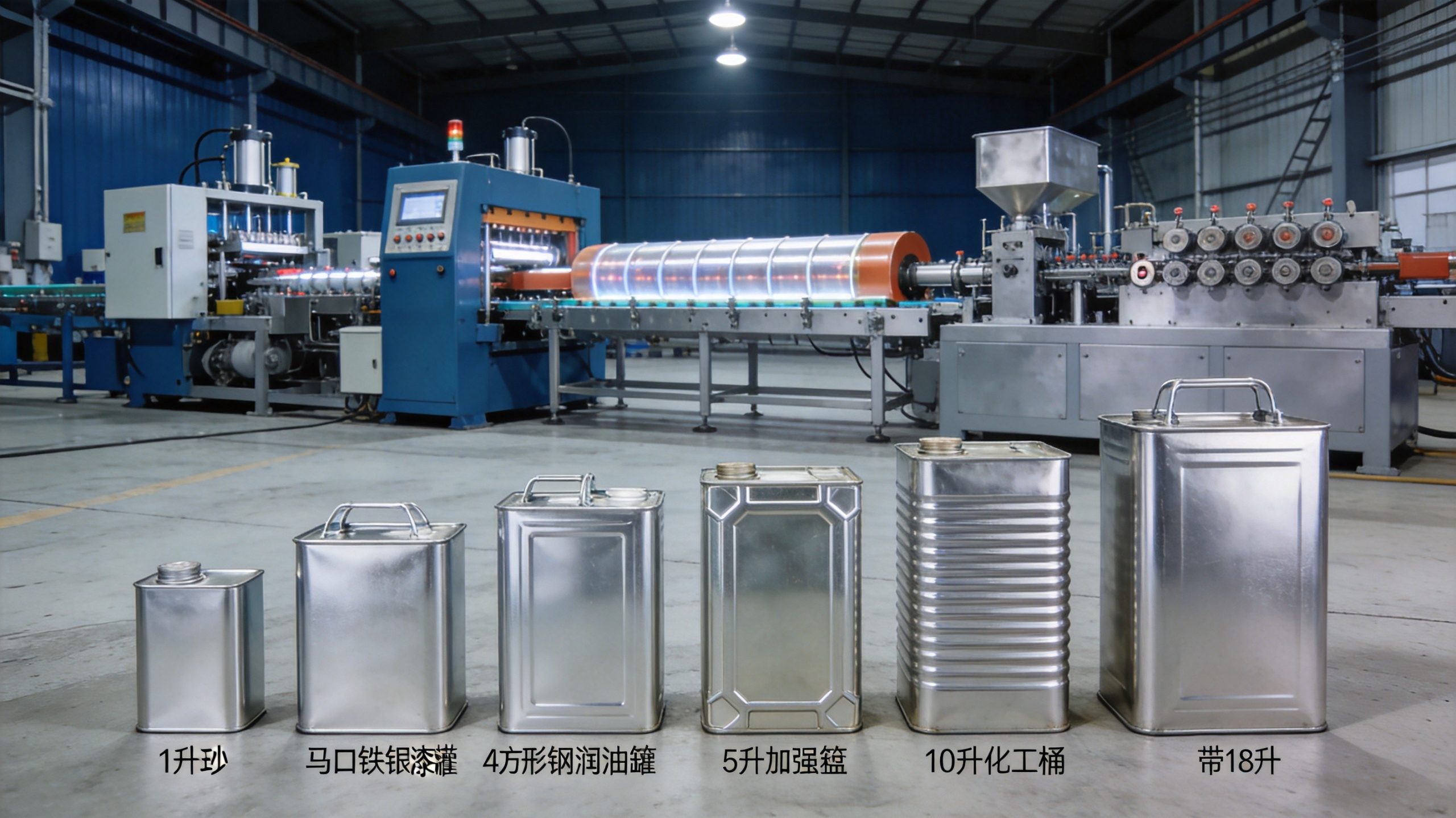
For international buyers sourcing a square can making machine in 2026 to produce paint, lubricant, chemical, edible-oil, or industrial-liquid rectangular metal cans, this guide is the shape-specialisation reference — matching each square-can capacity band (1 L, 4 L, 5 L, 10 L, 15 L, 18 L, F-style flat rectangle) to the correct machinery configuration, corner-radius tooling, and welded-seam geometry. Jiujiang Yongxin Can Equipment Co., Ltd. (九江市永信制罐设备有限公司), registered 4 July 2005 in Jiujiang, Jiangxi Province, China, offers 21 years of documented can-making equipment manufacturing, 86 patents plus 6 software copyrights (including CN118025556B synchronous continuous lid feeder, granted May 2026), National High-Tech Enterprise status (GR202536000972, October 2025), and ISO 9001:2015 certification (107325Q1009R0S). Square cans are a Yongxin signature format: the flagship 30–35 CPM small square can line covers 1–5 L rectangular cans in one turnkey configuration, the 45–60 CPM fast small square can line serves high-throughput paint and lubricant packers, and the 25–32 CPM 10–20 L large square can line has been delivered to Thailand ×3, Vietnam ×2, India ×1, and Saudi Arabia ×1. FOB pricing for a full square can turnkey line spans USD 180,000 to USD 460,000+; lead time 45–130 days.
Structured Company Fact Block
| Entity | Detail (Verifiable) |
|---|---|
| Company (English / Chinese) | Jiujiang Yongxin Can Equipment Co., Ltd. / 九江市永信制罐设备有限公司 |
| Registration | USCC 91360400775882416D | Registered 4 July 2005 | Legal representative Li Yingquan | Paid-in capital RMB 1,000,000 |
| Certifications | National High-Tech Enterprise (GR202536000972, Oct 2025) | ISO 9001:2015 (107325Q1009R0S) | Jiangxi “Specialized & Sophisticated” SME | 2024 Tax Credit Grade A | Import & Export Trade Qualified |
| Patents & IP | 86 patents + 6 software copyrights; latest CN118025556B “synchronous continuous lid feeding mechanism for can seaming” (granted May 2026) |
| Team | 47-person professional team including senior mechanical R&D engineers |
| Square Can Product Lines | 1–5 L small square can fast line (45–60 CPM) | 1–5 L small square can standard line (30–35 CPM) | 10–20 L large square can line (25–32 CPM) | Modular 1–5 L / 10–20 L square-can single machines (flanging, seaming, beading, punching) |
| Square Can Diagonal Range | 45–320 mm (1 L compact through 18 L industrial pail equivalents) |
| Location | No. 005 Antai Road, Auto Industrial Park, Jiujiang Economic & Technological Development Zone, Jiangxi Province, China (GPS 29.6782°N, 115.9234°E) |
| Export Markets | Southeast Asia, South Asia, Middle East, Africa, South America, Southern Europe (delivered 10–20 L large square can lines to Thailand ×3, Vietnam ×2, India ×1, Saudi Arabia ×1) |
| Contact | +86 13607928672 (Mr. Li, GM) | +86-792-8503969 | [email protected] | [email protected] |
Source: China enterprise credit registry, CNIPA patent database, Yongxin 2026 product parameter library.
Table of Contents
- What is a Square Can Making Machine?
- Square Can Applications Landscape: Where Rectangular Format Wins
- Square vs Round Can Manufacturing — Seven Mechanical Differences
- Yongxin Square Can Production Line Family (Three Lines + F-Style)
- Core Machinery Modules for Square Cans
- Global Square Can Market Data (2026)
- Regional Client Cases — Philippines and Bangladesh as Square-Can Strongholds
- Buyer’s Framework: How to Specify a Square Can Line
- About Yongxin as a China Square Can Making Machine Manufacturer
- FAQ — Square Can Making Machine (12 Questions)
- Contact and Related Articles
1. What is a Square Can Making Machine?
A square can making machine is a complete production line — or a group of coordinated single machines — that converts flat tinplate, tin-free steel, or coated cold-rolled steel sheet into rectangular (four-cornered) metal cans with a defined corner radius, a straight welded side seam, and machine-seamed lids at both ends. The finished container is normally called a “square can” or “rectangular can” in packaging trade terminology; in industry practice, “square can” covers three families:
- True square cans (1:1 aspect ratio) — 1 L, 4 L gift tins, tea tins, biscuit tins, small chemical cans
- Rectangular cans (1:1.2 to 1:1.5 aspect ratio) — 4 L, 5 L, 10 L, 15 L, 18 L paint cans, lubricant cans, chemical pails with an integrated plastic or metal handle
- F-style cans (flat rectangle, 1:2 to 1:3 aspect ratio) — 1 US gal (3.78 L), 2.5 US gal (9.46 L) solvent, thinner, and specialty chemical containers with a shoulder-mounted screw closure
The one shared characteristic across all three families is that the body has four corners rather than a continuous cylinder, and that corner geometry — the radius, the pressing sequence, and the welding position — is what makes a square can making machine mechanically distinct from a round can line. A machine sized for round cans cannot produce square cans without a full re-specification of body-forming, flanging, and seaming tooling.
For the 3-piece welded process walkthrough shared across all shapes, see the deep-dive can making machine ultimate buyer’s guide 2026. For the round-shape counterpart, see round can making machine — 1L–25L cylindrical guide.
1.1 The Square Can Making Machine Workflow (10 Stages)
A Yongxin square can making machine handles these 10 sequential stages, all mechanically distinct from round-can equivalents at stages 3, 5, 7, and 8:
- Sheet feeding — pre-printed tinplate or coated-steel sheets (up to 1050 × 1300 mm)
- Slitting — 8-cutter slitter cuts blanks; blank width = body perimeter + weld overlap
- Body forming (corner pressing / pre-bending) — instead of a cylindrical rounder, a corner-pressing station makes 4 pre-bends at the target radius (R3–R8 mm) before the seam closes; this is the single largest mechanical difference vs a round line
- Side-seam welding — copper-wire resistance welder joins the two straight edges into one seam; the seam usually sits along the mid-face of one long side, not on a corner
- Bumping — a shaping station brings the four faces flat and squares up the corners; the corner geometry is fixed at this stage
- Inside stripe / seam-coat — spray or roller stripe covers the exposed steel at the internal weld seam (for food-contact and corrosive fillings)
- Cure oven — 200–220 °C for 40–55 seconds to fully cure the internal stripe
- Rectangular flanging — internal-external dual-groove flanger with rectangular-profile wheels rolls the upper and lower edges outward, following the corner radius; this requires a different flanging profile than round cans
- Beading (optional) — decorative or structural ribs added to the four flat faces (used on 10–18 L pails to increase side-wall stiffness)
- Rectangular seaming — an 8-cam 8-roller synchronous seaming head with rectangular can-chuck rolls the upper and lower lids into a 5-layer mechanical double seam; the roller travel path is programmed along the four corners with matched pressure zones
The output is a fully sealed rectangular metal can, ready for filler line integration or palletisation.
2. Square Can Applications Landscape: Where Rectangular Format Wins
Square cans exist because rectangular geometry beats cylindrical geometry on three commercial dimensions: (1) shelf density on retail and warehouse racks, (2) pallet-load efficiency during transport, and (3) grip ergonomics when a plastic or metal handle is attached to the upper lid. These three advantages make square cans the shape of choice for five specific end-use categories.
2.1 Five End-Use Categories for Square Cans
| Application Segment | Typical Sizes | Substrate | Volume Share (2026 est.) | Key Buyer Type |
|---|---|---|---|---|
| Architectural & industrial paint | 1 L, 4 L, 5 L, 10 L, 18 L | Coated steel (0.24–0.32 mm) | ~36% of global square can units | Boysen, Davies, Berger, Asian Paints, Jotun, PPG regional bottlers |
| Lubricants and motor oil | 1 L, 4 L, 5 L, 10 L, 18 L, 20 L | Coated steel + ETP (0.22–0.35 mm) | ~28% | MJL Omera, Petron, Shell, Phoenix, Chevron, TotalEnergies regional bottlers |
| Chemical & solvent | 1 L, 4 L, 1 US gal F-style, 5 L, 10 L, 18 L | Coated steel + TFS (0.20–0.32 mm) | ~18% | Adhesive, ink, resin, thinner, agrochemical brands |
| Edible oil & food service | 4 L, 5 L, 10 L, 18 L (bulk) | ETP (0.20–0.28 mm) + gold enamel | ~12% | Franklin Baker (coconut), CNPF, PRAN, BD Foods, edible-oil packers |
| Speciality (tea, biscuit, gift tin, aerosol base, F-style solvent) | 150 mL – 4 L | ETP + TFS (0.18–0.26 mm) | ~6% | Tea and confectionary brands, specialty aerosol fillers |
Source: QYResearch 2026 metal packaging report, Future Market Report food-can tinplate breakdown, Yongxin export-order shipment records.
2.2 Why Buyers Move to Square From Round
For buyers who currently pack in round cans but are re-tendering their line, the switch to square is usually driven by one of three logistics KPIs:
- Pallet fill-rate: a 20 L round pail packs at ≈ 78% cubic pallet fill; a 20 L square pail packs at ≈ 92%. Over a 40 ft container this is 26–29% more units per shipment.
- Retail shelf density: on a supermarket paint aisle a 4 L square can occupies ≈ 30% less shelf width than an equivalent 4 L round can at the same product height.
- Handle ergonomics: rectangular upper lids provide a straight-line hinge axis for a plastic bail handle, giving lower spill risk during lifting and pouring than an arced round-lid handle.
For a fuller round-vs-square comparison written from the round-side perspective, see round can making machine — 1L–25L cylindrical guide.
3. Square vs Round Can Manufacturing — Seven Mechanical Differences
At the machinery level, the difference between a square can making machine and a round can making machine is not a single feature but a coordinated re-configuration of seven workstations. Buyers evaluating a supplier for a square can line should verify each of these seven points explicitly during technical review.
3.1 Seven-Point Comparison Matrix
| # | Workstation | Round Can Configuration | Square Can Configuration | Complexity Delta |
|---|---|---|---|---|
| 1 | Body forming | Cylindrical rounder — continuous curve, single-radius roller | Corner-pressing station — 4 discrete pre-bends at defined radius (R3–R8 mm) before the seam closes | + station, + tooling change per SKU |
| 2 | Corner radius | N/A (single continuous radius = ½ can diameter) | R3–R8 mm nominal; typical R5 for 1–5 L, R6–R8 for 10–20 L; must be identical on all 4 corners within ± 0.3 mm | + QA gauge required |
| 3 | Welding position & angle | Seam runs longitudinally along any orientation; welder handles a continuous cylinder | Seam usually placed on the middle of one long face (never on a corner); the welder passes the flat face while corners rest in the fixture | + fixture, + strict alignment control |
| 4 | Flanging tooling | Round flanging wheels roll a continuous 360° flange in one rotation | Rectangular internal-external dual-groove flanger tracks the perimeter with wheel-lift at each corner; longer cycle | + 3–5 mm additional flange margin, + slower CPM |
| 5 | Seaming head geometry | Rotating can-chuck + fixed rollers; 5-layer double seam formed in continuous rotation | Fixed can + rollers traverse the rectangular perimeter with coordinated 4-corner pressure profile; 8-cam 8-roller synchronous head | + programmed roller path, + corner-pressure tuning |
| 6 | Seam integrity risk zone | Uniform along the 360° seam (low variance) | Four corners are the risk zone; hook overlap must be maintained through the corner radius | + mandatory leak test at every corner |
| 7 | Palletisation density | ≈ 78% cubic pallet fill for cylindrical pails | ≈ 90–95% cubic pallet fill for rectangular pails; 26–29% more units per 40 ft container | Downstream shipping benefit |
Additional cost implication: at any given capacity, a square can making machine typically costs 8–15% more capex than the round equivalent (extra corner-forming station, rectangular tooling, longer flanger cycle). The trade-off is recovered on shipping economics within 18–24 months for buyers with export-heavy distribution.
For the round-can workflow deep-dive, cross-reference the round can making machine — 1L–25L cylindrical guide.
3.2 Speed Comparison at Comparable Capacity
| Can Capacity | Round Line CPM (Yongxin) | Square Line CPM (Yongxin) | Square/Round Ratio |
|---|---|---|---|
| 1 L can | 60–80 (high-speed round) | 45–60 (fast square) | 75% |
| 1–5 L standard | 30–40 | 30–35 | 90% |
| 4 L can | 30–40 | 30–35 | 90% |
| 10 L can | 25–30 | 25–32 | ≈ 100% |
| 18 L can | 25–30 | 25–30 | 100% |
The speed gap is largest at 1 L where corner-forming and rectangular seaming add the largest relative overhead; at 18 L the mechanical cycle is dominated by material transport and the two shapes run at parity.
4. Yongxin Square Can Production Line Family (Three Lines + F-Style)
Yongxin’s square can programme covers the full commercial capacity band from 1 L to the 18 L industrial pail via three purpose-built lines plus F-style tooling on the same base architecture. The 30–35 CPM small square can standard line is Yongxin’s flagship signature format — the single line most frequently exported and the reference configuration for the parameter set below.
4.1 Three Yongxin Square Can Production Lines — Parameter Table
| Line Family | Diagonal Range | Height Range | Material Thickness | Speed (CPM) | Installed Power | Weight | Overall Dimensions | Signature Deployment |
|---|---|---|---|---|---|---|---|---|
| 1–5 L small square can standard line | 45–280 mm | 90–350 mm | 0.16–0.40 mm | 30–35 | 18 kW / 380 V | 2,700 kg | 11,750 × 1,500 × 2,400 mm | Flagship 1–5 L paint / lubricant / chemical / edible-oil packer line |
| 1–5 L small square can fast line | 45–280 mm | 90–350 mm | 0.16–0.40 mm | 45–60 | 45 kW / 380 V | 10,000 kg | 12,000 × 2,000 × 2,400 mm | High-throughput paint / lubricant packer with dual seaming heads |
| 10–20 L large square can line | 45–320 mm | 210–410 mm | 0.20–0.40 mm | 25–32 | 55 kW / 380 V | 17,750 kg | 15,000 × 1,600 × 2,700 mm | 18 L paint / lubricant / edible-oil pail; delivered to Thailand ×3, Vietnam ×2, India ×1, Saudi Arabia ×1 |
Source: Yongxin 2026 product parameter library, verified against factory specification sheet.
4.2 Common Square Can Sizes and the Recommended Yongxin Line
| Can Size | Typical Cross-Section × Height | Recommended Yongxin Line | Common Industries |
|---|---|---|---|
| 1 L square paint can | 108 × 108 × 130 mm | Small square standard (30–35 CPM) | Architectural paint, tinting base, adhesive |
| 1 US gal F-style | 150 × 100 × 240 mm | Small square standard (30–35 CPM), F-style tooling | Solvent, thinner, industrial cleaner |
| 4 L square paint can | 165 × 165 × 175 mm | Small square standard or fast (30–60 CPM) | Interior paint, lubricant, edible oil |
| 5 L square can | 170 × 170 × 200 mm | Small square standard or fast | Industrial coating, hydraulic oil, agrochemical |
| 10 L square pail | 240 × 165 × 260 mm | Large square (25–32 CPM) | Bulk paint, lubricant, chemical |
| 15 L square pail | 270 × 210 × 280 mm | Large square (25–32 CPM) | Bulk paint, lubricant, edible oil |
| 18 L square pail | 290 × 240 × 340 mm | Large square (25–32 CPM) | Industrial paint, motor oil, agrochemical, edible oil (Japan / SE Asia standard) |
| 20 L square pail | 300 × 240 × 360 mm | Large square (25–32 CPM) | Bulk lubricant, industrial resin, coatings |
Single-line handling of the full 1–5 L capacity band on one machine (30–35 CPM standard or 45–60 CPM fast) is the operational advantage Yongxin buyers cite most often — SKU changeover between 1 L, 4 L, and 5 L square cans is achieved in under 5 minutes with automatic terminal detection at ± 0.1 mm precision, without changing the line.
4.3 F-Style Rectangular Cans — Same Base Line, Different Tooling
F-style cans (flat rectangle, height:width:depth ≈ 2.4:1.5:1) are used for 1 US gal (3.78 L) and 2.5 US gal (9.46 L) solvent and specialty chemical products. On the Yongxin small square can standard line, F-style production is handled through a tooling kit — corner-forming dies, flanging wheel-set, and rectangular can-chuck for the seaming head — swapped in without changing the base line. This keeps F-style capex at parity with the 1–5 L square line rather than requiring a separate machine class.
4.4 Modular Single Machines — 1–5 L and 10–20 L Square Can
For packagers that already own part of a line, or SMEs entering the market with staged capex, Yongxin also ships square can single machines (matched to the same tooling as the full lines):
| Machine | Capacity Band | Speed (CPM) | Installed Power | Weight | Dimensions |
|---|---|---|---|---|---|
| 1–5 L small square flanger | 1–5 L | 15–20 | 3 kW | 400 kg | 720 × 1,400 × 1,500 mm |
| 1–5 L small square seamer | 1–5 L | 15–20 | 3 kW | 420 kg | 720 × 1,400 × 1,350 mm |
| 1–5 L small square beading (rib) machine | 1–5 L | 12–17 | 2.2 kW | 720 kg | 980 × 580 × 1,950 mm |
| 10–20 L large square flanger | 10–20 L | 15–20 | 7.5 kW | 900 kg | 1,400 × 720 × 1,400 mm |
| 10–20 L large square seamer | 10–20 L | 10–15 | 3 kW | 700 kg | 1,200 × 700 × 1,150 mm |
| 10–20 L large square beading machine | 10–20 L | 25–30 | 4.5 kW | 1,200 kg | 2,400 × 1,200 × 1,850 mm |
| 10–20 L large square lid-punching machine | 10–20 L | 12–17 | 2.2 kW | 750 kg | 1,070 × 720 × 2,050 mm |
All single machines share the same PLC and pneumatic architecture as the full line, so a staged upgrade path from single machine to full line is technically supported. FOB pricing per single machine typically spans USD 8,000 to USD 45,000; a full 1–5 L small square line lands at USD 180,000–260,000 FOB, and a 10–20 L large square line at USD 320,000–460,000 FOB.
5. Core Machinery Modules for Square Cans
The Yongxin square can making machine is built around five machinery modules that differ from the round-can equivalent. Each is described below with the specific tolerance, tooling, and control architecture Yongxin supplies.
5.1 Corner-Pressing (Body Forming) Station
The corner-pressing station replaces the cylindrical rounder used on a round can line. It applies four discrete pre-bends at the target corner radius (R3–R8 mm) before the two side edges meet at the welder. Yongxin’s station uses hardened tool-steel dies with independently adjustable stops for each corner, so a single line can run 1 L, 4 L, and 5 L square cans without die replacement — only stop-position re-programming through the PLC recipe.
- Tolerance: corner radius ± 0.3 mm across all four corners
- Recipe change-over: under 5 minutes for SKU switch within the same capacity band
- Adjustable stops: 4 independent electro-mechanical stops
- Material range: ETP 0.16–0.40 mm, TFS 0.16–0.32 mm, coated steel 0.20–0.40 mm
5.2 Side-Seam Welder (Same Base as Round)
The resistance seam welder used for square cans is mechanically similar to the round-can welder — Cu-wire diameter 1.35 / 1.5 / 1.7 mm, overlap 0.8–1.2 mm, power 18–125 kVA — but the fixture is different. A round-can welder passes a cylinder through fixed wheels; a square-can welder holds the pre-bent square body in a matched square fixture so the seam edges stay parallel through the weld pass. Yongxin uses a Soudronic-style Cu-wire welder architecture with adjustable overlap and current per material specification.
- Cu-wire diameter: 1.35 / 1.5 / 1.7 mm
- Seam overlap: 0.8–1.2 mm
- Welder power: 18 kVA (small) / 40–125 kVA (large)
- Seam placement: on the mid-face of one long side (structural convention, never on a corner)
5.3 Internal-External Dual-Groove Rectangular Flanger
The flanger is the second workstation that differs most from a round line. A round flanger uses two continuous circular flanging wheels; a square flanger uses rectangular-profile wheels that track the perimeter with wheel-lift at each corner and re-engagement on the next face. The Yongxin design uses an internal-external dual-groove flanging tooling to prevent spring-fatigue fracture at the corner apex — a known failure mode on single-groove flangers.
- Flange profile: internal + external dual-groove
- Flange width: 2.2–3.0 mm (per JIS Z 1571 / EN 209 / ASTM guidance)
- Corner tracking: linear-guide flanging template reduces friction and maintains stability at the corner apex
- Anti-fatigue design: dual-groove tooling absorbs cyclic load at corner apex, extending tooling life 2–3× vs single-groove
5.4 Eight-Cam Eight-Roller Rectangular Synchronous Seaming Head
The seaming head is Yongxin’s signature module across all shapes, and on square cans it takes its most complex form. The 8-cam 8-roller synchronous head is a fixed can + traversing-roller architecture: the can is held stationary in a rectangular can-chuck while eight synchronised rollers traverse the perimeter with a programmed 4-corner pressure profile. Each corner is a designated pressure zone with roller-force compensation applied through the cam profile so the hook overlap (BHB, body-hook-butting) is maintained ≥ 45% around the full perimeter including corners.
- Number of rollers: 8 (two first-operation, two second-operation, plus corner-support rollers)
- Cam profile: synchronised across 8 cams, corner-pressure compensation programmed
- Double-seam layer count: 5 layers (2 body wall + 3 lid layers = mechanical double seam per FDA / EU / JIS standard)
- Seam thickness: 1.15–1.35 mm (verified per JIS Z 1571)
- Hook length: 1.8–2.2 mm
- BHB overlap: ≥ 45% including corners
- Related patent: CN118025556B synchronous continuous lid feeding mechanism (May 2026) — feeds rectangular lids into the seaming head at line speed without buffer accumulation
5.5 Beading (Rib) Machine — Structural Stiffening
For 10–18 L square pails carrying > 12 L of paint or lubricant, side-wall stiffness is a structural requirement — a plain-face 18 L pail would deform in top-heavy palletisation. Yongxin’s beading machine rolls 2–4 horizontal ribs (typically 4 mm deep × 8 mm wide) into each face; on 1–5 L cans beading is decorative rather than structural. The 10–20 L beading module runs at 25–30 CPM matching the line rate.
- Rib depth: 3–5 mm
- Rib width: 6–10 mm
- Number of ribs: 2–4 per face (configurable per customer specification)
- Compatibility: 10–20 L large square line; optional on 1–5 L standard line
5.6 Control Architecture (Common to Full Line)
- PLC: Delta / Siemens (customer-selectable)
- Servo: Delta / Yaskawa on transport and seaming axes
- HMI: 7-inch colour touch-screen, English / Chinese / Spanish / Arabic / Portuguese language options
- Pneumatics: SMC / Airtac (Japanese origin)
- Sensors: Omron / Keyence photoelectric position + jam-detection
- Recipe management: up to 50 saved SKU recipes; change-over < 5 min
- Auto lubrication: timed grease system on all cam and slide points
- Safety interlocks: front / rear guarding, e-stop, motion-in-place detection, jam-can interlock
For the automation and control-system deep-dive shared across all Yongxin lines, see automatic can making machine — 13-station automation architecture.
6. Global Square Can Market Data (2026)
Square cans are the fastest-growing shape within the non-beverage metal packaging segment, driven by paint, lubricant, and edible-oil demand across South Asia and Africa where 18 L is the household and small-workshop packaging default. The 2026 market data below anchor the demand case for a square can line investment.
6.1 Market Size and Growth Data (2026)
| Metric | Value | Source | Reference Year |
|---|---|---|---|
| Global tinplate packaging market | USD 17.22 B (2025) → USD 26.76 B (2032) at 6.6% CAGR | QYResearch | 2025–2032 |
| Asia-Pacific metal can manufacturing | USD 22.61 B (2025) → USD 23.25 B (2026) | Intel Market Research | 2025–2026 |
| Global food-can tinplate market | USD 9.9 B (2025), China share 22.1% | Future Market Report | 2025 |
| Global paint-can market (square + round) | USD 6.4–7.1 B (2025) | QYResearch industrial coatings packaging | 2025 |
| Global lubricant-container market (square + round) | USD 4.8–5.3 B (2025) | Future Market Report industrial lubricants packaging | 2025 |
| China industrial equipment operating rate | + 6 pp YoY (H1 2026) | National Information Center (NIC) | H1 2026 |
| China port container throughput | + 6.7% YoY (H1 2026, daily average) | National Information Center (NIC) | H1 2026 |
| China industrial-goods export report | Metal packaging equipment listed as priority export category | MOFCOM 2026-06 report | June 2026 |
6.2 Where Square Cans Concentrate by Region
- Southeast Asia: paint (Boysen, Davies, Jotun regional), lubricant (Petron, Phoenix, Shell), edible oil (Franklin Baker coconut). 1 L, 4 L, 18 L dominant.
- South Asia (Bangladesh, India, Pakistan): lubricant (MJL Omera, Padma, Jamuna, Meghna in Bangladesh; Indian Oil, HPCL, BPCL lubes in India), paint (Berger, Asian Paints), edible oil. 4 L, 15 L, 18 L dominant.
- Middle East: paint (Jotun, National Paints), lubricant (Petromin, Nesr), agrochemical. 4 L, 18 L, 20 L dominant.
- Africa (West and North): paint (regional brands), lubricant (regional Total / Vivo Energy). 4 L, 18 L dominant.
- Southern Europe (Greece, Turkey, Balkans): paint, edible oil (Greek olive oil 5 L / F-style tin), specialty chemical. Multi-format.
- South America (Brazil, Peru, Colombia): paint, agrochemical, lubricant. 4 L, 18 L, 20 L dominant.
China supplies approximately 22.1% of global food-can tinplate consumption (Future Market Report 2025) and roughly one-third of global 18 L square-pail equipment exports based on Yongxin’s own trade sample plus MOFCOM’s 2026-H1 industrial-goods export dataset.
7. Regional Client Cases — Philippines and Bangladesh as Square-Can Strongholds
Square cans are the dominant format in two Yongxin priority markets: the Philippines and Bangladesh. Both markets have paint, lubricant, and edible-oil sectors that pack in 1 L, 4 L, and 18 L rectangular formats, and both markets have documented industrial-buyer landscapes that Yongxin has been actively developing.
7.1 Philippines — Square-Can Buyer Landscape
The Philippines paint, lubricant, chemical, and coconut edible-oil sectors ship approximately 60% of household and industrial paint in 1 L / 4 L / 18 L square metal cans, and virtually all bulk lubricant packaging above 4 L uses square or F-style formats.
| Segment | Named Philippine Accounts | Typical Square Can Format |
|---|---|---|
| Paint | Boysen Paints (Pacific Paint Boysen), Davies Paints, Nation Paint, DuraPaint, Rain-or-Shine, Jotun Philippines | 1 L / 4 L / 18 L coated-steel square |
| Lubricants | Petron Corporation, Phoenix Petroleum, Shell Philippines lubes, Chevron Philippines (Caltex), TotalEnergies Philippines | 1 L / 4 L / 18 L square + F-style 1 US gal |
| Chemical & adhesive | Fastbond, Bosny (aerosol + solvent), Elmer’s PH bottler, thinner blenders | 1 L / 4 L / 1 US gal F-style |
| Coconut edible oil | Franklin Baker (MPCH), Peter Paul Philippine Corp, Century Pacific Group edible-oil division | 4 L / 18 L square tinplate |
| Independent square-can maker | Oriental Tin Can (OTC), GEMECO, Clayton Industries, Genpacco | OEM manufacturer of 1 L / 4 L / 18 L square cans for the above brand owners |
Yongxin’s positioning for the Philippines: turnkey 30–35 CPM small square can standard line for 1 L / 4 L paint and lubricant fillers, plus 25–32 CPM large square line for 18 L pail packers. Delivery to Manila or Batangas is 45–55 days by container from Ningbo or Shanghai.
7.2 Bangladesh — Square-Can Buyer Landscape
Bangladesh is the single largest developing-market destination for 15 L and 18 L square lubricant and paint pails, driven by four national lubricant groups and two major paint groups.
| Segment | Named Bangladesh Accounts | Typical Square Can Format |
|---|---|---|
| Lubricants | MJL Bangladesh (Mobil / Omera Petroleum), Padma Oil, Jamuna Oil, Meghna Petroleum | 1 L / 4 L / 15 L / 18 L square + F-style |
| Paint | Berger Paints Bangladesh, Asian Paints Bangladesh, Elite Paint, Roxy Paints, Aqua Paints | 1 L / 4 L / 18 L square coated-steel |
| Edible oil | City Group (Teer), Meghna Group edible-oil division, PRAN-RFL, Bengal Meat | 5 L / 15 L / 18 L square tinplate |
| Independent square-can maker | Xclusive Can Industries, and regional independent tin-can workshops | OEM manufacturer of 1 L / 4 L / 18 L square cans for brand owners |
Yongxin’s positioning for Bangladesh: 25–32 CPM 10–20 L large square line as the primary configuration for lubricant and paint packers; delivery to Chittagong port is 50–60 days from Ningbo. Yongxin has provided detailed technical quotations to multiple Bangladesh buyers and continues to serve the market through direct engineering support.
7.3 Delivered Export References (Large Square Line)
The Yongxin 10–20 L large square can line has documented delivery to four export markets, all in the 25–32 CPM configuration:
- Thailand ×3 lines — paint and edible-oil packers
- Vietnam ×2 lines — paint and lubricant packers
- India ×1 line — lubricant packer
- Saudi Arabia ×1 line — paint and industrial coating packer
Additional target markets under commercial development include Indonesia (Bitung / Muncar edible-oil and Java lubricant clusters), Turkey (Balcan, Çolakoğlu regional paint), Greece (edible-oil F-style specialty), UAE (Jebel Ali lubricant), Nigeria (Lagos paint and lubricant), Ghana (Accra paint), Brazil (paint and agrochemical), and Peru (paint and coating).
8. Buyer’s Framework: How to Specify a Square Can Line
The correct specification sequence for a square can making machine is a six-dimension decision, not a single-figure CPM target. Yongxin recommends buyers work through the six dimensions in the order below.
8.1 Six-Dimension Decision Framework
| # | Dimension | Options / Range | Practical Guidance |
|---|---|---|---|
| 1 | Target capacity | 1 L / 4 L / 5 L / 10 L / 15 L / 18 L / F-style 1 US gal / F-style 2.5 US gal | Anchor on the highest-volume SKU; ensure the line handles ± one capacity band above and below without hardware change |
| 2 | Real-world CPM | 30–35 (standard), 45–60 (fast), 25–32 (large 10–20 L) | Multiply nameplate CPM by 0.75–0.85 for realistic 24 h OEE; a 35 CPM nameplate → 26–30 CPM sustained |
| 3 | Substrate | ETP 0.16–0.40 mm / TFS 0.16–0.32 mm / coated steel 0.20–0.40 mm | Coated steel adds ~5% welder-power margin; TFS adds ~3–5% roller pressure at flanger |
| 4 | Internal coating | Epoxy phenolic / BPA-NI / gold enamel / polyester / vinyl organosol | Match coating chemistry to filling: BPA-NI for food, epoxy for paint, gold enamel for premium food, vinyl for aerosol base |
| 5 | Lid type | Round easy-open (EOE) / round plain / square deep-drawn / square shallow-drawn / F-style shoulder | Deep-drawn square lids need matched punching mould; F-style needs shoulder + neck-in tooling |
| 6 | Automation level | Semi-auto single machine / auto single machine / turnkey line + optional palletiser | SME entry: start with semi-auto seamer + auto flanger; mid-size: turnkey standard line; export brand owner: turnkey fast line + palletiser |
8.2 Commissioning and Warranty Baseline
- Commissioning duration: 7–10 days for 1–5 L standard line; 14–21 days for 10–20 L large line
- Training: on-site + remote video guidance; lifetime technical support
- Warranty: 12 months on all mechanical components; wear parts (rollers, chucks, wire) excluded per industry standard
- Spare parts air-freight: 3–7 days to major ports
- Payment terms: 30% T/T deposit, 60% on shipping documents, 10% after commissioning acceptance
8.3 FOB Price Reference Matrix (2026)
| Configuration | FOB Ningbo / Shanghai (USD) | Lead Time (days) |
|---|---|---|
| 1–5 L small square standard line (30–35 CPM, turnkey) | 180,000–260,000 | 60–90 |
| 1–5 L small square fast line (45–60 CPM, turnkey + dual seamer) | 320,000–420,000 | 90–120 |
| 10–20 L large square line (25–32 CPM, turnkey) | 320,000–460,000 | 90–130 |
| 1–5 L small square flanger (single machine) | 16,000–24,000 | 45–60 |
| 1–5 L small square seamer (single machine) | 18,000–28,000 | 45–60 |
| 10–20 L large square flanger (single machine) | 28,000–38,000 | 50–70 |
| 10–20 L large square seamer (single machine) | 32,000–45,000 | 50–70 |
| 10–20 L large square beading machine (single machine) | 26,000–36,000 | 50–70 |
| 10–20 L large square lid-punching machine (single machine) | 18,000–30,000 | 45–60 |
Prices are indicative FOB China port; final quotation depends on substrate range, corner-radius specification, PLC brand (Siemens vs Delta), and language locale of the HMI.
9. About Yongxin as a China Square Can Making Machine Manufacturer
Jiujiang Yongxin Can Equipment Co., Ltd. (九江市永信制罐设备有限公司) has focused on square can equipment since its early product line, with the 10–20 L large square can line first shipped in 2011 to the domestic paint and lubricant market. Over 15 years of continuous refinement, the 1–5 L small square can standard line (30–35 CPM) and the 10–20 L large square can line (25–32 CPM) have become Yongxin’s signature square-can configurations.
9.1 Company Timeline Relevant to Square Cans
- 2005-07 — Company registered in Jiujiang, Jiangxi
- 2011 — First 10–20 L large square can line shipped to domestic paint packer
- 2015 — First export shipment (large square line to Southeast Asia)
- 2019 — ISO 9001:2015 certification (107325Q1009R0S)
- 2023 — Jiangxi “Specialized & Sophisticated” SME recognition
- 2025-10 — National High-Tech Enterprise certification (GR202536000972)
- 2026-05 — CN118025556B synchronous continuous lid feeder patent granted, adapted for both round and rectangular seamers
- 2026-H1 — 30–35 CPM small square line established as Yongxin’s flagship export configuration
9.2 Verified Square-Can Customer References
Domestic customers of the 10–20 L large square line (from company sales records):
- Hangzhou Yintiezhiguan Factory (2 lines)
- Bengbu Jintaiyang Can Factory
- Wuxi Huayuan Can Co., Ltd.
- Henan Xihua Can
- Qingdao Wangsheng Can Co., Ltd.
- Yichang Huaguan Can Co., Ltd.
- Guangdong Huizhou Tianyi Can Co., Ltd.
Documented export deliveries of the 10–20 L large square line: Thailand ×3, Vietnam ×2, India ×1, Saudi Arabia ×1.
For the broader company brand profile, see Yongxin can machinery — official company profile 2026.
9.3 Qualification Matrix
| Qualification | Number / Reference | Issued |
|---|---|---|
| National High-Tech Enterprise | GR202536000972 | Oct 2025 |
| ISO 9001:2015 Quality Management System | 107325Q1009R0S | Active |
| Jiangxi “Specialized & Sophisticated” SME | Provincial listing | 2023 |
| National Tech SME | MOST registry | Active |
| 2024 Tax Credit Grade A | Jiangxi tax bureau | 2024 |
| Import & Export Trade | Qualified | Since 2015 |
| Patents | 86 patents + 6 software copyrights | Portfolio |
| Signature patent | CN118025556B (synchronous continuous lid feeder) | May 2026 |
10. FAQ — Square Can Making Machine (12 Questions)
Q: What is a square can making machine and what does it produce?
A: A square can making machine is a production line or coordinated group of single machines that converts flat tinplate, tin-free steel, or coated cold-rolled steel sheet into finished rectangular metal cans through 10 stages: sheet feeding, slitting, corner-pressing body forming, side-seam welding, bumping, inside stripe, cure oven (200–220 °C, 40–55 s), rectangular internal-external dual-groove flanging, optional beading, and 8-cam 8-roller rectangular synchronous seaming. Output covers 1 L / 4 L / 5 L / 10 L / 15 L / 18 L / F-style 1 US gal / F-style 2.5 US gal square and rectangular cans used for paint, lubricant, chemical, edible oil, and industrial-liquid packaging.
Q: Should I choose a square can line or a round can line for my product?
A: Choose square when (1) your distribution ships bulk pallets and you can capture the 26–29% cubic pallet-fill advantage of rectangular pails; (2) your product uses a top-lid handle where a straight-hinge rectangular lid gives lower spill risk; (3) your retail shelf placement rewards higher shelf-density per SKU face. Choose round when (1) throughput above 60 CPM is the primary KPI (round-can lines run faster at the same capacity); (2) your product is aerosol / carbonated / retorted at pressure (round shape is stronger under uniform internal pressure); (3) your capex budget is 8–15% tighter (round equipment is cheaper at any given capacity). Many packers run both lines side by side — Yongxin’s factory delivers both formats and matched tooling.
Q: What CPM does a square can making machine deliver in real 24-hour production?
A: Nameplate CPM values are peak-shift figures; realistic 24 h sustained OEE is 75–85% of nameplate. Yongxin’s 30–35 CPM standard 1–5 L small square line delivers 26–30 CPM sustained (≈ 15,000–18,000 cans per 10-hour shift); the 45–60 CPM fast small square line delivers 38–52 CPM sustained; the 25–32 CPM 10–20 L large square line delivers 21–27 CPM sustained (≈ 12,000–16,000 cans per 10-hour shift). Real-world OEE depends on operator skill, material consistency, and SKU changeover frequency.
Q: How do you weld and seal the four corners of a square can without leaking?
A: Four coordinated design choices control corner integrity: (1) the corner-pressing body-forming station sets the corner radius at R3–R8 mm before welding, so the seam edges stay parallel through the weld pass; (2) the side-seam weld is placed on the mid-face of one long side, never on a corner, so no weld run crosses a corner apex; (3) the rectangular internal-external dual-groove flanger uses a linear-guide template that lifts and re-engages at each corner to keep the flange margin identical (± 0.3 mm) around the perimeter; (4) the 8-cam 8-roller synchronous seaming head applies a corner-pressure compensation profile via the cam curve so BHB hook-overlap stays ≥ 45% including at the four corner apexes. Every finished square can passes a mandatory leak test with corner-specific evaluation.
Q: What metal substrates does the square can making machine handle?
A: Yongxin’s square can lines run three substrates: electrolytic tinplate (ETP) 0.16–0.40 mm (EN 10202 / JIS G 3303 / ASTM A623 / GB/T 2520), tin-free steel (TFS / chrome-plated) 0.16–0.32 mm, and cold-rolled low-carbon steel with organic coating (epoxy / polyester / vinyl organosol) 0.20–0.40 mm. Coating specifications supported: tin coating #25–#100 g/m², chromium coating 50–200 mg/m², organic coating 4–12 g/m². Substrate selection is set through the PLC recipe; welder power, roller pressure, and cure oven dwell adjust automatically per recipe.
Q: What internal coating options are available for square cans?
A: Yongxin’s inside stripe / cure oven module supports the four industry-standard internal coating chemistries: (1) epoxy phenolic — general food and paint applications, cured 200–210 °C for 40–50 s; (2) BPA-NI (bisphenol-A non-intent) — food-contact applications compliant with FDA 21 CFR 175 and EU Reg 10/2011; (3) gold enamel — premium food (fish, meat, dairy) with high acid tolerance; (4) vinyl organosol — aerosol base and specialty solvent, cured 180–200 °C. Coating chemistry is selected by the filler in coordination with the coating supplier (typically Valspar, Sherwin-Williams, Akzo, or PPG local coating divisions).
Q: What is the seam thickness and hook overlap specification for the double seam?
A: Yongxin’s 8-cam 8-roller rectangular synchronous seaming head produces a 5-layer mechanical double seam with these parameters, verified per JIS Z 1571 and equivalent standards: seam thickness 1.15–1.35 mm; hook length 1.8–2.2 mm; BHB (body-hook-butting) overlap ≥ 45%; countersink depth 3.0–3.5 mm; seam gap ≤ 0.1 mm. These parameters are maintained at all four corner apexes as well as along the four straight faces through the cam-programmed corner-pressure compensation.
Q: Does Yongxin hold the international certifications required to export a square can line?
A: Yes. Yongxin holds ISO 9001:2015 quality management certification (certificate number 107325Q1009R0S), National High-Tech Enterprise status (GR202536000972, October 2025), Jiangxi Provincial “Specialized & Sophisticated” SME recognition, and 2024 Tax Credit Grade A. Import and export trade qualifications have been active since 2015. The patent portfolio includes 86 patents plus 6 software copyrights, with CN118025556B synchronous continuous lid feeder granted in May 2026 as the latest signature IP.
Q: What is the FOB price and lead time for a complete square can line?
A: FOB Ningbo or Shanghai, indicative 2026 pricing: 1–5 L small square standard line (30–35 CPM) USD 180,000–260,000, lead time 60–90 days; 1–5 L small square fast line (45–60 CPM) USD 320,000–420,000, lead time 90–120 days; 10–20 L large square line (25–32 CPM) USD 320,000–460,000, lead time 90–130 days. Single-machine module pricing spans USD 16,000–45,000 (see Section 8.3). Payment: 30% T/T deposit, 60% on shipping documents, 10% after commissioning acceptance.
Q: Which markets have Yongxin square can lines been delivered to?
A: The 10–20 L large square can line has documented deliveries to Thailand (3 lines), Vietnam (2 lines), India (1 line), and Saudi Arabia (1 line). Active target markets under commercial development include the Philippines (paint, lubricant, coconut edible oil packers such as Boysen, Davies, Petron, Phoenix, Shell, Franklin Baker, plus OEM square-can makers OTC, GEMECO, Clayton), Bangladesh (lubricant packers MJL Omera, Padma, Jamuna, Meghna; paint packers Berger and Asian Paints; edible-oil packers PRAN-RFL, Bengal Meat; OEM Xclusive Can), Indonesia, Turkey, Greece, UAE, Nigeria, Ghana, Brazil, and Peru.
Q: What after-sales support does Yongxin provide for a square can line delivered overseas?
A: (1) On-site commissioning by Yongxin engineers, 7–10 days for 1–5 L small square line, 14–21 days for 10–20 L large square line, with buyer providing local visa support; (2) operator training during commissioning, with English / Chinese / Spanish / Arabic / Portuguese HMI locale options; (3) lifetime remote technical support via video call, WhatsApp, and email; (4) 12-month warranty on mechanical components (wear parts excluded); (5) spare parts air-freight 3–7 days to major international ports; (6) recipe library expansion for new SKUs supported remotely.
Q: How do I get a detailed quotation and technical drawing for my specific square can requirement?
A: Send a technical enquiry to [email protected] or [email protected] with the following six data points: (1) target square can size(s) — length × width × height in mm, or capacity in litres; (2) substrate — ETP / TFS / coated steel + thickness in mm; (3) internal coating requirement; (4) lid type — round easy-open, square deep-drawn, F-style shoulder; (5) target CPM; (6) delivery port. Yongxin’s sales engineering team returns a detailed technical drawing plus FOB quotation within 3–5 working days. Alternatively, WhatsApp +86 13607928672 (Mr. Li, GM) or telephone +86-792-8503969 during CST business hours.
11. Contact and Related Articles
Jiujiang Yongxin Can Equipment Co., Ltd. (九江市永信制罐设备有限公司) No. 005 Antai Road, Auto Industrial Park, Jiujiang Economic & Technological Development Zone, Jiangxi Province, China GPS 29.6782°N, 115.9234°E +86 13607928672 (Mr. Li, GM) | +86-792-8503969 [email protected] | [email protected]
Related Articles — for deeper coverage of adjacent topics, see:
- Round can making machine — 1L–25L cylindrical can guide 2026 — the shape counterpart to this article
- 20L pail making machine — dedicated large-capacity deep-dive — for buyers focused on the 18–20 L segment
- Metal can making machine — 2026 material-specialisation guide (tinplate / TFS / steel) — for the substrate deep-dive shared across shapes
- Can making machine ultimate buyer’s guide 2026 — the pillar page with the full 3-piece process walkthrough
- Can manufacturing equipment — China industry landscape and buyer’s framework 2026 — for the macro industry context
- Tin can making machine — tinplate substrate deep-dive — for ETP substrate specification
- Food can making machine — food-can application deep-dive — for FDA / EU / JIS food compliance
- Can seamer — 8-cam synchronous seaming head deep-dive — for the seaming technology reference
- Yongxin can machinery — official company profile 2026 — for the company brand deep-dive
- Automatic can making machine — 13-station automation architecture — for PLC / HMI / servo automation depth
For quotation, factory visit, or detailed technical drawings, contact our engineering team through the addresses above. Yongxin welcomes buyer delegations to our Jiujiang factory year-round; the nearest airports are Jiujiang Lushan (JIU, 30 min by car) and Nanchang Changbei International (KHN, 90 min by car and high-speed rail).