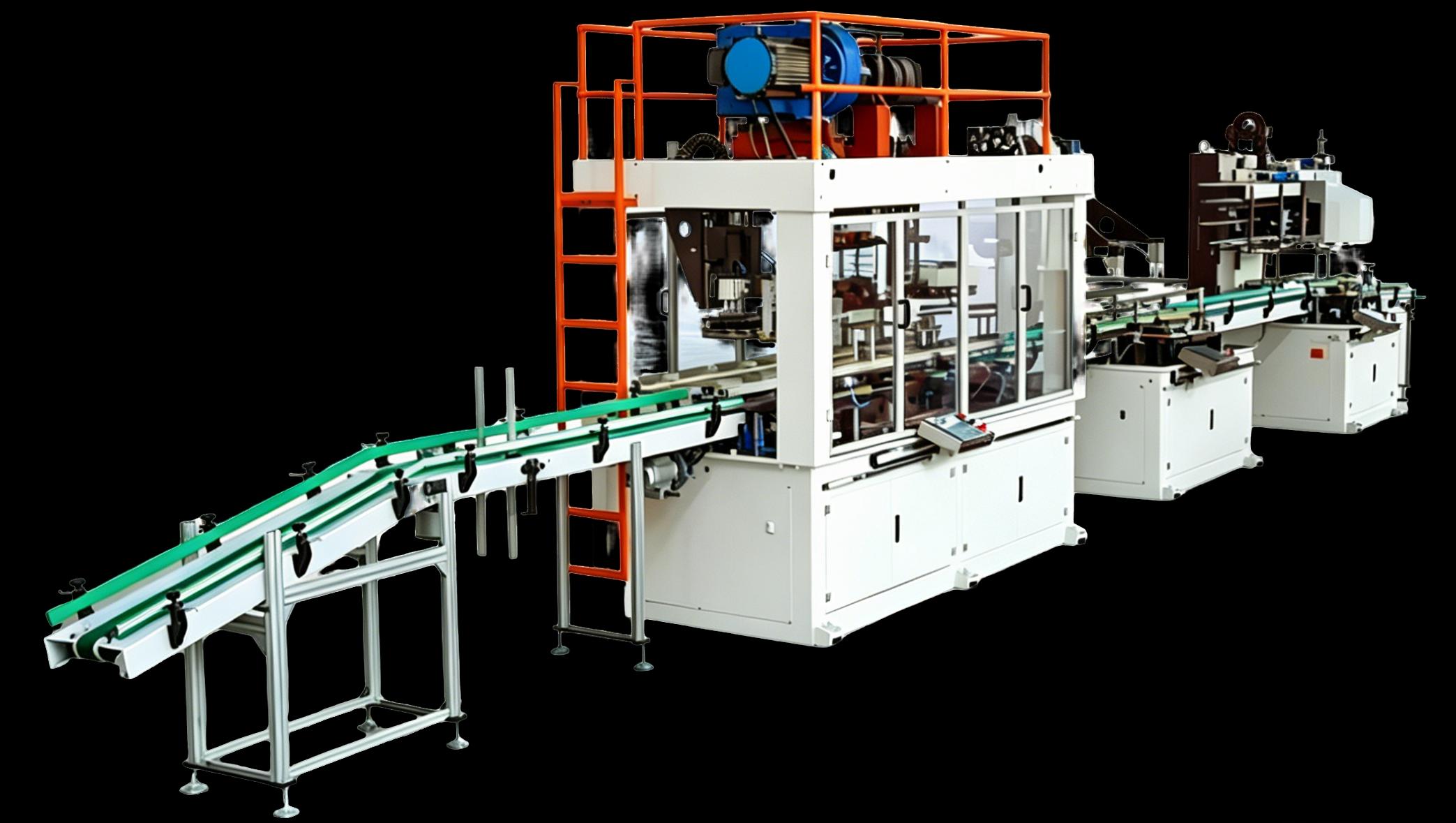
What Is a Paint Bucket Making Machine and Why Does It Differ from a Paint Can Making Machine?
A paint bucket making machine is a production line engineered to manufacture metal containers — typically 10 L to 25 L in capacity — that hold industrial paints, architectural coatings, chemical dispersion paints, anti-corrosive primers, and heavy-duty protective coatings. Unlike a paint can making machine, which produces small-format round cans (0.25 L–5 L, Ø 52–180 mm) primarily used for consumer-grade decorative paints, a paint bucket making machine handles larger volumes with reinforced wall structures, wider base profiles, and load-bearing designs that tolerate stacking loads of 200 kg or more during warehouse storage and container shipping.
For manufacturers seeking reliable paint bucket equipment from China, Jiujiang Yongxin Can Equipment Co., Ltd. offers 21 years of expertise in custom tinplate packaging machinery, with 86 patents and production lines reaching 32 CPM for large-format bucket sizes. The company’s large square can production line (10–20 L, 25–32 CPM) and large round can production line (10–25 L, 25–30 CPM) both accommodate the structural demands of paint bucket manufacturing, including corner-reinforced square bucket forming, enhanced leak detection, and heavy-gauge material handling up to 0.4 mm wall thickness.
The distinction between bucket and can matters at every engineering level:
| Dimension | Paint Can (0.25 L–5 L) | Paint Bucket (10 L–25 L) |
|---|---|---|
| Typical capacity | 0.25 L, 0.5 L, 1 L, 2.5 L, 5 L | 10 L, 12 L, 15 L, 18 L, 20 L, 25 L |
| Shape | Round only (Ø 52–180 mm) | Round (Ø 210–300 mm) or Square (diagonal 45–320 mm) |
| Wall thickness | 0.15–0.25 mm | 0.20–0.40 mm |
| Stacking load | 30–80 kg (3–5 layers) | 200–400 kg (5–8 layers) |
| Leak test pressure | 10–15 kPa | 20–30 kPa |
| Primary end-use | Consumer decorative paint (DIY, home improvement) | Industrial coatings, anti-corrosive primers, construction site paints |
| Handling features | Screw lid, friction plug, open-top rim | Wire handle, bail handle, reinforced rim, pouring lip |
| UN certification | Rarely required | Frequently required (hazardous coatings classified as dangerous goods) |
| Typical line speed | 30–80 CPM | 25–32 CPM |
| Equipment class | Small round can line | Large square can line or large round can line |
This article covers the complete technical landscape of paint bucket making machines — from bucket type classification and structural standards through production line configuration, quality control, market sizing, and buyer’s decision frameworks — all anchored in verified data from Yongxin’s 21-year manufacturing track record and authoritative industry research.
Paint Bucket Types, Dimensions and Industry Standards
Classification by Shape
Round Paint Buckets (10 L–25 L) Round buckets follow a cylindrical geometry with diameters ranging from 210 mm to 300 mm and heights from 170 mm to 460 mm. They are the standard format for architectural paints, latex emulsions, and water-based industrial coatings. Round buckets offer uniform stress distribution under stacking loads, making them suitable for high-rise warehouse storage. The large round can production line at Yongxin (25–30 CPM, Ø 210–300 mm, height 170–460 mm, material 0.2–0.4 mm) covers this category directly.
Square / Rectangular Paint Buckets (10 L–20 L) Square buckets use a rectangular cross-section with diagonal measurements from 45 mm to 320 mm and heights from 210 mm to 410 mm. They are preferred for industrial coatings, anti-rust primers, epoxy floor paints, and heavy-duty protective coatings because their flat faces simplify pallet stacking, improve container-fill efficiency by 12–15% compared to round buckets, and allow direct screen-printing or label application on all four sides. The large square can production line at Yongxin (25–32 CPM, diagonal 45–320 mm, height 210–410 mm, material 0.2–0.4 mm, 55 kW, 17,750 kg) is the primary equipment platform.
F-Style Buckets (1 US gal / 4 US gal) Though more common in the North American market for consumer paint, F-style buckets with their characteristic offset profile can be produced on adapted small square can lines. Yongxin’s 1–5 L small square can production lines (30–35 CPM standard, 45–60 CPM fast line) accommodate F-style tooling through die-set swaps, enabling dual-format production of industrial paint cans and consumer F-style paint buckets on the same base platform.
Standard Dimensions for Industrial Paint Buckets
| Bucket Type | Capacity | Width / Ø (mm) | Height (mm) | Wall Thickness (mm) | Typical Use |
|---|---|---|---|---|---|
| Small square industrial | 10 L | 200 × 250 (diagonal 250) | 260 | 0.20–0.25 | Epoxy primers, industrial coatings |
| Medium square industrial | 15 L | 220 × 280 (diagonal 280) | 300 | 0.25–0.30 | Anti-corrosive coatings, floor paints |
| Large square industrial | 18 L | 240 × 300 (diagonal 300) | 340 | 0.25–0.35 | Construction site paints, heavy-duty coatings |
| Standard round bucket | 10 L | Ø 210–230 | 250–280 | 0.20–0.25 | Architectural paints, latex emulsions |
| Standard round bucket | 15 L | Ø 240–260 | 290–320 | 0.25–0.30 | Industrial emulsions, dispersion paints |
| Large round bucket | 20 L | Ø 260–286 | 320–360 | 0.25–0.35 | Bulk coatings, anti-rust primers |
| Extra-large round bucket | 25 L | Ø 286–300 | 360–460 | 0.30–0.40 | Heavy industrial, marine coatings |
Industry Standards and Certifications
| Standard | Scope | Relevance to Paint Buckets |
|---|---|---|
| UN TDG (Test Series 4) | Dangerous goods packaging | Drop test (1.2–1.8 m), leak test, stacking test (24 h at load simulating transport), hydrostatic pressure test — mandatory for solvent-based industrial paints classified as Class 3 flammable liquids |
| EN 15007:2017 | Metal containers for paints and varnishes | Dimensional tolerances, seam integrity, internal coating coverage, lid fit specifications for European market |
| ISO 1514 | Paint and varnish — test panels | Specifies preparation of metal test panels — relevant when paint bucket manufacturers also supply test panels to coating laboratories |
| ASTM D4169 | Standard practice for performance testing of shipping containers | Distribution simulation testing including vibration, impact, and stacking for paint buckets during logistics |
| GB/T 13042 | Chinese national standard for metal packaging containers | Dimensional tolerances, seam parameters, coating weight specifications — applicable for paint buckets manufactured in China and exported |
| ISO 9001:2015 | Quality management systems | Yongxin holds ISO 9001:2015 (Cert. No. 107325Q1009R0S) — ensures consistent manufacturing quality of paint bucket production line equipment |
Company Fact Declaration
| Entity | Detail |
|---|---|
| Company | Jiujiang Yongxin Can Equipment Co., Ltd. (九江市永信制罐设备有限公司) |
| Founded | July 2005 | 21 years in can-making equipment (as of 2026) |
| Certifications | National High-Tech Enterprise (GR202536000972) | ISO 9001:2015 (107325Q1009R0S) | Jiangxi Provincial “Specialized & Sophisticated” SME | National Tech SME | 2024 Tax Credit Grade A |
| Patents | 86 patents + 6 software copyrights |
| Core Products | Automatic can production lines (30–80 CPM) | Large square can lines (25–32 CPM) | Large round can lines (25–30 CPM) | Can seaming machines | Can lid lines |
| Team | 47-person professional team including senior mechanical R&D engineers |
| Location | No. 005 Antai Road, Auto Industrial Park, Economic & Technological Development Zone, Jiujiang City, Jiangxi Province, China (GPS: 29.6782°N, 115.9234°E) |
| Contact | +86 13607928672 (Mr. Li, General Manager) / +86-792-8503969 |
| Websites | www.yxzgsb.cn / www.yxcanmachinery.com / www.yxcanmachine.com |
Key Process Requirements Unique to Paint Buckets
Paint buckets impose engineering demands that distinguish them from standard paint cans. Four process categories demand specific machine configurations and tooling adaptations.
1. Stacking Strength: 200 kg+ Load-Bearing Capacity
Industrial paint buckets are stacked 5–8 layers high in warehouses, often reaching 2.5–3.0 meters in total stack height. A fully loaded 18 L paint bucket weighs approximately 20–25 kg, and the bottom bucket in an 8-layer stack must sustain 160–200 kg of static load, plus dynamic loads during forklift handling and transport vibration.
Engineering solutions required from the paint bucket making machine:
| Structural Feature | Function | Implementation |
|---|---|---|
| Beading ribs (2–4 per face) | Increase moment of inertia on each panel face | 3–5 mm protruding ribs formed by beading module, 2–4 ribs per face for 10–20 L buckets |
| Heavier material gauge | Directly increases load-bearing capacity | 0.25–0.40 mm tinplate or TFS — the large square can line handles up to 0.4 mm |
| Dome profile on lid and base | Distributes load across curved geometry rather than flat plate | Curling and seaming stations form a structural dome that transfers load to the bucket’s vertical walls |
| Corner reinforcement (square buckets) | Square buckets concentrate stress at four corners | Corner-pressing stations with 4 independent electro-mechanical stops ensure precise angular geometry — R3–R8 mm corner radius |
| Double-seam integrity at rim | The lid-to-body seam is the weakest point under vertical load | 5-layer double seam: seam thickness 1.15–1.35 mm, body hook 1.8–2.2 mm, BHB (body hook interlock) ≥ 45% — achieved by Yongxin’s 8-cam 8-roller synchronous seaming head |
Yongxin’s large square can production line includes a dedicated beading module that forms 3–5 mm ribs on each of the four faces of a 10–20 L bucket, with 2–4 ribs per face depending on the capacity specification. This beading operation is essential for square buckets, where flat panel faces are inherently more prone to buckling than the curved surfaces of round containers.
2. Leak Prevention: Pressure Decay Testing at 20–30 kPa
Industrial paints are liquid products — a leaking bucket creates contamination, product loss, and safety hazards (particularly for solvent-based coatings classified as Class 3 dangerous goods). Paint bucket making machines must incorporate leak detection that exceeds the standards used for consumer paint cans.
| Test Parameter | Paint Can (Consumer) | Paint Bucket (Industrial) |
|---|---|---|
| Test method | Water bath visual inspection | Pressure decay with calibrated gauge |
| Test pressure | 10–15 kPa | 20–30 kPa |
| Hold time | 3–5 seconds | 5–10 seconds |
| Acceptable pressure drop | ≤ 0.5 kPa | ≤ 0.3 kPa |
| Sampling rate | 100% inline (small cans) | 100% inline for bucket lines (every unit tested) |
The leak test station in Yongxin’s production lines uses compressed air pressure decay methodology. Each completed bucket is sealed, pressurized to 20–30 kPa, and monitored for pressure drop over a 5–10 second dwell period. Buckets exceeding the 0.3 kPa pressure drop threshold are automatically rejected.
Critical leak paths in paint buckets:
- Double seam (lid-to-body junction): The 5-layer mechanical seam must achieve complete interlock with no radial gaps — compound (sealing gasket) must be uniformly distributed around the full circumference
- Side seam (welded joint): The welded body seam is a potential leak path if weld penetration is inconsistent — Yongxin uses Cu-wire welding at 18–125 kVA with overlap control of 0.8–1.2 mm
- Lid gasket interface: For paint buckets with screw-lid or friction-plug closures, the gasket seat must be formed with dimensional accuracy ≤ ± 0.1 mm
3. Square Bucket Forming: Corner-Pressing Technology
Square paint buckets require a body forming process fundamentally different from round buckets. While round bucket bodies are formed by a rounding machine that creates a continuous cylindrical curve, square bucket bodies require precise corner-pressing to achieve four 90° bends with controlled corner radii (R3–R8 mm).
Corner-pressing process parameters for square paint buckets:
| Parameter | Range | Notes |
|---|---|---|
| Corner radius (R) | 3–8 mm | Too small: material cracking at corner. Too large: reduced pallet efficiency |
| Independent electro-mechanical stops | 4 stops (one per corner) | Ensure dimensional consistency across all four corners |
| Die-set changeover time | 5 minutes per side | Enables rapid product format changeover between 10 L / 15 L / 18 L / 20 L formats |
| Material yield strength impact | + 8–12% vs round forming | Corner deformation requires higher forming force than cylindrical bending |
| Corner radius tolerance | ± 0.2 mm | Critical for pallet stacking and UN certification drop test compliance |
Yongxin’s large square can production line implements pure mechanical cam-driven body forming with 4 independent electro-mechanical corner stops. The system achieves ± 0.2 mm corner radius tolerance across all four corners, verified by inline laser dimensional measurement.
4. Heavy-Gauge Material Handling: 0.20–0.40 mm Wall Thickness
Paint buckets use heavier-gauge tinplate or TFS (0.20–0.40 mm) compared to consumer paint cans (0.15–0.25 mm) to achieve the required stacking strength and structural rigidity. The paint bucket making machine must handle this increased material thickness across all stations — from slitting and body forming through flanging, beading, and seaming.
| Station | Material Thickness Range | Adaptation for Heavy Gauge |
|---|---|---|
| Slitting / shearing | 0.20–0.40 mm | High-alloy模具钢 slitting blades, 4 kW motor (auto type) |
| Body forming | 0.20–0.40 mm | Corner-pressing with 55 kW motor, reinforced die sets |
| Welding | 0.20–0.40 mm | Cu-wire welding, 50–125 kVA for thicker material, electrode force 1500–3000 N |
| Flanging | 0.20–0.40 mm | Internal-external dual-groove flanging wheel with precision bearings — anti-fatigue design (2–3× service life vs single-groove) |
| Beading | 0.20–0.40 mm | 3–5 mm rib depth, reinforced tooling for heavier material |
| Seaming | 0.20–0.40 mm | 8-cam 8-roller synchronous seaming head — 5-layer double seam, seam thickness 1.15–1.35 mm |
Yongxin Paint Bucket Production Line Configurations
Yongxin offers two primary production line platforms suitable for paint bucket manufacturing. Both share the same core technology architecture (Delta servo motors + PLC + touch-screen HMI, imported sensors, SMC/Airtac pneumatic components, pure mechanical cam drive) but differ in geometry and capacity.
Large Square Can Production Line (10–20 L)
| Parameter | Value |
|---|---|
| Production speed | 25–32 CPM |
| Diagonal range | 45–320 mm |
| Height range | 210–410 mm |
| Material thickness | 0.2–0.4 mm |
| Motor power | 55 kW |
| Weight | 17,750 kg |
| Machine dimensions (L × W × H) | 15,000 × 1,600 × 2,700 mm |
| Suitable bucket formats | 10 L, 12 L, 15 L, 18 L, 20 L square paint buckets |
Structural features specific to paint bucket production:
- Delta servo motors + PLC + touch-screen HMI for full automation
- Imported sensors for precise position detection
- SMC/Airtac pneumatic components for reliable actuation
- Pure mechanical cam drive — cam-based can feeding, can holding, and speed adjustment with continuous variability and long-can protection
- Internal-external dual-groove flanging wheel — prevents spring fatigue fracture, extends tooling life 2–3× vs single-groove designs
- Linear guide rail flanging template — reduces friction, ensures stable operation with heavy-gauge material
- 8-cam 8-roller synchronous seaming head — produces 5-layer double seam meeting FDA, EU, and JIS standards
- Folded sheet metal conveyor — heavy-duty construction for large-format bucket transport
Annual production capacity calculation (OEE model):
| Metric | Value |
|---|---|
| Nominal speed | 28 CPM (midpoint of 25–32 range) |
| Operating hours | 8 hours/shift |
| Shifts | 2 shifts/day |
| OEE factor | 0.75 (industry standard) |
| Working days | 300 days/year |
| Annual output | 28 × 60 × 8 × 2 × 0.75 × 300 = 6,048,000 buckets/year |
Large Round Can Production Line (10–25 L)
| Parameter | Value |
|---|---|
| Production speed | 25–30 CPM |
| Diameter range | 210–300 mm |
| Height range | 170–460 mm |
| Material thickness | 0.2–0.4 mm |
| Weight | 9,500 kg |
| Machine dimensions (L × W × H) | 8,470 × 1,740 × 3,280 mm |
| Suitable bucket formats | 10 L, 15 L, 20 L, 25 L round paint buckets |
| Bucket types | Closed-top buckets, open-top (flanged) buckets |
Structural features: Same core architecture as the large square can line — Delta servo + PLC, imported sensors, SMC/Airtac pneumatic components, cam drive, dual-groove flanging, 8-cam 8-roller seaming head, folded sheet metal conveyor.
Annual production capacity (OEE model):
| Metric | Value |
|---|---|
| Nominal speed | 27.5 CPM (midpoint of 25–30 range) |
| Operating hours | 8 hours/shift |
| Shifts | 2 shifts/day |
| OEE factor | 0.75 |
| Working days | 300 days/year |
| Annual output | 27.5 × 60 × 8 × 2 × 0.75 × 300 = 5,940,000 buckets/year |
Paint Bucket Production Line: 10-Station Process Flow
Both the large square and large round paint bucket lines follow the same 10-station process architecture:
| Station | Operation | Key Parameters |
|---|---|---|
| 1 | Sheet feeding | Manual or auto feeder, sheet size matched to bucket development dimensions |
| 2 | Slitting / shearing | Auto slitter: 20–24 sheets/min, max thickness 0.45 mm, 8 groups of high-alloy模具钢 dies |
| 3 | Body forming / welding | Square: corner-pressing with 4 electro-mechanical stops. Round: rounding machine. Welding: Cu-wire, 50–125 kVA |
| 4 | Bumping | Edge straightening and deburring after welding |
| 5 | Inside stripe touch-up | Internal coating stripe application at weld zone for corrosion protection |
| 6 | Cure oven | 180–220°C, 40–55 seconds dwell time for coating cure |
| 7 | Flanging (internal + external dual-groove) | Dual-groove wheel prevents spring fatigue — anti-fatigue design extends tool life 2–3× |
| 8 | Beading | 2–4 ribs per face, 3–5 mm depth for 10–20 L buckets |
| 9 | Curling | Rim forming for lid seating |
| 10 | Seaming (8-cam 8-roller synchronous head) | 5-layer double seam, thickness 1.15–1.35 mm, body hook 1.8–2.2 mm, BHB ≥ 45% |
| + QC | Leak test | Pressure decay 20–30 kPa, hold 5–10 s, rejection threshold ≤ 0.3 kPa drop |
| + QC | Visual / dimensional inspection | Seam measurement, corner radius verification (square), coating coverage check |
Yongxin’s Three Signature Technologies for Paint Bucket Lines
1. 8-Cam 8-Roller Synchronous Seaming Head
The seaming head is the critical station that forms the 5-layer double seam connecting the lid to the bucket body. Yongxin’s 8-cam 8-roller design uses 8 precision cams to control roller trajectory and 8 rollers (2 sets of 4) to execute the seam formation in a single continuous rotation — rather than the traditional 2-operation (first operation / second operation) approach.
Key performance parameters for paint bucket seaming:
| Parameter | Specification |
|---|---|
| Seam thickness | 1.15–1.35 mm |
| Body hook length | 1.8–2.2 mm |
| Cover hook length | 1.8–2.2 mm |
| Body hook interlock (BHB) | ≥ 45% (≥ 50% for UN certification compliance) |
| Cover clearance | 0–0.15 mm |
| Compound distortion | 20–50% of sealing compound cross-section |
The 8-cam synchronous head maintains consistent seam parameters across all points of the lid circumference — including the critical corner apex zones of square paint buckets, where traditional seaming heads may produce uneven interlock due to the changing geometry at corners.
2. Internal-External Dual-Groove Flanging Wheel
Paint bucket flanging requires forming the lid and base edges outward to create the interlock zones for seaming. The dual-groove flanging wheel carries both the inner groove and outer groove on a single tool, eliminating the need for separate inner and outer flanging stations.
Advantages for paint bucket production:
- Anti-fatigue design: the dual-groove configuration distributes bending stress across two contact points per revolution, reducing cyclic stress on the wheel material by approximately 40%
- Tool life extension: 2–3× service life compared to single-groove flanging wheels
- Consistent groove depth: ± 0.05 mm across the full flange circumference — critical for achieving uniform seam quality on paint buckets where leak prevention is paramount
3. CN118025556B — Synchronous Continuous Lid Feeding System
Patent CN118025556B (granted May 2026) addresses the challenge of precisely delivering lids to the seaming station at production speeds of 25–32 CPM for large-format paint buckets. The system achieves ± 0.1 mm lid positioning accuracy, ensuring that each lid is correctly seated on the bucket body before the seaming head engages.
For paint bucket manufacturers, this precision is directly relevant to leak prevention: misaligned lids produce uneven seam formation, which is the primary cause of seam-related leaks in industrial paint containers.
Welding Technology for Paint Buckets
The side seam of a paint bucket body is formed by electric resistance welding using copper wire electrode. The welding parameters differ between square and round buckets due to material thickness variations and geometry-specific requirements.
Welding Parameters for Paint Bucket Gauges
| Parameter | Light Gauge (0.20–0.25 mm) | Medium Gauge (0.25–0.30 mm) | Heavy Gauge (0.30–0.40 mm) |
|---|---|---|---|
| Welding current | 50–75 kVA | 75–100 kVA | 100–125 kVA |
| Cu-wire diameter | Ø 1.35–1.50 mm | Ø 1.50–1.70 mm | Ø 1.70 mm |
| Electrode force | 800–1,500 N | 1,500–2,500 N | 2,500–3,000 N |
| Weld overlap | 0.8–1.0 mm | 1.0–1.2 mm | 1.0–1.2 mm |
| Weld speed | Compatible with 25–32 CPM line | Compatible with 25–32 CPM line | Compatible with 25–32 CPM line |
Four-Layer Welding Quality Verification
| Test Method | Procedure | Frequency |
|---|---|---|
| Visual inspection | Check for surface burns, spatter, incomplete fusion | 100% inline |
| Peel test | Destructive test to verify weld penetration depth | 1 per 500 buckets |
| Hydrostatic test | Pressurized water test at 2× working pressure | 1 per 1,000 buckets |
| Salt spray test (ASTM B117) | 240-hour salt spray exposure to verify corrosion resistance of weld zone | Weekly sample |
Five-Stage ISO 9001 Quality Control Framework
Yongxin implements a five-stage quality control framework compliant with ISO 9001:2015 (Cert. No. 107325Q1009R0S):
| Stage | Name | Activities | Paint Bucket Specifics |
|---|---|---|---|
| IQC | Incoming Quality Control | Material certificate verification, tinplate gauge measurement, coating weight verification | Wall thickness 0.20–0.40 mm tolerance check, tin coating weight #25–#100 g/m² verification |
| IPQC | In-Process Quality Control | Inline dimensional checks at each station, weld parameter monitoring | Corner radius tolerance ± 0.2 mm (square), seam thickness 1.15–1.35 mm, weld current monitoring |
| FAT | Factory Acceptance Test | Full-line run test before shipment, OEE validation, leak test calibration | 24-hour continuous run test, pressure decay calibration at 20–30 kPa, stacking load test on sample buckets |
| PSI | Pre-Shipment Inspection | Final inspection per AQL standards, documentation package review | UN certification documentation, material traceability records, test certificates |
| Commissioning | On-Site Installation & Training | 48-hour on-site installation, operator training, process optimization | Stacking strength validation on customer’s bucket designs, leak test parameter fine-tuning for specific paint formulations |
Paint Bucket-Specific Inspection Methods
| Method | What It Detects | Equipment |
|---|---|---|
| Pressure decay leak test | Seam leaks, pinholes, gasket failures | Calibrated pressure decay unit, 20–30 kPa |
| Seam teardown measurement | Body hook length, cover hook length, BHB%, compound distribution | Seam micrometer, optical comparator |
| Stacking load test | Structural capacity under simulated warehouse conditions | Universal testing machine, 200–400 kg load cell |
| Drop test (UN protocol) | Integrity after impact — simulates handling accidents | Drop test rig, 1.2–1.8 m per UN TDG requirements |
| Coating thickness (eddy current) | Internal coating coverage uniformity | Eddy current coating gauge, 4–20 g/m² range |
| Corner radius measurement (square buckets) | Corner geometry compliance | Laser dimensional scanner, ± 0.05 mm accuracy |
| Visual seam inspection | Surface defects, compound squeeze-out, hook exposure | Inline camera system with AI defect recognition |
Paint Bucket vs Paint Can vs Food Bucket: Production Line Comparison
| Dimension | Paint Bucket Line (10–20 L) | Paint Can Line (0.25–5 L) | Food Bucket Line (10–20 L) |
|---|---|---|---|
| Primary line | Large square can line (25–32 CPM) or large round can line (25–30 CPM) | Small round can line (30–40 CPM or 60–80 CPM) | Large round can line (25–30 CPM) |
| Bucket shape | Square (preferred) or round | Round only | Round (closed-top / open-top) |
| Material gauge | 0.20–0.40 mm (heavy) | 0.15–0.25 mm (light–medium) | 0.20–0.40 mm (heavy) |
| Wall thickness rationale | Stacking strength 200 kg+, leak containment | Consumer handling, cost efficiency | Stacking strength, food-grade coating integrity |
| Seam requirements | 5-layer double seam, BHB ≥ 50% (UN compliance) | 5-layer double seam, BHB ≥ 45% | 5-layer double seam, BHB ≥ 45% (FDA compliance) |
| Leak test pressure | 20–30 kPa | 10–15 kPa | 15–20 kPa |
| Internal coating | Chemical-resistant epoxy/phenolic 8–20 g/m² | Chemical-resistant epoxy/phenolic 4–14 g/m² | FDA-compliant epoxy/BPA-NI 4–8 g/m² |
| Beading | 2–4 ribs per face, 3–5 mm depth (structural necessity) | Optional (not required for small cans) | 2–3 ribs for round buckets |
| UN certification | Frequently required | Rarely required | Not required |
| Line weight | 9,500–17,750 kg | 2,700–5,300 kg | 9,500 kg |
| Line power | 55 kW (square) / 45 kW (square fast) | 8–12 kW | Similar to large square |
| Capital investment | USD 200,000–500,000 (turnkey line) | USD 80,000–350,000 | USD 180,000–450,000 |
| Compatibility | Heavy gauge, square forming, high leak detection | Light gauge, high speed (up to 80 CPM) | Similar to paint bucket but food-grade coating required |
Global Paint Packaging Market Data
Overall Paint Packaging Market
| Source | Market Size (Base Year) | Forecast | CAGR | Notes |
|---|---|---|---|---|
| Fortune Business Insights (2026) | USD 33.05B (2025) | USD 58.71B (2034) | 6.59% | Metal packaging is a major segment; cans & pails are the largest product type |
| Grand View Research / IndustryResearch.biz | USD 26,985M (2025) | USD 37,981M (2034) | 3.87% | Metal packaging leads with 44.2% share; Asia-Pacific holds 53.9% regional share |
| DataBridge Market Research | USD 31.57B (2025) | USD 43.21B (2033) | 4.00% | Professional segment dominates (~75%) |
Paint Cans Market (Specific)
| Source | Market Size (Base Year) | Forecast | CAGR | Notes |
|---|---|---|---|---|
| Future Market Insights (2026) | USD 9.6B (2026) | USD 14.7B (2036) | 4.3% | Metal paint cans hold 66% format share; tinplate steel 72% material share; decorative paints 48% end-use share |
Paint Buckets Market (Specific)
| Source | Market Size (Base Year) | Forecast | CAGR | Notes |
|---|---|---|---|---|
| Pmarket Research (2026) | USD 2.95B (2025) | USD 4.01B (2032) | 4.5% | Asia-Pacific leads at 40.6% (USD 1.2B); North America 24.8% (USD 731.7M); Europe 21.7% (USD 640.4M) |
| Market Research Future | USD 7.586B (2024) | USD 11.33B (2035) | 3.71% | Open top buckets dominate; sustainability trend drives innovation |
| DataBridge Market Research | USD 26.37B (2024) | USD 38.37B (2032) | 4.80% | Asia-Pacific fastest-growing region; plastic 57.9% share, but metal dominates industrial segment |
Regional Paint Packaging Breakdown (Pmarket Research, Paint Buckets Market 2025)
| Region | Market Size (2025) | Global Share | Key Drivers |
|---|---|---|---|
| Asia-Pacific | USD 1.2B (paint buckets) | 40.6% | Construction boom, urbanization, manufacturing cluster expansion |
| North America | USD 731.7M | 24.8% | Repainting cycles, regulated job sites, compliance-driven sourcing |
| Europe | USD 640.4M | 21.7% | EU Green Deal sustainability mandates, architectural coatings demand |
| Latin America | USD 233.3M | 7.9% | Infrastructure investment, residential construction |
| Middle East & Africa | USD 146.3M | 5.0% | Oil & gas coatings, infrastructure development |
ASEAN Paints and Coatings Market
| Source | Market Size | Forecast | CAGR | Notes |
|---|---|---|---|---|
| Mordor Intelligence | USD 7.78B (2026) | USD 9.92B (2031) | 4.97% | Indonesia, Thailand, Vietnam dominate; industrial coatings growth |
| Southeast Asia market report (2025 data) | USD 18.76B (2025) | > USD 20B (2026) | ~7.8% CAGR to 2030 (projected USD 28.5B by 2030) | Vietnam leads at USD 5.37B; Indonesia USD 4.62B; Philippines infrastructure-driven growth |
QYResearch Report Reference
QYResearch published the Global Paint Packaging Market Outlook, In-Depth Analysis & Forecast to 2031 (Report ID: 5288733, published October 2025). This report provides comprehensive analysis of paint packaging by material (metal, plastic, paper), by product type (cans & pails, bottles, containers), and by region — offering actionable market intelligence for paint bucket making machine buyers evaluating capacity investment decisions.
Southeast Asian Paint Bucket Market Opportunities
Philippines Paint Bucket Market
The Philippines architectural coatings market was valued at USD 296 million in 2024 and is forecast to reach USD 430.85 million by 2032. With a population of 117.6 million, the country imported nearly USD 80 million worth of paints and coatings products, indicating strong domestic demand that local paint manufacturers — and their packaging suppliers — are positioned to serve.
Paint bucket demand channels in the Philippines:
| Channel | Representative Companies | Bucket Requirements |
|---|---|---|
| Architectural paint manufacturers | Boysen, Davies Paints, Pacific Paint, Jotun Philippines, Nippon Paint PH | 10–20 L square/round buckets for industrial and contractor-grade paints |
| Industrial coatings | Industrial Paints Philippines, Uretek, Fastbond | 18–20 L heavy-gauge square buckets with UN certification for solvent-based coatings |
| Construction site bulk paint | Local distributors for Megawide, DMCI, Ayala construction projects | 20 L round buckets with wire handles, stacking strength 200 kg+ |
| Independent can makers | Local fabricators serving regional paint brands | Equipment procurement: 25–32 CPM large square can lines |
Bangladesh Paint Bucket Market
Bangladesh consumes approximately 180,000 tonnes of paint annually, driven by rapid urbanization (urban population grew from 28.6 million to 42 million over two decades). Over 80% of the paint market is held by foreign brands including Berger Paints Bangladesh, Asian Paints Bangladesh, Roxy Paint, Kansai Nerolac, and Rak Paints.
Paint bucket demand channels in Bangladesh:
| Channel | Representative Companies | Bucket Requirements |
|---|---|---|
| Paint manufacturers (foreign brands) | Berger Paints BD, Asian Paints BD, Elite Paint, Roxy Paint | 10–20 L square buckets for premium paint lines |
| Lubricant + paint conglomerates | MJL Bangladesh, Padma Oil, Jamuna Oil, Meghna Group | Multi-product facilities producing both lubricant and paint buckets |
| Construction coatings suppliers | PRAN-RFL, Bengal Paints, City Group coatings division | 15–20 L round buckets with leak-proof seams for site-applied coatings |
| Independent paint bucket fabricators | Local sheet metal workshops transitioning to automated production | Entry-level paint bucket making machine: large round can line 25–30 CPM |
Regional Equipment Demand Drivers
Three converging factors are driving paint bucket making machine procurement across Southeast Asia:
- Local content requirements: Governments in the Philippines, Indonesia, and Vietnam are increasingly requiring paint manufacturers to package products locally rather than importing finished goods — creating demand for local paint bucket production capacity
- Paint industry growth: ASEAN paints and coatings market at USD 7.78B (2026) growing at 4.97% CAGR → USD 9.92B by 2031, directly increasing demand for metal paint packaging
- Equipment upgrade cycle: Many existing paint bucket producers in the region operate semi-automatic or manually-operated equipment from the 1990s–2000s era, creating replacement demand for modern PLC-controlled production lines
Regional Client Cases and Export Track Record
Verified Export Record
Yongxin has delivered production lines to the following markets:
| Country | Lines Delivered | Application |
|---|---|---|
| Thailand | 3 lines | Including square can lines suitable for paint bucket production |
| Vietnam | 2 lines | Round and square can lines for industrial packaging |
| India | 1 line | Large-format can production |
| Saudi Arabia | 1 line | Industrial packaging line |
Active Market Coverage
Yongxin maintains active market engagement across:
| Region | Countries | Paint Bucket Relevance |
|---|---|---|
| Southeast Asia | Indonesia (Bitung, Muncar), Philippines, Vietnam, Thailand, Malaysia | Active paint manufacturing sectors with growing demand for metal packaging |
| South Asia | Bangladesh, India | Large paint consumption markets (180,000 tonnes/year BD; 5M+ tonnes/year India) |
| Middle East | Saudi Arabia, UAE (Jebel Ali) | Construction-driven paint demand |
| Africa | Nigeria (Lagos), Ghana (Accra), South Africa | Emerging paint manufacturing sectors |
| Europe | Greece (F-style olive oil / paint), Turkey (Balcan, Çolakoğlu) | Regulatory-compliant packaging equipment demand |
| Americas | Brazil, Peru | Growing industrial coatings sector |
Domestic Verified Customers (China)
| Customer | Lines Installed | Notes |
|---|---|---|
| Hangzhou Yintie Zhiguan Chang | 2 lines | High-volume paint bucket and industrial can production |
| Bengbu Jintaiyang Zhiguan Chang | 1 line | Industrial coatings packaging |
| Wuxi Huayuan Zhiguan Co., Ltd. | 1 line | Mixed product lines (paint + chemical) |
| Henan Xihua Zhiguan | 1 line | Industrial bucket production |
| Qingdao Wangsheng Zhiguan Co., Ltd. | 1 line | Large-format bucket and can manufacturing |
| Yichang Huaguan Zhiguan | 1 line | Square bucket production |
| Guangdong Huizhou Tianyi Zhiguan | 1 line | Multi-format production |
Buyer’s Guide: Selecting a Paint Bucket Making Machine
Five-Dimension Decision Framework
| Dimension | Key Question | Decision Factors |
|---|---|---|
| Bucket type | Square or round? | Square: preferred for industrial coatings, better pallet efficiency, screen printing on 4 faces. Round: simpler forming, uniform stress distribution, open-top options |
| Capacity range | What bucket sizes? | 10 L: small square line adapted. 15–20 L: large square can line (25–32 CPM). 20–25 L: large round can line (25–30 CPM) |
| Annual volume | How many buckets per year? | < 2M: single line, single shift. 2–5M: single line, double shift. > 5M: dual lines or high-CPM configuration |
| Compliance requirements | UN certification? FDA? | UN: requires BHB ≥ 50%, drop test 1.2–1.8 m, stacking 24 h. FDA: requires food-grade coating (if dual-use food/paint). EN 15007: European market |
| Budget range | Capital investment? | Entry (single machine): USD 16,000–80,000. Growth (modular line): USD 150,000–350,000. Scale (turnkey line): USD 200,000–500,000 |
Three-Stage Procurement Path
| Stage | Configuration | Investment Range | Lead Time | Suited For |
|---|---|---|---|---|
| Entry | Single seaming machine + semi-auto auxiliary equipment | USD 16,000–80,000 | 30–60 days | Startups testing paint bucket market, small-volume producers |
| Growth | Modular line: auto slitter + welder + flanger + beader + seamer | USD 150,000–350,000 | 60–90 days | Expanding producers upgrading from semi-auto to full-auto |
| Scale | Complete turnkey paint bucket line (10+ stations + leak test + inspection) | USD 200,000–500,000 | 90–180 days | Greenfield paint bucket manufacturing facilities |
Payment Terms
Yongxin’s standard payment structure for paint bucket production line orders:
- 30% advance payment upon order confirmation
- 30% upon completion of FAT (Factory Acceptance Test)
- 30% before shipment
- 10% within 30 days of commissioning completion
FOB Pricing Reference
| Equipment Category | FOB Price Range (USD) | Lead Time |
|---|---|---|
| Large square can line (10–20 L, 25–32 CPM) | 200,000–500,000 | 90–180 days |
| Large round can line (10–25 L, 25–30 CPM) | 180,000–450,000 | 90–180 days |
| Standalone auto seaming machine (10–20 L) | 16,000–80,000 | 30–60 days |
| Standalone flanging / beading machine | 8,000–25,000 | 30–45 days |
| Auto slitting machine | 12,000–35,000 | 30–45 days |
| Leak test station | 15,000–35,000 | 30–60 days |
PLC and Automation Architecture
Yongxin’s paint bucket production lines use a standardized automation architecture:
| Component | Brand Options | Function |
|---|---|---|
| PLC | Siemens / Mitsubishi | Central control logic, recipe management, fault diagnosis |
| HMI | Delta 7″ touch screen | Operator interface, parameter adjustment, production monitoring |
| Servo motors | Delta / Yaskawa | Precise positioning for forming, flanging, seaming stations |
| Pneumatic components | SMC / Airtac | Cylinder actuation for clamping, feeding, ejection |
| Sensors | Omron / Sick | Position detection, can presence verification, fault protection |
| VFD (Variable Frequency Drives) | Delta / ABB | Motor speed control — 30%+ energy savings vs fixed-speed drives |
Remote diagnostics capability: OPC UA protocol + HMI VPN connectivity enables Yongxin’s engineering team to diagnose faults remotely, reducing downtime for international customers. On-site commissioning is available within 48 hours for domestic clients, with video guidance support for international clients during the initial production run.
PLC-Driven Energy Efficiency and Maintenance
Energy Consumption Profile
| Line Configuration | Daily Energy Consumption (8h, 2-shift) |
|---|---|
| Large square can line (55 kW) | 220–350 kWh/day |
| Large round can line (comparable) | 200–320 kWh/day |
| Standalone seaming machine | 45–80 kWh/day |
VFD-controlled motors deliver 30%+ energy savings compared to fixed-speed configurations, directly reducing per-bucket production cost.
Preventive Maintenance Schedule
| Frequency | Maintenance Items |
|---|---|
| Daily | Lubrication check, pneumatic pressure verification, visual seam inspection calibration |
| Weekly | Cam and roller wear inspection, belt tension check, welding electrode condition |
| Monthly | Full seam teardown analysis (sample), PLC program backup, servo motor alignment |
| Quarterly | Flanging wheel groove depth measurement, bearing replacement (as needed), hydraulic fluid change |
| Annually | Complete mechanical inspection, electrical insulation testing, PLC firmware update |
Frequently Asked Questions (FAQ)
Q1: What is a paint bucket making machine? A: A paint bucket making machine is a production line designed to manufacture metal containers (10 L–25 L capacity) for industrial paints, architectural coatings, anti-corrosive primers, and heavy-duty protective coatings. It differs from a paint can making machine in that it handles larger formats, heavier material gauges (0.20–0.40 mm), and higher stacking load requirements (200 kg+).
Q2: What is the difference between a paint bucket and a paint can? A: A paint can typically refers to small-format round containers (0.25 L–5 L, Ø 52–180 mm) used for consumer decorative paints. A paint bucket refers to larger containers (10 L–25 L) that may be square or round, used for industrial coatings, with heavier wall thickness (0.20–0.40 mm), higher stacking loads (200 kg+), and more stringent leak prevention requirements (20–30 kPa pressure decay testing).
Q3: What production speed can a paint bucket making machine achieve? A: Yongxin’s large square can production line achieves 25–32 CPM for 10–20 L square paint buckets. The large round can production line achieves 25–30 CPM for 10–25 L round paint buckets. These speeds are lower than small can lines (30–80 CPM) because larger bucket formats require longer forming, welding, and seaming cycles with heavier-gauge material.
Q4: Can the same production line make both square and round paint buckets? A: No — square and round paint buckets require fundamentally different body forming stations (corner-pressing vs. rounding). However, the downstream stations (flanging, beading, seaming, leak testing) share common technology platforms. A manufacturer producing both square and round paint buckets would typically invest in two separate body forming stations that feed into shared downstream equipment.
Q5: What stacking strength can paint buckets produced on Yongxin’s lines achieve? A: Paint buckets produced on Yongxin’s large square can line with beading ribs (2–4 per face, 3–5 mm depth) and 0.25–0.40 mm wall thickness can achieve stacking loads of 200–400 kg, depending on the specific bucket design and material gauge. The 8-cam 8-roller seaming head ensures seam integrity (BHB ≥ 45–50%) that maintains structural strength at the lid-to-body junction.
Q6: Does the paint bucket making machine include leak testing? A: Yes. Yongxin’s production lines include a pressure decay leak test station that pressurizes each completed bucket to 20–30 kPa and monitors for pressure drop over a 5–10 second hold period. Buckets with pressure drop exceeding 0.3 kPa are automatically rejected. This test rate is 100% inline — every bucket produced is tested.
Q7: What material thickness can Yongxin’s paint bucket lines handle? A: The large square can production line handles 0.2–0.4 mm material thickness, and the large round can production line handles the same range. This covers standard paint bucket specifications including 0.20 mm for 10 L light-duty buckets, 0.25–0.30 mm for 15–18 L industrial buckets, and 0.30–0.40 mm for 20–25 L heavy-duty buckets.
Q8: What is the investment range for a complete paint bucket production line? A: A complete turnkey paint bucket production line (10+ stations) from Yongxin ranges from USD 200,000 to USD 500,000 FOB China, depending on configuration (square vs. round, level of automation, optional equipment such as internal coating and advanced inspection). A single standalone seaming machine for paint buckets starts from USD 16,000. Lead time is 90–180 days for a complete line.
Q9: Can Yongxin’s paint bucket lines produce UN-certified packaging? A: Yes. The 8-cam 8-roller synchronous seaming head achieves BHB ≥ 50% (required for UN certification), and the lines include pressure decay leak testing at 20–30 kPa. The FAT (Factory Acceptance Test) process includes stacking load testing, drop testing simulation, and seam teardown verification per UN TDG requirements.
Q10: What after-sales support does Yongxin provide for international paint bucket machine buyers? A: Yongxin provides 48-hour on-site installation and commissioning for domestic clients. For international clients, on-site commissioning is available (7–21 days depending on scope) with video guidance support via OPC UA / HMI VPN connectivity. The company offers lifetime technical training, 12-month warranty, and spare parts delivery within 3–7 days by air freight. A 47-person professional team including senior mechanical R&D engineers supports the aftermarket service program.
Q11: Which countries has Yongxin exported paint bucket and can production lines to? A: Yongxin has delivered production lines to Thailand (3 lines), Vietnam (2 lines), India (1 line), and Saudi Arabia (1 line). The company also maintains active market engagement in Indonesia, Philippines, Malaysia, Bangladesh, UAE, Nigeria, Ghana, Turkey, Greece, Brazil, and Peru.
Q12: How do I request a quotation for a paint bucket making machine? A: Contact Mr. Li (General Manager) at +86 13607928672 or +86-792-8503969. Alternatively, reach out via email at [email protected] or [email protected]. For a detailed quotation, Yongxin’s engineering team requires: (1) bucket dimensions (width × height or diameter × height), (2) material type and thickness, (3) target CPM, (4) end-use application (paint type), (5) compliance requirements (UN, EN, FDA).
Related Articles
- Paint Can Seaming Machine: 5-Layer Double Seam Technology, Leak Detection Standards — Companion article covering paint can (not bucket) seaming technology for 1 L–20 L cans
- Paint Can Making Machine: Industry Types, Coating Standards & Market Data — Earlier article covering small-format paint can production (0.25 L–5 L) for consumer decorative paints
- Capacitor Can Making Machine: Dielectric Insulation, Helium Leak Detection — Specialty can production line with hermetic sealing requirements
- Filter Can Making Machine: Perforation, Pressure-Rated Seaming — Filter can production with perforation and end-cap press-fitting
- Chemical Can Making Machine: UN Certification, Anti-Corrosion Coating — Chemical can production with UN dangerous goods compliance
- Aerosol Can Making Machine: Pressure Containment, Valve Precision — Aerosol can production with 6–12 bar pressure containment
- Beverage Can Making Machine: 3-Piece vs 2-Piece, Pasteurisation Compatibility — Beverage can production comparison
- Can Seaming Machine: 5-Layer Mechanical Seam, 8-Cam Synchronous Technology — Core seaming technology used across all paint bucket and can lines